

the Phanerozoic sedimentary record (e.g., Saltzman and
Thomas, 2012) and have become a focal point for Earth
system research. Negative CIEs have been related to a
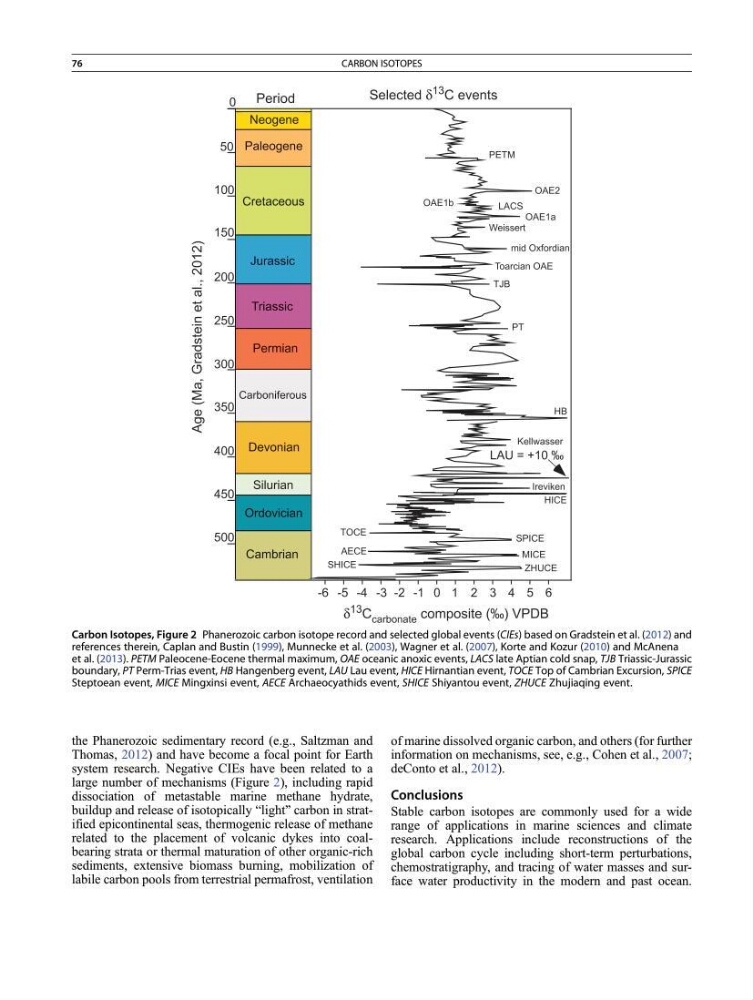
large number of mechanisms (Figure 2), including rapid
dissociation of metastable marine methane hydrate,
buildup and release of isotopically “light” carbon in stratified epicontinental seas, thermogenic release of methane
related to the placement of volcanic dykes into coalbearing strata or thermal maturation of other organic-rich
sediments, extensive biomass burning, mobilization of
labile carbon pools from terrestrial permafrost, ventilation
of marine dissolved organic carbon, and others (for further
information on mechanisms, see, e.g., Cohen et al., 2007;
deConto et al., 2012).
Conclusions
Stable carbon isotopes are commonly used for a wide
range of applications in marine sciences and climate
research. Applications include reconstructions of the
global carbon cycle including short-term perturbations,
chemostratigraphy, and tracing of water masses and surface water productivity in the modern and past ocean.
Carbon Isotopes, Figure 2 Phanerozoic carbon isotope record and selected global events (CIEs) based on Gradstein et al. (2012) and
references therein, Caplan and Bustin (1999), Munnecke et al. (2003), Wagner et al. (2007), Korte and Kozur (2010) and McAnena
et al. (2013). PETM Paleocene-Eocene thermal maximum, OAE oceanic anoxic events, LACS late Aptian cold snap, TJB Triassic-Jurassic
boundary, PT Perm-Trias event, HB Hangenberg event, LAU Lau event, HICE Hirnantian event, TOCE Top of Cambrian Excursion, SPICE
Steptoean event, MICE Mingxinsi event, AECE Archaeocyathids event, SHICE Shiyantou event, ZHUCE Zhujiaqing event.
76
CARBON ISOTOPES
Thomas, 2012) and have become a focal point for Earth
system research. Negative CIEs have been related to a
large number of mechanisms (Figure 2), including rapid
dissociation of metastable marine methane hydrate,
buildup and release of isotopically “light” carbon in stratified epicontinental seas, thermogenic release of methane
related to the placement of volcanic dykes into coalbearing strata or thermal maturation of other organic-rich
sediments, extensive biomass burning, mobilization of
labile carbon pools from terrestrial permafrost, ventilation
of marine dissolved organic carbon, and others (for further
information on mechanisms, see, e.g., Cohen et al., 2007;
deConto et al., 2012).
Conclusions
Stable carbon isotopes are commonly used for a wide
range of applications in marine sciences and climate
research. Applications include reconstructions of the
global carbon cycle including short-term perturbations,
chemostratigraphy, and tracing of water masses and surface water productivity in the modern and past ocean.
Carbon Isotopes, Figure 2 Phanerozoic carbon isotope record and selected global events (CIEs) based on Gradstein et al. (2012) and
references therein, Caplan and Bustin (1999), Munnecke et al. (2003), Wagner et al. (2007), Korte and Kozur (2010) and McAnena
et al. (2013). PETM Paleocene-Eocene thermal maximum, OAE oceanic anoxic events, LACS late Aptian cold snap, TJB Triassic-Jurassic
boundary, PT Perm-Trias event, HB Hangenberg event, LAU Lau event, HICE Hirnantian event, TOCE Top of Cambrian Excursion, SPICE
Steptoean event, MICE Mingxinsi event, AECE Archaeocyathids event, SHICE Shiyantou event, ZHUCE Zhujiaqing event.
76
CARBON ISOTOPES