

S9
Cirripedia
the cell through the water, and transport food particles to the mouth or
cytostoma. The body shape is normally constant and asymmetrical, and in
some groups of ciliates housed inside a basket -like house or lorica, excreted,
and often composed of foreign materials like coccoliths. Ciliophora are widely distributed in marine and freshwater. In the sea they are important in
shallow microbenthic foodwebs, and also in the microzooplankton, where
the suborder Tintinnina is of interest.
circadian rhythm ~biological clock.
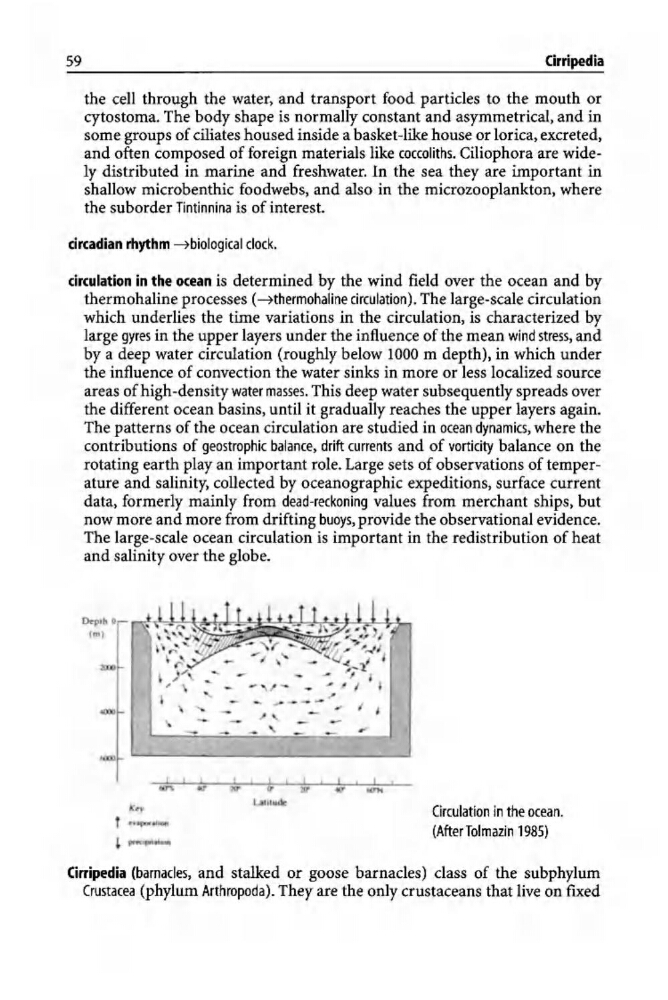
circulation in the ocean is determined by the wind field over the ocean and by
thermohaline processes (~thermohaline circulation). The large-scale circulation
which underlies the time variations in the circulation, is characterized by
large gyres in the upper layers under the influence of the mean wind stress, and
by a deep water circulation (roughly below 1000 m depth), in which under
the influence of convection the water sinks in more or less localized source
areas of high -density water masses. This deep water subsequently spreads over
the different ocean basins, until it gradually reaches the upper layers again.
The patterns of the ocean circulation are studied in ocean dynamics, where the
contributions of geostrophic balance, drift currents and of vorticity balance on the
rotating earth play an important role. Large sets of observations of temperature and salinity, collected by oceanographic expeditions, surface current
data, formerly mainly from dead-reckoning values from merchant ships, but
now more and more from drifting buoys, provide the observational evidence.
The large-scale ocean circulation is important in the redistribution of heat
and salinity over the globe.
Circulation in the ocean.
(After Tolmazin 1985)
Cirripedia (barnacles, and stalked or goose barnacles) class of the subphylum
Crustacea (phylum Arthropoda). They are the only crustaceans that live on fixed
Cirripedia
the cell through the water, and transport food particles to the mouth or
cytostoma. The body shape is normally constant and asymmetrical, and in
some groups of ciliates housed inside a basket -like house or lorica, excreted,
and often composed of foreign materials like coccoliths. Ciliophora are widely distributed in marine and freshwater. In the sea they are important in
shallow microbenthic foodwebs, and also in the microzooplankton, where
the suborder Tintinnina is of interest.
circadian rhythm ~biological clock.
circulation in the ocean is determined by the wind field over the ocean and by
thermohaline processes (~thermohaline circulation). The large-scale circulation
which underlies the time variations in the circulation, is characterized by
large gyres in the upper layers under the influence of the mean wind stress, and
by a deep water circulation (roughly below 1000 m depth), in which under
the influence of convection the water sinks in more or less localized source
areas of high -density water masses. This deep water subsequently spreads over
the different ocean basins, until it gradually reaches the upper layers again.
The patterns of the ocean circulation are studied in ocean dynamics, where the
contributions of geostrophic balance, drift currents and of vorticity balance on the
rotating earth play an important role. Large sets of observations of temperature and salinity, collected by oceanographic expeditions, surface current
data, formerly mainly from dead-reckoning values from merchant ships, but
now more and more from drifting buoys, provide the observational evidence.
The large-scale ocean circulation is important in the redistribution of heat
and salinity over the globe.
Circulation in the ocean.
(After Tolmazin 1985)
Cirripedia (barnacles, and stalked or goose barnacles) class of the subphylum
Crustacea (phylum Arthropoda). They are the only crustaceans that live on fixed