

57
Ciliophora
Chrysophyta phylum of the kingdom Protoctista, golden-brown (including related
colorless forms), mostly microscopic algae which in many cases produce
urn-shaped, siliceous resting spores. Chrysophyta contain chlorophyll-c and
fucoxanthin (~carotenoids). They accumulate fluid chrysolaminarin in vacuoles as a carbohydrate reserve. Few of them are marine. The colorless
genus Monas, with reduced plastid, feeds on picoplanktonic algae. Dictyota and
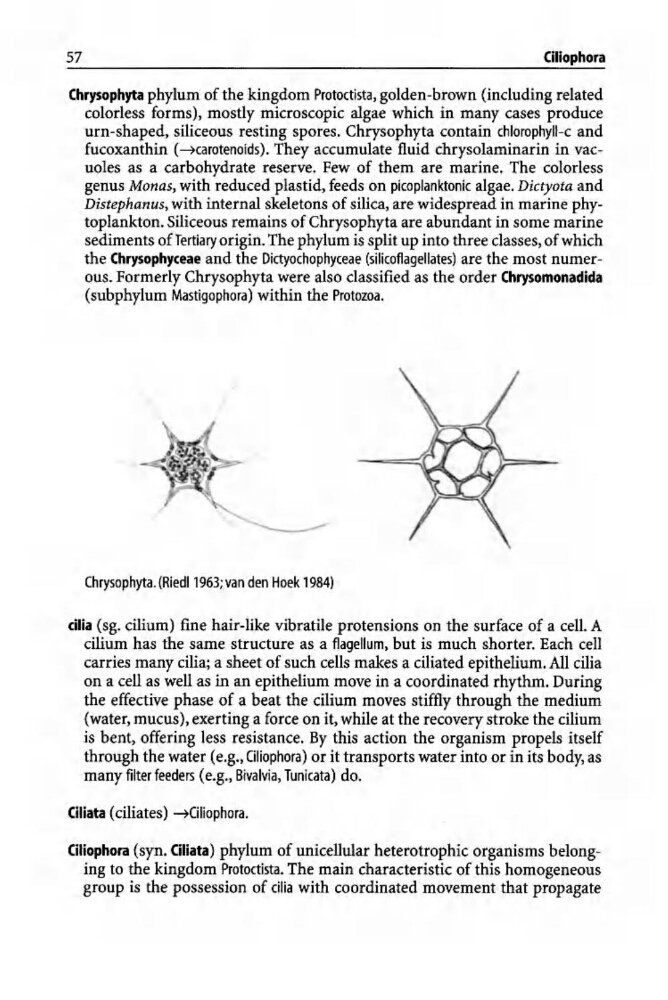
Distephanus, with internal skeletons of silica, are widespread in marine phytoplankton. Siliceous remains of Chrysophyta are abundant in some marine
sediments ofTertiary origin. The phylum is split up into three classes, of which
the Chrysophyceae and the Dictyochophyceae (silicoflagellates) are the most numerous. Formerly Chrysophyta were also classified as the order Chrysomonadida
(subphylum Mastigophora) within the Protozoa.
Chrysophyta. (Riedl 1963; van den Hoek 1984)
cilia (sg. cilium) fine hair-like vibratile protensions on the surface of a cell. A
cilium has the same structure as a flagellum, but is much shorter. Each cell
carries many cilia; a sheet of such cells makes a ciliated epithelium. All cilia
on a cell as well as in an epithelium move in a coordinated rhythm. During
the effective phase of a beat the cilium moves stiffly through the medium
(water, mucus), exerting a force on it, while at the recovery stroke the cilium
is bent, offering less resistance. By this action the organism propels itself
through the water (e.g., Ciliophora) or it transports water into or in its body, as
many filter feeders (e.g., Bivalvia, Tunicata) do.
Ciliata (ciliates) ~Ciliophora .
Ciliophora (syn. Ciliata) phylum of unicellular heterotrophic organisms belonging to the kingdom Protoctista. The main characteristic of this homogeneous
group is the possession of cilia with coordinated movement that propagate
Ciliophora
Chrysophyta phylum of the kingdom Protoctista, golden-brown (including related
colorless forms), mostly microscopic algae which in many cases produce
urn-shaped, siliceous resting spores. Chrysophyta contain chlorophyll-c and
fucoxanthin (~carotenoids). They accumulate fluid chrysolaminarin in vacuoles as a carbohydrate reserve. Few of them are marine. The colorless
genus Monas, with reduced plastid, feeds on picoplanktonic algae. Dictyota and
Distephanus, with internal skeletons of silica, are widespread in marine phytoplankton. Siliceous remains of Chrysophyta are abundant in some marine
sediments ofTertiary origin. The phylum is split up into three classes, of which
the Chrysophyceae and the Dictyochophyceae (silicoflagellates) are the most numerous. Formerly Chrysophyta were also classified as the order Chrysomonadida
(subphylum Mastigophora) within the Protozoa.
Chrysophyta. (Riedl 1963; van den Hoek 1984)
cilia (sg. cilium) fine hair-like vibratile protensions on the surface of a cell. A
cilium has the same structure as a flagellum, but is much shorter. Each cell
carries many cilia; a sheet of such cells makes a ciliated epithelium. All cilia
on a cell as well as in an epithelium move in a coordinated rhythm. During
the effective phase of a beat the cilium moves stiffly through the medium
(water, mucus), exerting a force on it, while at the recovery stroke the cilium
is bent, offering less resistance. By this action the organism propels itself
through the water (e.g., Ciliophora) or it transports water into or in its body, as
many filter feeders (e.g., Bivalvia, Tunicata) do.
Ciliata (ciliates) ~Ciliophora .
Ciliophora (syn. Ciliata) phylum of unicellular heterotrophic organisms belonging to the kingdom Protoctista. The main characteristic of this homogeneous
group is the possession of cilia with coordinated movement that propagate