

33
black shale
birds, marine those bird species whose normal habitat and food source is the sea,
whether coastal, offshore or oceanic; divers, grebes, pelicans, and sea ducks are
generally included, although they occur at sea only part of the year.
birth rate ~natality .
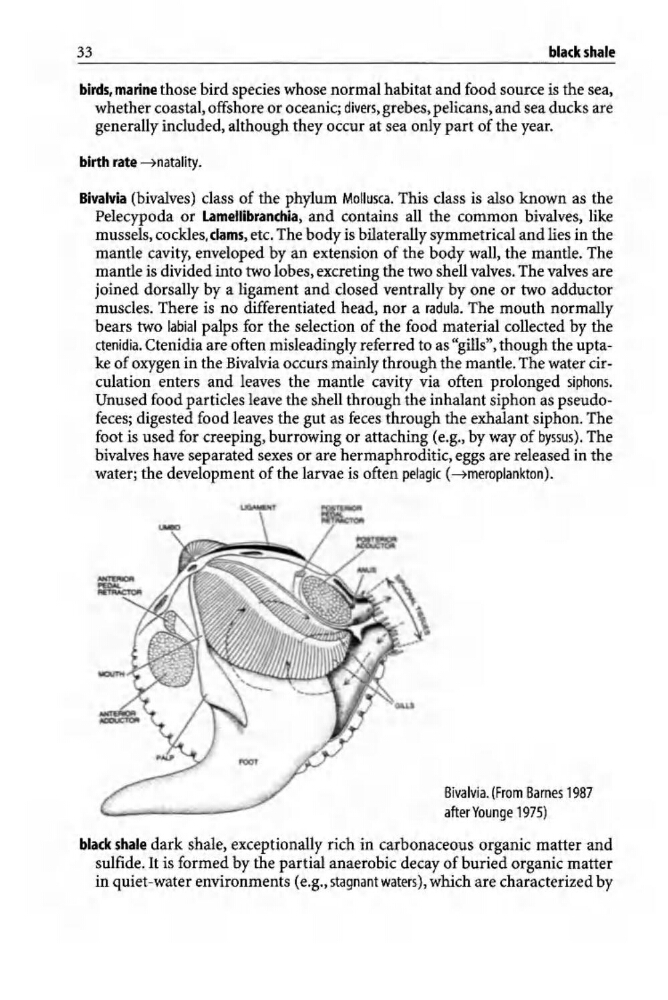
Bivalvia (bivalves) class of the phylum Mollusca. This class is also known as the
Pelecypoda or Lamellibranchia, and contains all the common bivalves, like
mussels, cockles, clams, etc. The body is bilaterally symmetrical and lies in the
mantle cavity, enveloped by an extension of the body wall, the mantle. The
mantle is divided into two lobes, excreting the two shell valves. The valves are
joined dorsally by a ligament and closed ventrally by one or two adductor
muscles. There is no differentiated head, nor a radula. The mouth normally
bears two labial palps for the selection of the food material collected by the
ctenidia. Ctenidia are often misleadingly referred to as "gills", though the uptake of oxygen in the Bivalvia occurs mainly through the mantle. The water circulation enters and leaves the mantle cavity via often prolonged siphons.
Unused food particles leave the shell through the inhalant siphon as pseudofeces; digested food leaves the gut as feces through the exhalant siphon. The
foot is used for creeping, burrowing or attaching (e.g., by way of byssus). The
bivalves have separated sexes or are hermaphroditic, eggs are released in the
water; the development of the larvae is often pelagic (~meroplankton).
Bivalvia. (From Barnes 1987
after Younge 1975)
black shale dark shale, exceptionally rich in carbonaceous organic matter and
sulfide. It is formed by the partial anaerobic decay of buried organic matter
in quiet -water environments (e.g., stagnant waters), which are characterized by
black shale
birds, marine those bird species whose normal habitat and food source is the sea,
whether coastal, offshore or oceanic; divers, grebes, pelicans, and sea ducks are
generally included, although they occur at sea only part of the year.
birth rate ~natality .
Bivalvia (bivalves) class of the phylum Mollusca. This class is also known as the
Pelecypoda or Lamellibranchia, and contains all the common bivalves, like
mussels, cockles, clams, etc. The body is bilaterally symmetrical and lies in the
mantle cavity, enveloped by an extension of the body wall, the mantle. The
mantle is divided into two lobes, excreting the two shell valves. The valves are
joined dorsally by a ligament and closed ventrally by one or two adductor
muscles. There is no differentiated head, nor a radula. The mouth normally
bears two labial palps for the selection of the food material collected by the
ctenidia. Ctenidia are often misleadingly referred to as "gills", though the uptake of oxygen in the Bivalvia occurs mainly through the mantle. The water circulation enters and leaves the mantle cavity via often prolonged siphons.
Unused food particles leave the shell through the inhalant siphon as pseudofeces; digested food leaves the gut as feces through the exhalant siphon. The
foot is used for creeping, burrowing or attaching (e.g., by way of byssus). The
bivalves have separated sexes or are hermaphroditic, eggs are released in the
water; the development of the larvae is often pelagic (~meroplankton).
Bivalvia. (From Barnes 1987
after Younge 1975)
black shale dark shale, exceptionally rich in carbonaceous organic matter and
sulfide. It is formed by the partial anaerobic decay of buried organic matter
in quiet -water environments (e.g., stagnant waters), which are characterized by