

Bernoulli's theorem
28
smaller ones to the meiobenthos or even microbenthos. The boundaries between
these groups are not sharp, and in most species young stages belong to another group than adults. Macrobenthic animals are big enough to be retained
by a I-mm sieve, whereas meiobenthos is smaller and separated from the
microbenthos by an arbitrary cutoff point at 100 11m. Benthos is particularly important in the productive shallow (coastal) water (~benthic systems)
where phytobenthic communities receive sufficient light to grow (~production) and to feed dense populations of benthic animals. In the sea, food is
produced almost exclusively in the surface water layers. Only small proportions (usually in the order of a few percent) of the material sink to the deeper water layers. Hence, biomass and production of benthic organisms are low
in areas deeper than 1000 or 2000 m. On the other hand, benthos is often
well developed in intertidal and other littoral areas. High values of biomass
are reached particularly in areas like coral reefs, tidal mud flats, and in
restricted bottom areas with high sedimentation in shelf seas.
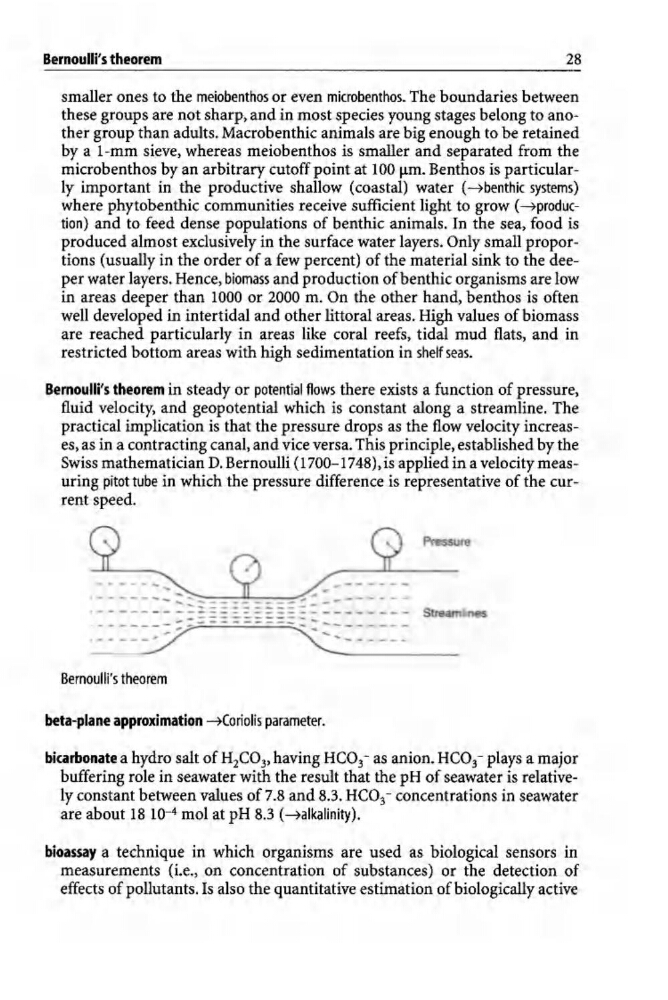
Bernoulli's theorem in steady or potential flows there exists a function of pressure,
fluid velocity, and geopotential which is constant along a streamline. The
practical implication is that the pressure drops as the flow velocity increases, as in a contracting canal, and vice versa. This principle, established by the
Swiss mathematician D. Bernoulli (1700-1748), is applied in a velocity measuring pitottube in which the pressure difference is representative of the current speed.
Streamlines
Bernoulli's theorem
beta-plane approximation ~Coriolis parameter.
bicarbonate a hydro salt of H z C0 3 , having HC0 3 - as anion. HC0 3 - plays a major
buffering role in seawater with the result that the pH of seawater is relatively constant between values of 7.8 and 8.3. HC0 3 - concentrations in seawater
are about 18 10- 4 mol at pH 8.3 (~alkalinity).
bioassay a technique in which organisms are used as biological sensors in
measurements (i.e., on concentration of substances) or the detection of
effects of pollutants. Is also the quantitative estimation of biologically active
28
smaller ones to the meiobenthos or even microbenthos. The boundaries between
these groups are not sharp, and in most species young stages belong to another group than adults. Macrobenthic animals are big enough to be retained
by a I-mm sieve, whereas meiobenthos is smaller and separated from the
microbenthos by an arbitrary cutoff point at 100 11m. Benthos is particularly important in the productive shallow (coastal) water (~benthic systems)
where phytobenthic communities receive sufficient light to grow (~production) and to feed dense populations of benthic animals. In the sea, food is
produced almost exclusively in the surface water layers. Only small proportions (usually in the order of a few percent) of the material sink to the deeper water layers. Hence, biomass and production of benthic organisms are low
in areas deeper than 1000 or 2000 m. On the other hand, benthos is often
well developed in intertidal and other littoral areas. High values of biomass
are reached particularly in areas like coral reefs, tidal mud flats, and in
restricted bottom areas with high sedimentation in shelf seas.
Bernoulli's theorem in steady or potential flows there exists a function of pressure,
fluid velocity, and geopotential which is constant along a streamline. The
practical implication is that the pressure drops as the flow velocity increases, as in a contracting canal, and vice versa. This principle, established by the
Swiss mathematician D. Bernoulli (1700-1748), is applied in a velocity measuring pitottube in which the pressure difference is representative of the current speed.
Streamlines
Bernoulli's theorem
beta-plane approximation ~Coriolis parameter.
bicarbonate a hydro salt of H z C0 3 , having HC0 3 - as anion. HC0 3 - plays a major
buffering role in seawater with the result that the pH of seawater is relatively constant between values of 7.8 and 8.3. HC0 3 - concentrations in seawater
are about 18 10- 4 mol at pH 8.3 (~alkalinity).
bioassay a technique in which organisms are used as biological sensors in
measurements (i.e., on concentration of substances) or the detection of
effects of pollutants. Is also the quantitative estimation of biologically active