

323
Tintinnina
modifies the earth's own gravitational field. This field of tide-generating
forces is symmetrical: it is directed to the sublunar (subsolar) point and the
opposite (antipodes or nadir) point. By the diurnal rotation of the earth
around its axis in this field each point on earth experiences a regular variation of its geopotential field. This variation (tide-generating potential) acting
on the oceans causes a variation of the sea level. In more detail, astronomical
variations in this system cause further variations at different periods
(~astronomical tides). The actual tide at any place and moment is the result of
their contributions (~harmonic analysis oftides). The resulting tide is not directly related to the phase and amplitude of the local tidal potential, because of
the dynamic response of the seas to different periods.
tide-generating potential ~tide.
time scales applied to water motions or transport problems, serve to assess the
relevance of the various possible effects or processes for a given situation.
Applied to dynamics the time scale usually appears as a "typical" time in the
assessment of a nondimensional number. Applied to the transport of water or
dissolved substances through a sea area several concepts such as age or transit, flushing, and residence time are used, but often differently defined. Usually
the transit time of an element (e.g., water particle) is the time it remains in the
area before leaving again. Its age is the time elapsed since an element entered
for the last time. Residence time and flushing time are sometimes synonymous
with one of the foregoing concepts, but different definitions are encountered.
Theory in relation to these time scales usually presupposes stationary conditions. In that case the average transit time is the quotient of the total mass
present and the total flux per unit of time. This quotient is sometimes called
the turnover time. ~chronostratigraphy and ~geological time scale.
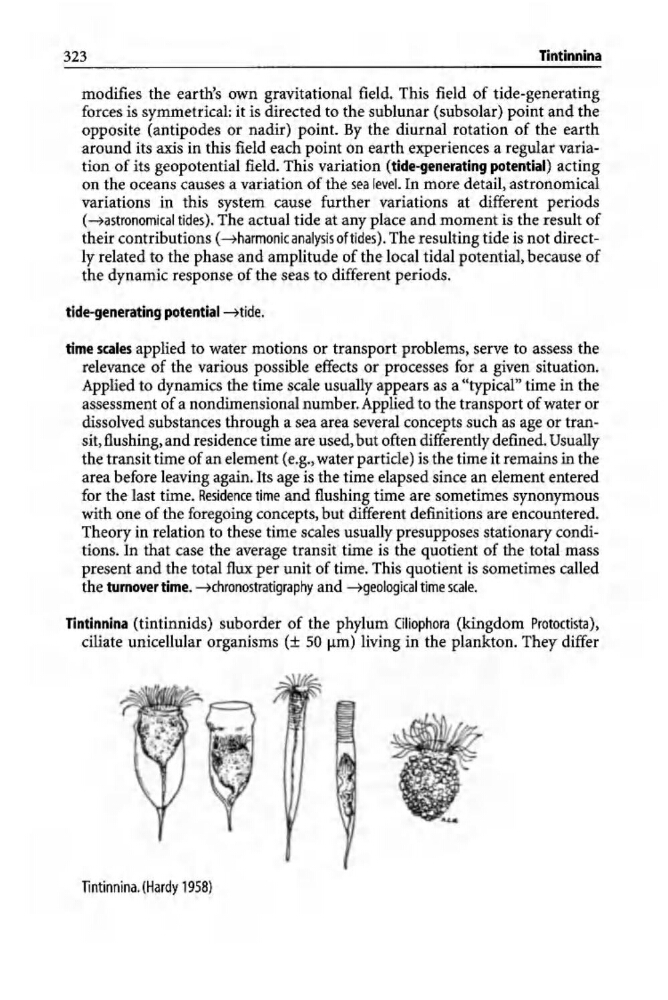
Tintinnina (tintinnids) suborder of the phylum Ciliophora (kingdom Protoctista),
ciliate unicellular organisms (± 50 Ilm) living in the plankton. They differ
Tintinnina. (Hardy 1958)
Tintinnina
modifies the earth's own gravitational field. This field of tide-generating
forces is symmetrical: it is directed to the sublunar (subsolar) point and the
opposite (antipodes or nadir) point. By the diurnal rotation of the earth
around its axis in this field each point on earth experiences a regular variation of its geopotential field. This variation (tide-generating potential) acting
on the oceans causes a variation of the sea level. In more detail, astronomical
variations in this system cause further variations at different periods
(~astronomical tides). The actual tide at any place and moment is the result of
their contributions (~harmonic analysis oftides). The resulting tide is not directly related to the phase and amplitude of the local tidal potential, because of
the dynamic response of the seas to different periods.
tide-generating potential ~tide.
time scales applied to water motions or transport problems, serve to assess the
relevance of the various possible effects or processes for a given situation.
Applied to dynamics the time scale usually appears as a "typical" time in the
assessment of a nondimensional number. Applied to the transport of water or
dissolved substances through a sea area several concepts such as age or transit, flushing, and residence time are used, but often differently defined. Usually
the transit time of an element (e.g., water particle) is the time it remains in the
area before leaving again. Its age is the time elapsed since an element entered
for the last time. Residence time and flushing time are sometimes synonymous
with one of the foregoing concepts, but different definitions are encountered.
Theory in relation to these time scales usually presupposes stationary conditions. In that case the average transit time is the quotient of the total mass
present and the total flux per unit of time. This quotient is sometimes called
the turnover time. ~chronostratigraphy and ~geological time scale.
Tintinnina (tintinnids) suborder of the phylum Ciliophora (kingdom Protoctista),
ciliate unicellular organisms (± 50 Ilm) living in the plankton. They differ
Tintinnina. (Hardy 1958)