

thermodynamics
320
TEMPERATURE IOC)
o
5
10
15
20
DEPTH Or--"""'---'...--"'T'"""--r-(m)
w_
_~ Seasonal~
1000
P",manenl thermocline
2000
3000
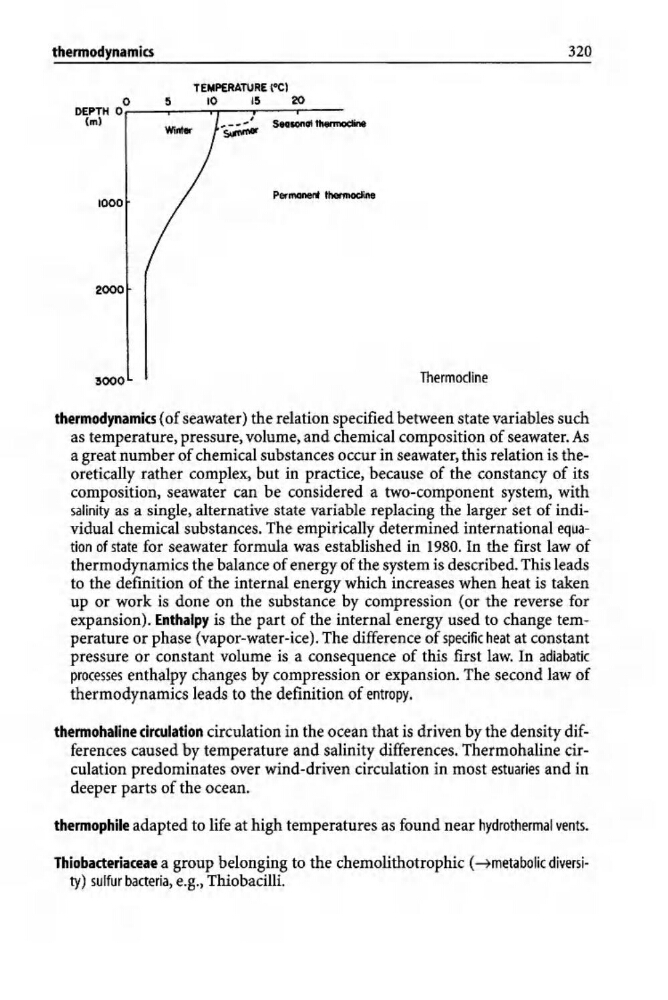
Thermocline
thermodynamics (of seawater) the relation specified between state variables such
as temperature, pressure, volume, and chemical composition of seawater. As
a great number of chemical substances occur in seawater, this relation is theoretically rather complex, but in practice, because of the constancy of its
composition, seawater can be considered a two-component system, with
salinity as a single, alternative state variable replacing the larger set of individual chemical substances. The empirically determined international equation of state for seawater formula was established in 1980. In the first law of
thermodynamics the balance of energy of the system is described. This leads
to the definition of the internal energy which increases when heat is taken
up or work is done on the substance by compression (or the reverse for
expansion). Enthalpy is the part of the internal energy used to change temperature or phase (vapor-water-ice). The difference of specific heat at constant
pressure or constant volume is a consequence of this first law. In adiabatic
processes enthalpy changes by compression or expansion. The second law of
thermodynamics leads to the definition of entropy.
thermohaline circulation circulation in the ocean that is driven by the density differences caused by temperature and salinity differences. Thermohaline circulation predominates over wind-driven circulation in most estuaries and in
deeper parts of the ocean.
thermophile adapted to life at high temperatures as found near hydrothermal vents.
Thiobacteriaceae a group belonging to the chemolithotrophic (-4metabolic diversity) sulfur bacteria, e.g., Thiobacilli.
320
TEMPERATURE IOC)
o
5
10
15
20
DEPTH Or--"""'---'...--"'T'"""--r-(m)
w_
_~ Seasonal~
1000
P",manenl thermocline
2000
3000
Thermocline
thermodynamics (of seawater) the relation specified between state variables such
as temperature, pressure, volume, and chemical composition of seawater. As
a great number of chemical substances occur in seawater, this relation is theoretically rather complex, but in practice, because of the constancy of its
composition, seawater can be considered a two-component system, with
salinity as a single, alternative state variable replacing the larger set of individual chemical substances. The empirically determined international equation of state for seawater formula was established in 1980. In the first law of
thermodynamics the balance of energy of the system is described. This leads
to the definition of the internal energy which increases when heat is taken
up or work is done on the substance by compression (or the reverse for
expansion). Enthalpy is the part of the internal energy used to change temperature or phase (vapor-water-ice). The difference of specific heat at constant
pressure or constant volume is a consequence of this first law. In adiabatic
processes enthalpy changes by compression or expansion. The second law of
thermodynamics leads to the definition of entropy.
thermohaline circulation circulation in the ocean that is driven by the density differences caused by temperature and salinity differences. Thermohaline circulation predominates over wind-driven circulation in most estuaries and in
deeper parts of the ocean.
thermophile adapted to life at high temperatures as found near hydrothermal vents.
Thiobacteriaceae a group belonging to the chemolithotrophic (-4metabolic diversity) sulfur bacteria, e.g., Thiobacilli.