

texture
318
texture (of sediment) the microgeometry of sediment, determined by the grain
size, and the shape and arrangement of grains.
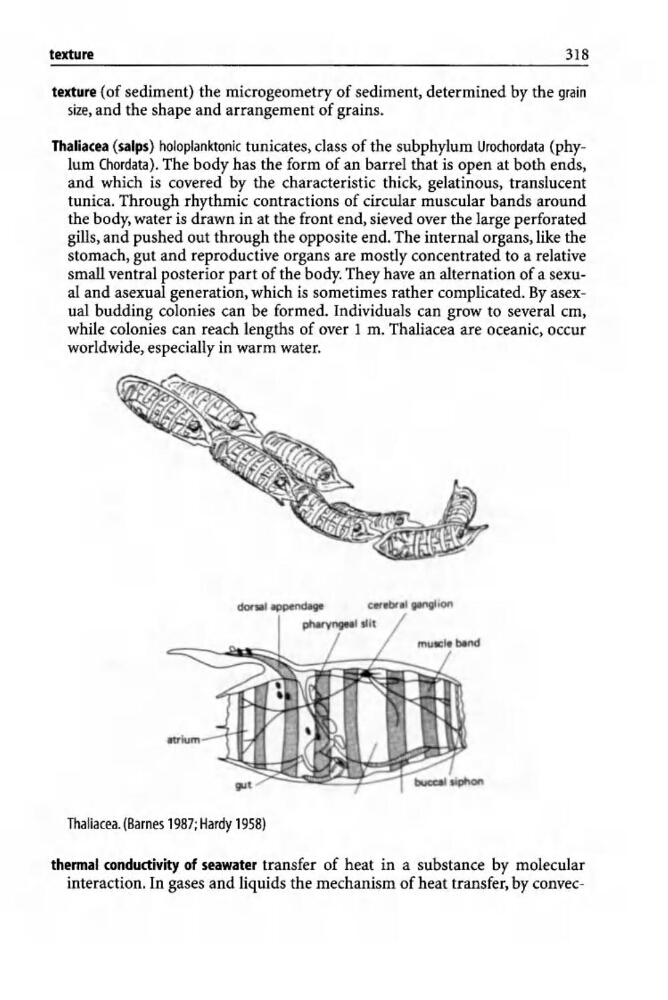
Thaliacea (salps) holoplanktonic tunicates, class of the subphylum Urochordata (phylum Chordata). The body has the form of an barrel that is open at both ends,
and which is covered by the characteristic thick, gelatinous, translucent
tunica. Through rhythmic contractions of circular muscular bands around
the body, water is drawn in at the front end, sieved over the large perforated
gills, and pushed out through the opposite end. The internal organs, like the
stomach, gut and reproductive organs are mostly concentrated to a relative
small ventral posterior part of the body. They have an alternation of a sexual and asexual generation, which is sometimes rather complicated. By asexual budding colonies can be formed. Individuals can grow to several cm,
while colonies can reach lengths of over 1 m. Thaliacea are oceanic, occur
worldwide, especially in warm water.
Thaliacea. (Barnes 1987; Hardy 1958)
thermal conductivity of seawater transfer of heat in a substance by molecular
interaction. In gases and liquids the mechanism of heat transfer, by convec-
318
texture (of sediment) the microgeometry of sediment, determined by the grain
size, and the shape and arrangement of grains.
Thaliacea (salps) holoplanktonic tunicates, class of the subphylum Urochordata (phylum Chordata). The body has the form of an barrel that is open at both ends,
and which is covered by the characteristic thick, gelatinous, translucent
tunica. Through rhythmic contractions of circular muscular bands around
the body, water is drawn in at the front end, sieved over the large perforated
gills, and pushed out through the opposite end. The internal organs, like the
stomach, gut and reproductive organs are mostly concentrated to a relative
small ventral posterior part of the body. They have an alternation of a sexual and asexual generation, which is sometimes rather complicated. By asexual budding colonies can be formed. Individuals can grow to several cm,
while colonies can reach lengths of over 1 m. Thaliacea are oceanic, occur
worldwide, especially in warm water.
Thaliacea. (Barnes 1987; Hardy 1958)
thermal conductivity of seawater transfer of heat in a substance by molecular
interaction. In gases and liquids the mechanism of heat transfer, by convec-