

315
tektite
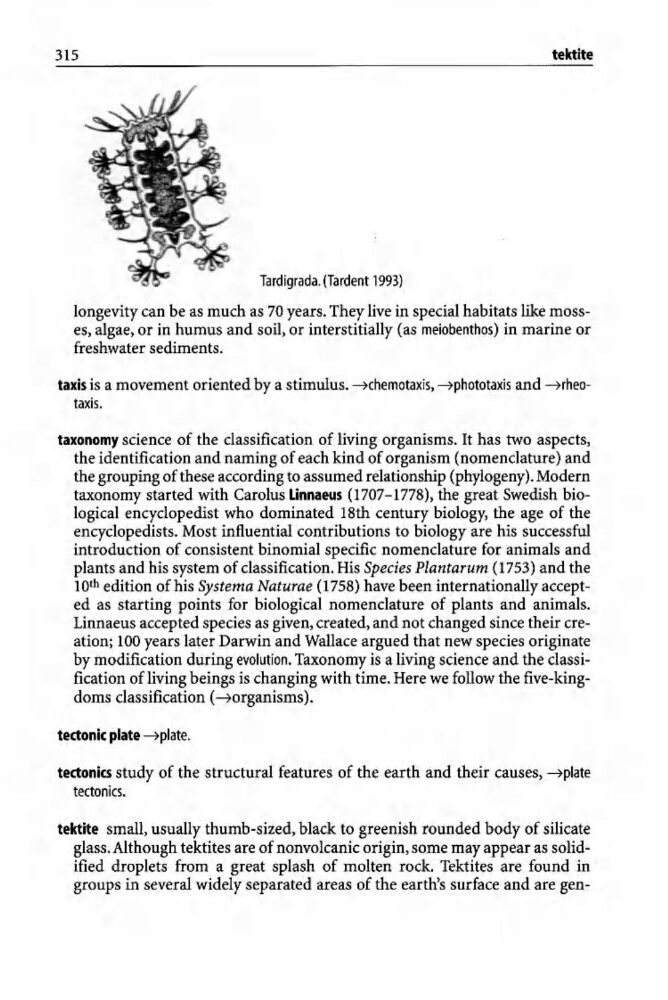
Tardigrada. (Tardent 1993)
longevity can be as much as 70 years. They live in special habitats like mosses, algae, or in humus and soil, or interstitially (as meiobenthos) in marine or
freshwater sediments.
taxis is a movement oriented by a stimulus. ~chemotaxis, ~phototaxis and ~rheotaxis.
taxonomy science of the classification of living organisms. It has two aspects,
the identification and naming of each kind of organism (nomenclature) and
the grouping of these according to assumed relationship (phylogeny). Modern
taxonomy started with Carolus Linnaeus (1707-1778), the great Swedish biological encyclopedist who dominated 18th century biology, the age of the
encyclopedists. Most influential contributions to biology are his successful
introduction of consistent binomial specific nomenclature for animals and
plants and his system of classification. His Species Plantarum (1753) and the
10 th edition of his Systema Naturae (1758) have been internationally accepted as starting points for biological nomenclature of plants and animals.
Linnaeus accepted species as given, created, and not changed since their creation; 100 years later Darwin and Wallace argued that new species originate
by modification during evolution. Taxonomy is a living science and the classification of living beings is changing with time. Here we follow the five-kingdoms classification (~organisms).
tectonic plate ~plate.
tectonics study of the structural features of the earth and their causes, ~plate
tectonics.
tektite small, usually thumb-sized, black to greenish rounded body of silicate
glass. Although tektites are of nonvolcanic origin, some may appear as solidified droplets from a great splash of molten rock. Tektites are found in
groups in several widely separated areas of the earth's surface and are gen-
tektite
Tardigrada. (Tardent 1993)
longevity can be as much as 70 years. They live in special habitats like mosses, algae, or in humus and soil, or interstitially (as meiobenthos) in marine or
freshwater sediments.
taxis is a movement oriented by a stimulus. ~chemotaxis, ~phototaxis and ~rheotaxis.
taxonomy science of the classification of living organisms. It has two aspects,
the identification and naming of each kind of organism (nomenclature) and
the grouping of these according to assumed relationship (phylogeny). Modern
taxonomy started with Carolus Linnaeus (1707-1778), the great Swedish biological encyclopedist who dominated 18th century biology, the age of the
encyclopedists. Most influential contributions to biology are his successful
introduction of consistent binomial specific nomenclature for animals and
plants and his system of classification. His Species Plantarum (1753) and the
10 th edition of his Systema Naturae (1758) have been internationally accepted as starting points for biological nomenclature of plants and animals.
Linnaeus accepted species as given, created, and not changed since their creation; 100 years later Darwin and Wallace argued that new species originate
by modification during evolution. Taxonomy is a living science and the classification of living beings is changing with time. Here we follow the five-kingdoms classification (~organisms).
tectonic plate ~plate.
tectonics study of the structural features of the earth and their causes, ~plate
tectonics.
tektite small, usually thumb-sized, black to greenish rounded body of silicate
glass. Although tektites are of nonvolcanic origin, some may appear as solidified droplets from a great splash of molten rock. Tektites are found in
groups in several widely separated areas of the earth's surface and are gen-