

bacteriocin
22
bacillus or a rod, a curved cell is a spirillum. Coiled bacteria are spirochetes
and there are also bacteria with stalks, the appendaged bacteria. Sometimes
the cells remain together in groups or clusters or in long chains. Some bacteria can form spores. Growth occurs by cell division. Like the diversity in
forms, the metabolic types of bacteria appear infinite, filling virtually every
environmental niche. Active metabolizing bacteria are found in ice brines of
the polar seas at temperatures below zero as well as in the hot water of
several hundred degrees above zero in the deep-sea hydrothermal vents
(~Archaebacteria). They can tolerate hydrostatic pressures of the deep sea and
grow under all kinds of oxygen concentrations. They are present in anaerobic sediments and anaerobic basins. Bacteria obtain their energy from the
oxidation (aerobic or anaerobic) of organic material, or of reduced inorganic
material or from solar energy through bacterial photosynthesis (~Cyanobacteria). Bacteria playa major role in the recycling of elements, the bioenergetics of ecosystems, the degradation of organic compounds, oil degradation,
degradation of xenobiotic compounds, etc. The role of bacteria as a sink or link
of organic matter in the sea is the subject of mineralization and microbialloop studies.
bacteriocin an agent produced by certain bacteria that inhibits or kills closely
related bacteria.
bacterioneuston the thin layer of pelagic bacteria in the uppermost surface of the
sea.
bacteriophage virus that attacks bacteria.
bacteriostatic capable of inhibiting bacterial growth without killing.
. su(\~Ges_
-
~~(\G
_
\SO
_
- -
- -
- -
- -
-
.......
-
-
.......
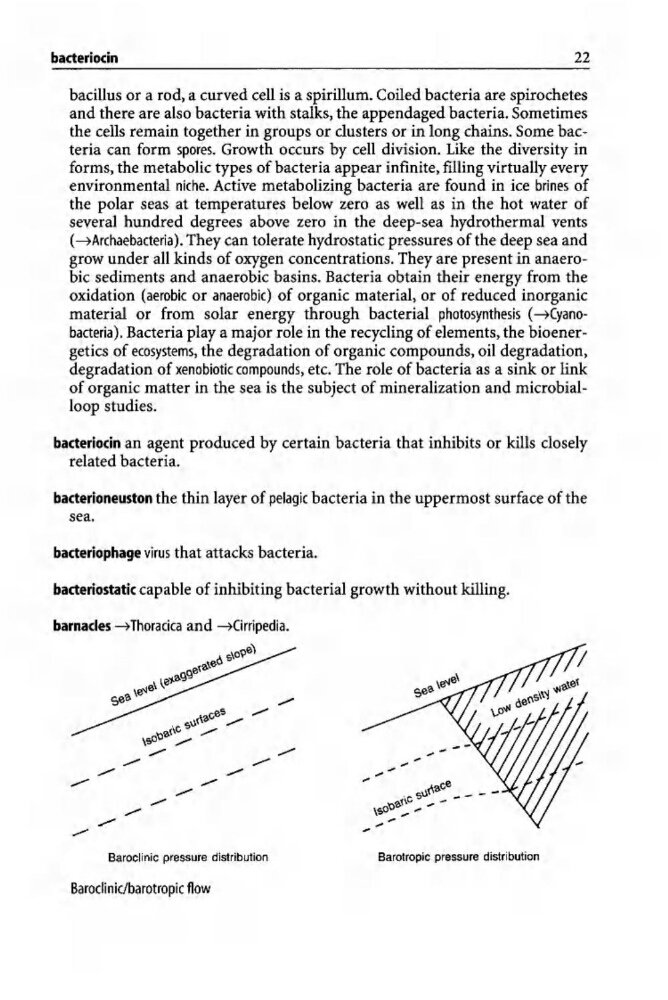
Baroclinic pressure distribution
Barotropic pressure distribution
Barociinic/barotropic flow
22
bacillus or a rod, a curved cell is a spirillum. Coiled bacteria are spirochetes
and there are also bacteria with stalks, the appendaged bacteria. Sometimes
the cells remain together in groups or clusters or in long chains. Some bacteria can form spores. Growth occurs by cell division. Like the diversity in
forms, the metabolic types of bacteria appear infinite, filling virtually every
environmental niche. Active metabolizing bacteria are found in ice brines of
the polar seas at temperatures below zero as well as in the hot water of
several hundred degrees above zero in the deep-sea hydrothermal vents
(~Archaebacteria). They can tolerate hydrostatic pressures of the deep sea and
grow under all kinds of oxygen concentrations. They are present in anaerobic sediments and anaerobic basins. Bacteria obtain their energy from the
oxidation (aerobic or anaerobic) of organic material, or of reduced inorganic
material or from solar energy through bacterial photosynthesis (~Cyanobacteria). Bacteria playa major role in the recycling of elements, the bioenergetics of ecosystems, the degradation of organic compounds, oil degradation,
degradation of xenobiotic compounds, etc. The role of bacteria as a sink or link
of organic matter in the sea is the subject of mineralization and microbialloop studies.
bacteriocin an agent produced by certain bacteria that inhibits or kills closely
related bacteria.
bacterioneuston the thin layer of pelagic bacteria in the uppermost surface of the
sea.
bacteriophage virus that attacks bacteria.
bacteriostatic capable of inhibiting bacterial growth without killing.
. su(\~Ges_
-
~~(\G
_
\SO
_
- -
- -
- -
- -
-
.......
-
-
.......
Baroclinic pressure distribution
Barotropic pressure distribution
Barociinic/barotropic flow