

Sipuncula
SwImming boll
(meduul
D...---Slam
296
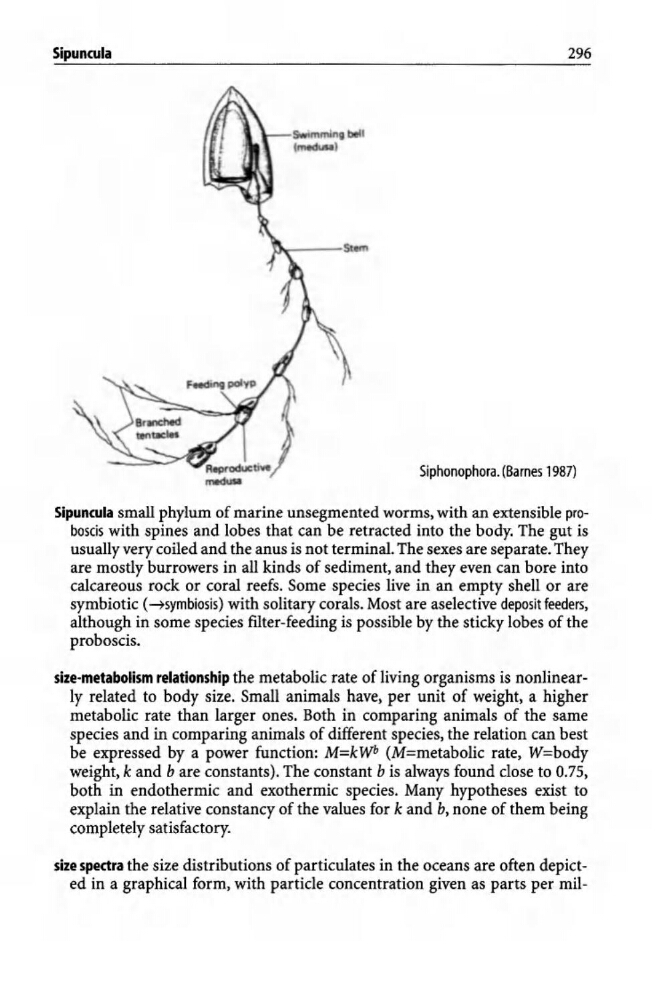
Siphonophora. (Barnes 1987)
Sipuncula small phylum of marine unsegmented worms, with an extensible proboscis with spines and lobes that can be retracted into the body. The gut is
usually very coiled and the anus is not terminal. The sexes are separate. They
are mostly burrowers in all kinds of sediment, and they even can bore into
calcareous rock or coral reefs. Some species live in an empty shell or are
symbiotic (~symbiosis) with solitary corals. Most are aselective deposit feeders,
although in some species filter-feeding is possible by the sticky lobes of the
proboscis.
size-metabolism relationship the metabolic rate of living organisms is nonlinearly related to body size. Small animals have, per unit of weight, a higher
metabolic rate than larger ones. Both in comparing animals of the same
species and in comparing animals of different species, the relation can best
be expressed by a power function: M=kWb (M=metabolic rate, W=body
weight, k and b are constants). The constant b is always found close to 0.75,
both in endothermic and exothermic species. Many hypotheses exist to
explain the relative constancy of the values for k and b, none of them being
completely satisfactory.
size spectra the size distributions of particulates in the oceans are often depicted in a graphical form, with particle concentration given as parts per mil-
SwImming boll
(meduul
D...---Slam
296
Siphonophora. (Barnes 1987)
Sipuncula small phylum of marine unsegmented worms, with an extensible proboscis with spines and lobes that can be retracted into the body. The gut is
usually very coiled and the anus is not terminal. The sexes are separate. They
are mostly burrowers in all kinds of sediment, and they even can bore into
calcareous rock or coral reefs. Some species live in an empty shell or are
symbiotic (~symbiosis) with solitary corals. Most are aselective deposit feeders,
although in some species filter-feeding is possible by the sticky lobes of the
proboscis.
size-metabolism relationship the metabolic rate of living organisms is nonlinearly related to body size. Small animals have, per unit of weight, a higher
metabolic rate than larger ones. Both in comparing animals of the same
species and in comparing animals of different species, the relation can best
be expressed by a power function: M=kWb (M=metabolic rate, W=body
weight, k and b are constants). The constant b is always found close to 0.75,
both in endothermic and exothermic species. Many hypotheses exist to
explain the relative constancy of the values for k and b, none of them being
completely satisfactory.
size spectra the size distributions of particulates in the oceans are often depicted in a graphical form, with particle concentration given as parts per mil-