

Scleractinia
280
Scleractinia ~Madreporaria.
Sclerospongiae class of the Porifera. These marine sponges are characterized by an
external calcareous covering of calcium carbonate. The living tissue beneath
also has spongine fibers and siliceous spicules. The few living representatives
live in shaded, mostly tropical habitats.
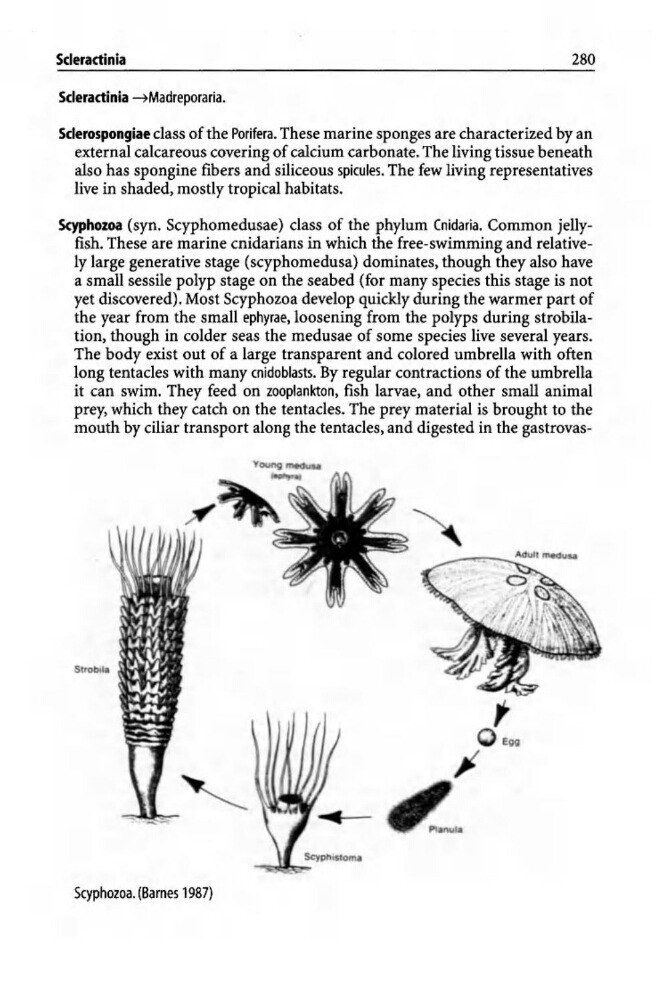
Scyphozoa (syn. Scyphomedusae) class of the phylum Cnidaria. Common jellyfish. These are marine cnidarians in which the free-swimming and relatively large generative stage (scyphomedusa) dominates, though they also have
a small sessile polyp stage on the seabed (for many species this stage is not
yet discovered). Most Scyphozoa develop quickly during the warmer part of
the year from the small ephyrae, loosening from the polyps during strobilation, though in colder seas the medusae of some species live several years.
The body exist out of a large transparent and colored umbrella with often
long tentacles with many cnidoblasts. By regular contractions of the umbrella
it can swim. They feed on zooplankton, fish larvae, and other small animal
prey, which they catch on the tentacles. The prey material is brought to the
mouth by ciliar transport along the tentacles, and digested in the gastrovasScyphozoa. (Barnes 1987)
280
Scleractinia ~Madreporaria.
Sclerospongiae class of the Porifera. These marine sponges are characterized by an
external calcareous covering of calcium carbonate. The living tissue beneath
also has spongine fibers and siliceous spicules. The few living representatives
live in shaded, mostly tropical habitats.
Scyphozoa (syn. Scyphomedusae) class of the phylum Cnidaria. Common jellyfish. These are marine cnidarians in which the free-swimming and relatively large generative stage (scyphomedusa) dominates, though they also have
a small sessile polyp stage on the seabed (for many species this stage is not
yet discovered). Most Scyphozoa develop quickly during the warmer part of
the year from the small ephyrae, loosening from the polyps during strobilation, though in colder seas the medusae of some species live several years.
The body exist out of a large transparent and colored umbrella with often
long tentacles with many cnidoblasts. By regular contractions of the umbrella
it can swim. They feed on zooplankton, fish larvae, and other small animal
prey, which they catch on the tentacles. The prey material is brought to the
mouth by ciliar transport along the tentacles, and digested in the gastrovasScyphozoa. (Barnes 1987)