

269
Reynolds number
YOlO
o
-,
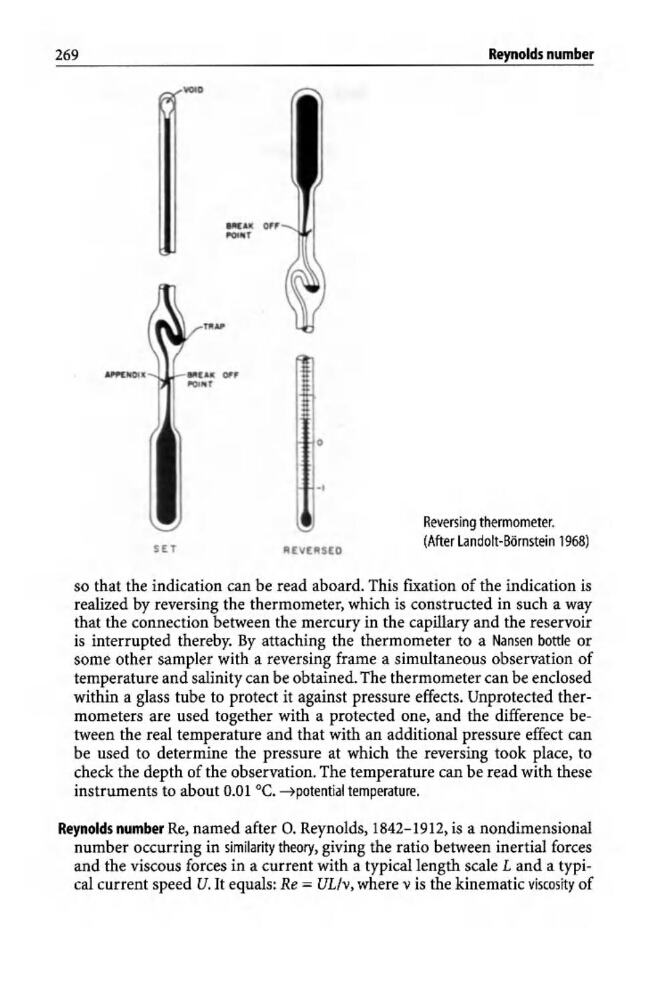
Reversing thermometer.
SET
REVERSED
(After Landolt-Bornstein 1968)
so that the indication can be read aboard. This fIxation of the indication is
realized by reversing the thermometer, which is constructed in such a way
that the connection between the mercury in the capillary and the reservoir
is interrupted thereby. By attaching the thermometer to a Nansen bottle or
some other sampler with a reversing frame a simultaneous observation of
temperature and salinity can be obtained. The thermometer can be enclosed
within a glass tube to protect it against pressure effects. Unprotected thermometers are used together with a protected one, and the difference between the real temperature and that with an additional pressure effect can
be used to determine the pressure at which the reversing took place, to
check the depth of the observation. The temperature can be read with these
instruments to about 0.01 0c. -')potential temperature.
Reynolds number Re, named after o. Reynolds, 1842-1912, is a nondimensional
number occurring in similarity theory, giving the ratio between inertial forces
and the viscous forces in a current with a typical length scale L and a typical current speed U. It equals: Re = UL/v, where v is the kinematic viscosity of
Reynolds number
YOlO
o
-,
Reversing thermometer.
SET
REVERSED
(After Landolt-Bornstein 1968)
so that the indication can be read aboard. This fIxation of the indication is
realized by reversing the thermometer, which is constructed in such a way
that the connection between the mercury in the capillary and the reservoir
is interrupted thereby. By attaching the thermometer to a Nansen bottle or
some other sampler with a reversing frame a simultaneous observation of
temperature and salinity can be obtained. The thermometer can be enclosed
within a glass tube to protect it against pressure effects. Unprotected thermometers are used together with a protected one, and the difference between the real temperature and that with an additional pressure effect can
be used to determine the pressure at which the reversing took place, to
check the depth of the observation. The temperature can be read with these
instruments to about 0.01 0c. -')potential temperature.
Reynolds number Re, named after o. Reynolds, 1842-1912, is a nondimensional
number occurring in similarity theory, giving the ratio between inertial forces
and the viscous forces in a current with a typical length scale L and a typical current speed U. It equals: Re = UL/v, where v is the kinematic viscosity of