

261
Redfield ratio
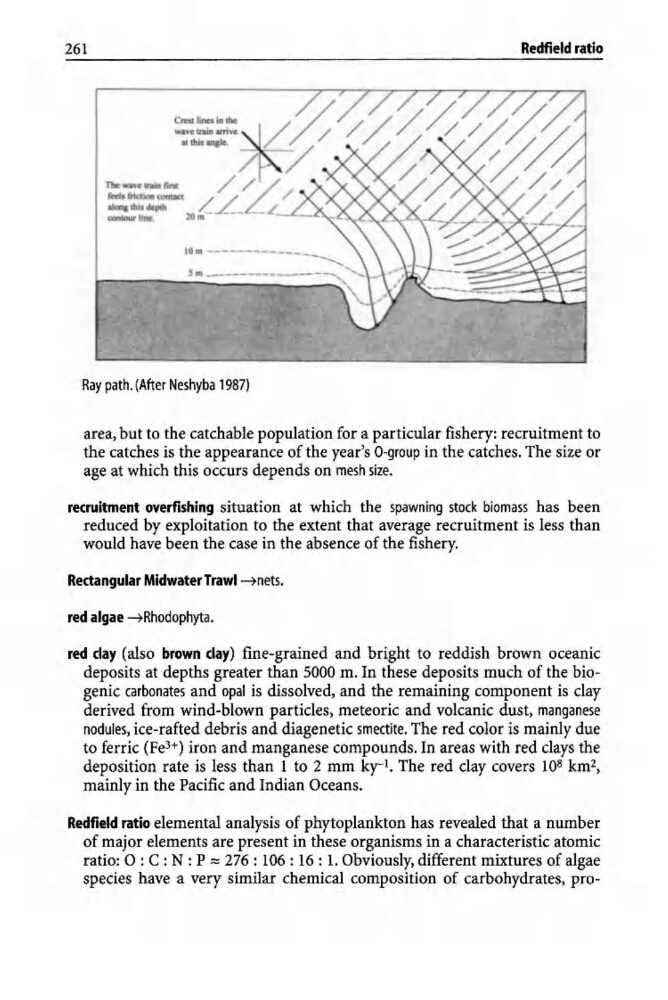
Ray path. (After Neshyba 1987)
area, but to the catchable population for a particular fishery: recruitment to
the catches is the appearance of the year's O-group in the catches. The size or
age at which this occurs depends on mesh size.
recruitment overfishing situation at which the spawning stock biomass has been
reduced by exploitation to the extent that average recruitment is less than
would have been the case in the absence of the fishery.
Rectangular Midwater Trawl -.?nets.
red algae -.?Rhodophyta.
red clay (also brown clay) fine-grained and bright to reddish brown oceanic
deposits at depths greater than 5000 m. In these deposits much of the biogenic carbonates and opal is dissolved, and the remaining component is clay
derived from wind-blown particles, meteoric and volcanic dust, manganese
nodules, ice-rafted debris and diagenetic smectite. The red color is mainly due
to ferric (Fe3+) iron and manganese compounds. In areas with red clays the
deposition rate is less than 1 to 2 mm ky-l. The red clay covers 10 8 km2,
mainly in the Pacific and Indian Oceans.
Redfield ratio elemental analysis of phytoplankton has revealed that a number
of major elements are present in these organisms in a characteristic atomic
ratio: 0 : C : N : P ::::: 276 : 106 : 16 : 1. Obviously, different mixtures of algae
species have a very similar chemical composition of carbohydrates, pro-
Redfield ratio
Ray path. (After Neshyba 1987)
area, but to the catchable population for a particular fishery: recruitment to
the catches is the appearance of the year's O-group in the catches. The size or
age at which this occurs depends on mesh size.
recruitment overfishing situation at which the spawning stock biomass has been
reduced by exploitation to the extent that average recruitment is less than
would have been the case in the absence of the fishery.
Rectangular Midwater Trawl -.?nets.
red algae -.?Rhodophyta.
red clay (also brown clay) fine-grained and bright to reddish brown oceanic
deposits at depths greater than 5000 m. In these deposits much of the biogenic carbonates and opal is dissolved, and the remaining component is clay
derived from wind-blown particles, meteoric and volcanic dust, manganese
nodules, ice-rafted debris and diagenetic smectite. The red color is mainly due
to ferric (Fe3+) iron and manganese compounds. In areas with red clays the
deposition rate is less than 1 to 2 mm ky-l. The red clay covers 10 8 km2,
mainly in the Pacific and Indian Oceans.
Redfield ratio elemental analysis of phytoplankton has revealed that a number
of major elements are present in these organisms in a characteristic atomic
ratio: 0 : C : N : P ::::: 276 : 106 : 16 : 1. Obviously, different mixtures of algae
species have a very similar chemical composition of carbohydrates, pro-