

Radiolaria
258
radioactive. All these nuclides occur naturally; (b) isotopes formed by interaction of cosmic rays with atmospheric elements. The inventory of these
nuclides,3H (12.26 y), lOBe (1.5 10 6 y), 14C (5730 y), 32Si (130-180 y), is a function of cosmic-ray intensity and T 1I2 • The testing of thermonuclear devices
around 1960 in the atmosphere has greatly increased the inventory of 3H
and to a lesser extent that of 14C. 3H is extensively used as a transient tracer
in circulation studies; (c) isotopes resulting from the use of nuclear fission;
all Pu and Am isotopes and, e.g., 90Sr (28 y) and l37Cs (30 y) fall in this category. The use of l37Cs and 134CS in water circulation studies around the
British Isles is an inadvertent application of the waste discharge of the
Windscale/Sellafield processing plants. Of nearly all elements radioactive
isotopes are known which are prepared on a laboratory scale and used in the
determination of rates. ~absolute age, ~isotopes, ~carbon, radioactive and ~cosmogenic nuclides.
Radiolaria (radiolarians) a term still in use for nontaxonomic purpose. It is
mostly used for small unicellular marine free-living creatures with
pseudopodia, that are in general characterized by their delicate and beautiful siliceous skeleton. These protozoans were formerly classified with
Foraminifera and Amoeba under the Sarcodina, but are now split up into two
classes, the Polycystina and Phaeodaria, and form together with the acantharians and Heliozoa the phylum Actinopoda (kingdom Protoctista). The living
matter or cytoplasm is divided by a mucoid or chitinous layer (the central
capsule, only present in Radiolaria) into an external and internal part, the
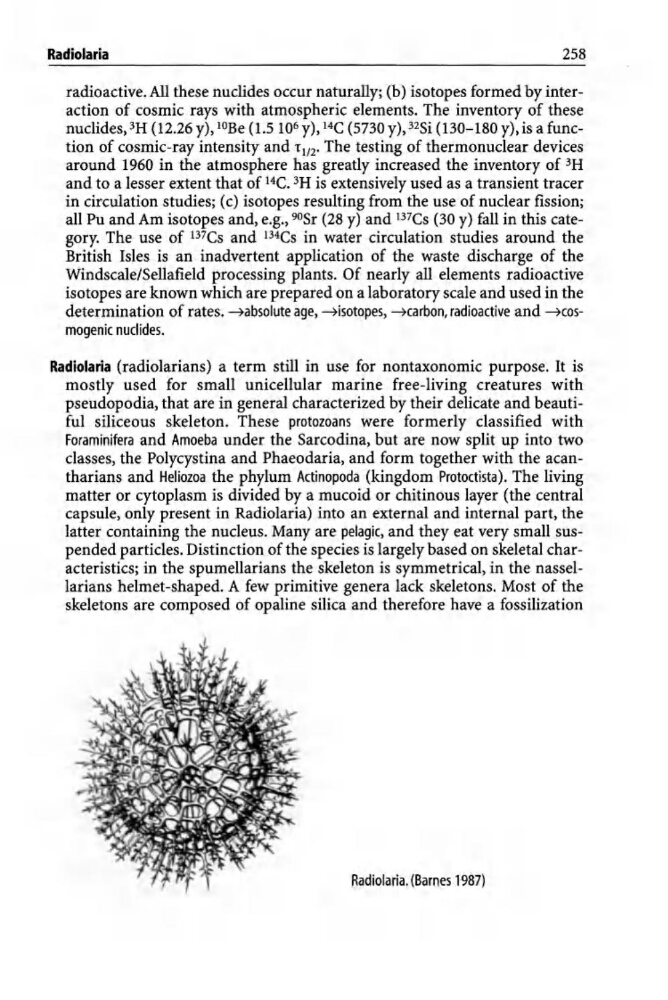
latter containing the nucleus. Many are pelagic, and they eat very small suspended particles. Distinction of the species is largely based on skeletal characteristics; in the spumellarians the skeleton is symmetrical, in the nassellarians helmet-shaped. A few primitive genera lack skeletons. Most of the
skeletons are composed of opaline silica and therefore have a fossilization
Radiolaria. (Barnes 1987)
258
radioactive. All these nuclides occur naturally; (b) isotopes formed by interaction of cosmic rays with atmospheric elements. The inventory of these
nuclides,3H (12.26 y), lOBe (1.5 10 6 y), 14C (5730 y), 32Si (130-180 y), is a function of cosmic-ray intensity and T 1I2 • The testing of thermonuclear devices
around 1960 in the atmosphere has greatly increased the inventory of 3H
and to a lesser extent that of 14C. 3H is extensively used as a transient tracer
in circulation studies; (c) isotopes resulting from the use of nuclear fission;
all Pu and Am isotopes and, e.g., 90Sr (28 y) and l37Cs (30 y) fall in this category. The use of l37Cs and 134CS in water circulation studies around the
British Isles is an inadvertent application of the waste discharge of the
Windscale/Sellafield processing plants. Of nearly all elements radioactive
isotopes are known which are prepared on a laboratory scale and used in the
determination of rates. ~absolute age, ~isotopes, ~carbon, radioactive and ~cosmogenic nuclides.
Radiolaria (radiolarians) a term still in use for nontaxonomic purpose. It is
mostly used for small unicellular marine free-living creatures with
pseudopodia, that are in general characterized by their delicate and beautiful siliceous skeleton. These protozoans were formerly classified with
Foraminifera and Amoeba under the Sarcodina, but are now split up into two
classes, the Polycystina and Phaeodaria, and form together with the acantharians and Heliozoa the phylum Actinopoda (kingdom Protoctista). The living
matter or cytoplasm is divided by a mucoid or chitinous layer (the central
capsule, only present in Radiolaria) into an external and internal part, the
latter containing the nucleus. Many are pelagic, and they eat very small suspended particles. Distinction of the species is largely based on skeletal characteristics; in the spumellarians the skeleton is symmetrical, in the nassellarians helmet-shaped. A few primitive genera lack skeletons. Most of the
skeletons are composed of opaline silica and therefore have a fossilization
Radiolaria. (Barnes 1987)