

assimilation ratio
16
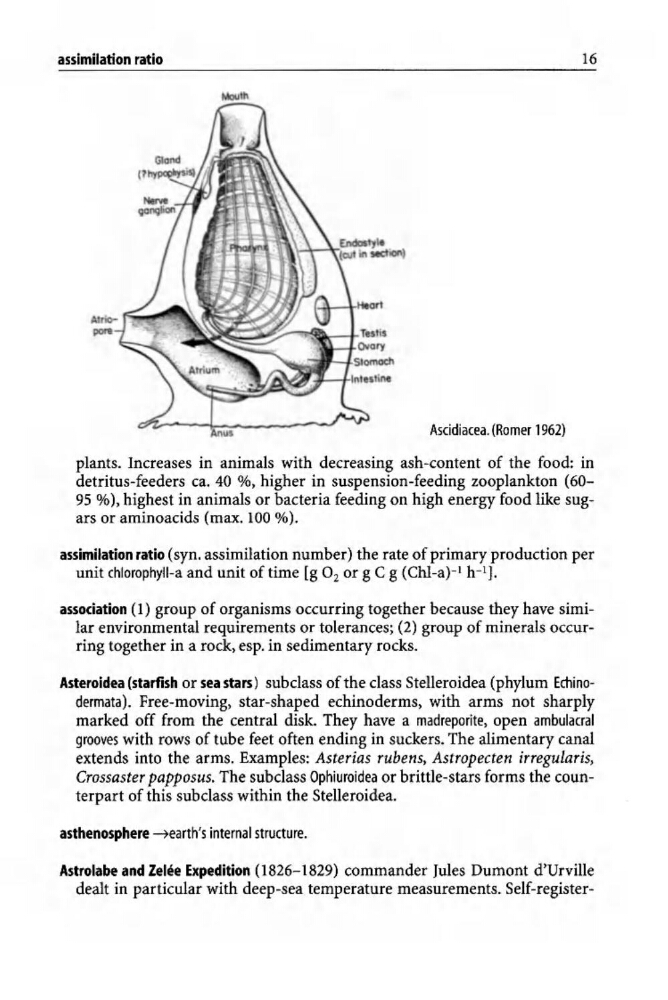
Ascidiacea. (Romer 1962)
plants. Increases in animals with decreasing ash-content of the food: in
detritus-feeders ca. 40 %, higher in suspension-feeding zooplankton (6095 %), highest in animals or bacteria feeding on high energy food like sugars or aminoacids (max. 100 %) .
assimilation ratio (syn. assimilation number) the rate of primary production per
unit chlorophyll-a and unit of time [g 02 or g C g (Chl-a)-l h-l].
association (1) group of organisms occurring together because they have similar environmental requirements or tolerances; (2) group of minerals occurring together in a rock, esp. in sedimentary rocks.
Asteroidea (starfish or sea stars) subclass of the class Stelleroidea (phylum Echinodermata). Free-moving, star-shaped echinoderms, with arms not sharply
marked off from the central disk. They have a madreporite, open ambulacral
grooves with rows of tube feet often ending in suckers. The alimentary canal
extends into the arms. Examples: Asterias rubens, Astropecten irreguiaris,
Crossaster papposus. The subclass Ophiuroidea or brittle-stars forms the counterpart of this subclass within the Stelleroidea.
asthenosphere ~earth's internal structure.
Astrolabe and Zelee Expedition (1826-1829) commander Jules Dumont d'Urville
dealt in particular with deep-sea temperature measurements. Self-register-
16
Ascidiacea. (Romer 1962)
plants. Increases in animals with decreasing ash-content of the food: in
detritus-feeders ca. 40 %, higher in suspension-feeding zooplankton (6095 %), highest in animals or bacteria feeding on high energy food like sugars or aminoacids (max. 100 %) .
assimilation ratio (syn. assimilation number) the rate of primary production per
unit chlorophyll-a and unit of time [g 02 or g C g (Chl-a)-l h-l].
association (1) group of organisms occurring together because they have similar environmental requirements or tolerances; (2) group of minerals occurring together in a rock, esp. in sedimentary rocks.
Asteroidea (starfish or sea stars) subclass of the class Stelleroidea (phylum Echinodermata). Free-moving, star-shaped echinoderms, with arms not sharply
marked off from the central disk. They have a madreporite, open ambulacral
grooves with rows of tube feet often ending in suckers. The alimentary canal
extends into the arms. Examples: Asterias rubens, Astropecten irreguiaris,
Crossaster papposus. The subclass Ophiuroidea or brittle-stars forms the counterpart of this subclass within the Stelleroidea.
asthenosphere ~earth's internal structure.
Astrolabe and Zelee Expedition (1826-1829) commander Jules Dumont d'Urville
dealt in particular with deep-sea temperature measurements. Self-register-