

Poincare wave
240
Poincare wave ---7Sverdrup wave.
poison substance of natural or anthropogenic origin that has an inherent tendency to destroy life or impair health. Marine animals can be venomous and
poisonous, and marine plants may be noxious either to protect themselves
against other organisms or as help in capturing prey. The toxic dinoflagellate Gonyaulax catenella, when consumed as food by shellfish and then
eaten by humans, may cause outbreaks of serious paralytic shellfish poisoning.
Mussel poisoning may cause death to humans from respiratory paralysis.
The sting of jellyfish and other coelenterates is caused by the minute stinging capsules or nematocysts which inject venom into the tissues of prey or victim. Snails of the genus Conus produce a virulent venom that may be lethal
to humans upon injection by the animal. It is primarily a mechanism used
in feeding but may be used as defense. Some fish are poisonous to eat (poisonous fish); others, such as the stingray, produce venom (venomous fish).
---7venomous marine organisms and ---7toxicity.
Pola Expeditions (1890-1898) this Austrian steamer explored the eastern Mediterranean, the Aegean and the Red Sea, its main emphasis was on hydrography under J. Luksch; Natterer was chemist on board.
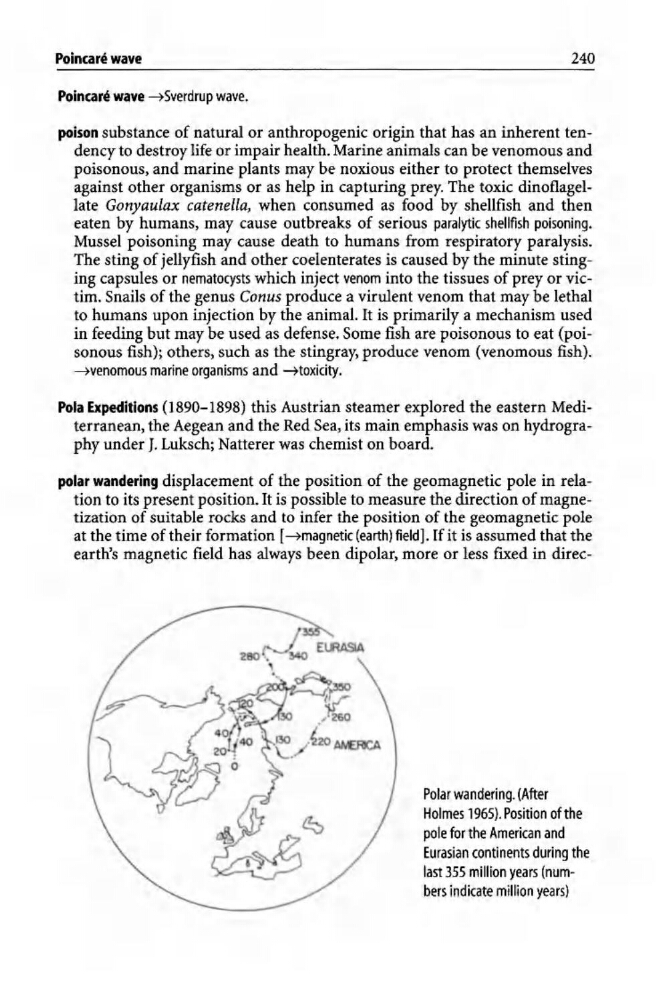
polar wandering displacement of the position of the geomagnetic pole in relation to its present position. It is possible to measure the direction of magnetization of suitable rocks and to infer the position of the geomagnetic pole
at the time of their formation [---7magnetic (earth) field]. If it is assumed that the
earth's magnetic field has always been dipolar, more or less fixed in direcPolar wandering. (After
Holmes 1965). Position ofthe
pole for the American and
Eurasian continents during the
last 355 million years (numbers indicate million years)
240
Poincare wave ---7Sverdrup wave.
poison substance of natural or anthropogenic origin that has an inherent tendency to destroy life or impair health. Marine animals can be venomous and
poisonous, and marine plants may be noxious either to protect themselves
against other organisms or as help in capturing prey. The toxic dinoflagellate Gonyaulax catenella, when consumed as food by shellfish and then
eaten by humans, may cause outbreaks of serious paralytic shellfish poisoning.
Mussel poisoning may cause death to humans from respiratory paralysis.
The sting of jellyfish and other coelenterates is caused by the minute stinging capsules or nematocysts which inject venom into the tissues of prey or victim. Snails of the genus Conus produce a virulent venom that may be lethal
to humans upon injection by the animal. It is primarily a mechanism used
in feeding but may be used as defense. Some fish are poisonous to eat (poisonous fish); others, such as the stingray, produce venom (venomous fish).
---7venomous marine organisms and ---7toxicity.
Pola Expeditions (1890-1898) this Austrian steamer explored the eastern Mediterranean, the Aegean and the Red Sea, its main emphasis was on hydrography under J. Luksch; Natterer was chemist on board.
polar wandering displacement of the position of the geomagnetic pole in relation to its present position. It is possible to measure the direction of magnetization of suitable rocks and to infer the position of the geomagnetic pole
at the time of their formation [---7magnetic (earth) field]. If it is assumed that the
earth's magnetic field has always been dipolar, more or less fixed in direcPolar wandering. (After
Holmes 1965). Position ofthe
pole for the American and
Eurasian continents during the
last 355 million years (numbers indicate million years)