

Placodermi
234
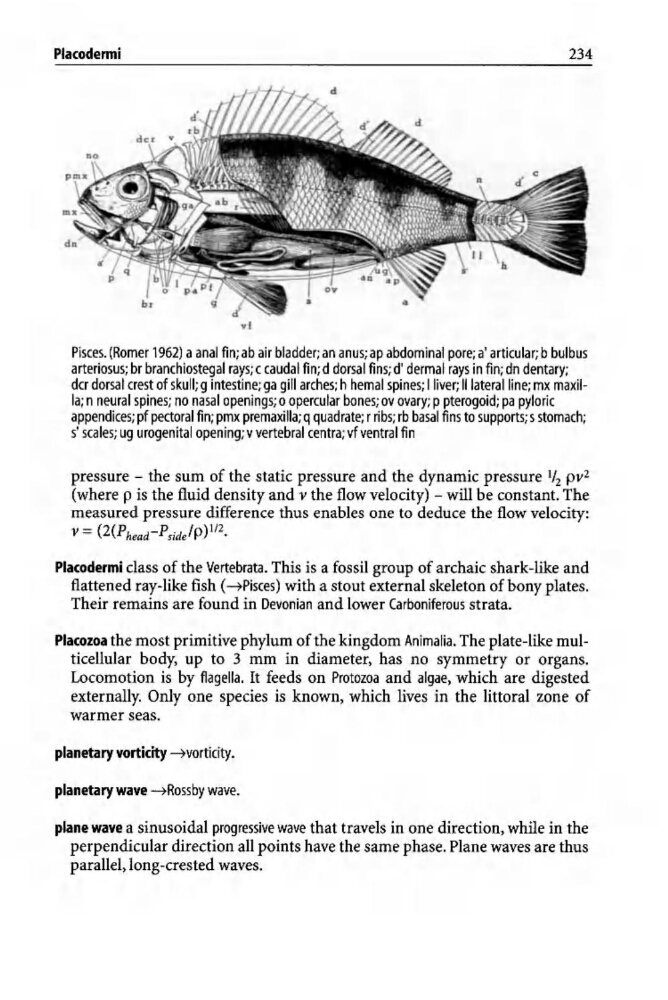
Pisces. (Romer 1962) a anal fin; ab air bladder; an anus; ap abdominal pore; a' articular; b bulbus
arteriosus; br branchiostegal rays; c caudal fin; d dorsal fins; d' dermal rays in fin; dn dentary;
dcr dorsal crest of skull; g intestine; ga gill arches; h hemal spines; I liver; II lateral line; mx maxilla; n neural spines; no nasal openings; 0 opercular bones; ov ovary; p pterogoid; pa pyloric
appendices; pf pectoral fin; pmx premaxilla; q quadrate; r ribs; rb basal fins to supports; s stomach;
s' scales; ug urogenital opening; v vertebral centra; vf ventral fin
pressure - the sum of the static pressure and the dynamic pressure 1/2 pv2
(where p is the fluid density and v the flow velocity) - will be constant. The
measured pressure difference thus enables one to deduce the flow velocity:
v = (2(PhearPsidelp )112.
Placodermi class of the Vertebrata. This is a fossil group of archaic shark-like and
flattened ray-like fish (-tPisces) with a stout external skeleton of bony plates.
Their remains are found in Devonian and lower Carboniferous strata.
Placozoa the most primitive phylum of the kingdom Animalia. The plate-like multicellular body, up to 3 mm in diameter, has no symmetry or organs.
Locomotion is by flagella. It feeds on Protozoa and algae, which are digested
externally. Only one species is known, which lives in the littoral zone of
warmer seas.
planetary vorticity -tvorticity.
planetary wave -tRossby wave.
plane wave a sinusoidal progressive wave that travels in one direction, while in the
perpendicular direction all points have the same phase. Plane waves are thus
parallel, long-crested waves.
234
Pisces. (Romer 1962) a anal fin; ab air bladder; an anus; ap abdominal pore; a' articular; b bulbus
arteriosus; br branchiostegal rays; c caudal fin; d dorsal fins; d' dermal rays in fin; dn dentary;
dcr dorsal crest of skull; g intestine; ga gill arches; h hemal spines; I liver; II lateral line; mx maxilla; n neural spines; no nasal openings; 0 opercular bones; ov ovary; p pterogoid; pa pyloric
appendices; pf pectoral fin; pmx premaxilla; q quadrate; r ribs; rb basal fins to supports; s stomach;
s' scales; ug urogenital opening; v vertebral centra; vf ventral fin
pressure - the sum of the static pressure and the dynamic pressure 1/2 pv2
(where p is the fluid density and v the flow velocity) - will be constant. The
measured pressure difference thus enables one to deduce the flow velocity:
v = (2(PhearPsidelp )112.
Placodermi class of the Vertebrata. This is a fossil group of archaic shark-like and
flattened ray-like fish (-tPisces) with a stout external skeleton of bony plates.
Their remains are found in Devonian and lower Carboniferous strata.
Placozoa the most primitive phylum of the kingdom Animalia. The plate-like multicellular body, up to 3 mm in diameter, has no symmetry or organs.
Locomotion is by flagella. It feeds on Protozoa and algae, which are digested
externally. Only one species is known, which lives in the littoral zone of
warmer seas.
planetary vorticity -tvorticity.
planetary wave -tRossby wave.
plane wave a sinusoidal progressive wave that travels in one direction, while in the
perpendicular direction all points have the same phase. Plane waves are thus
parallel, long-crested waves.