

nitrogen fixation
210
denitrification - N,O,
/
denitrification
N,
\
I
NO;
nitrogen f70n
' / \
NH, ~
nitrification! ;enitrification
\ ~dissimilatOry nitrate reduction NO\ . ammonification
/
'
assimilation ' \
~
assimilation
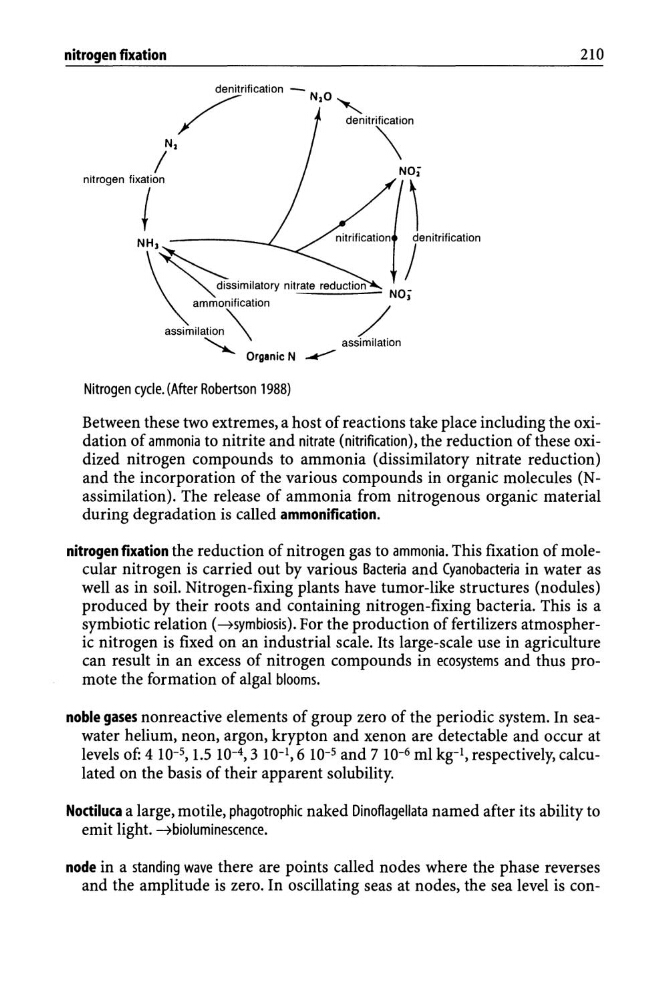
Organic N ..........Nitrogen cycle. (After Robertson 1988)
Between these two extremes, a host of reactions take place including the oxidation of ammonia to nitrite and nitrate (nitrification), the reduction of these oxidized nitrogen compounds to ammonia (dissimilatory nitrate reduction)
and the incorporation of the various compounds in organic molecules (Nassimilation). The release of ammonia from nitrogenous organic material
during degradation is called ammonification.
nitrogen fixation the reduction of nitrogen gas to ammonia. This fixation of molecular nitrogen is carried out by various Bacteria and Cyanobacteria in water as
well as in soil. Nitrogen-fixing plants have tumor-like structures (nodules)
produced by their roots and containing nitrogen-fixing bacteria. This is a
symbiotic relation (~symbiosis). For the production of fertilizers atmospheric nitrogen is fixed on an industrial scale. Its large-scale use in agriculture
can result in an excess of nitrogen compounds in ecosystems and thus promote the formation of algal blooms.
noble gases nonreactive elements of group zero of the periodic system. In seawater helium, neon, argon, krypton and xenon are detectable and occur at
levels of: 4 10-5, l.5 10-4, 3 10-1, 6 10-5 and 7 10-6 ml kg-I, respectively, calculated on the basis of their apparent solubility.
Noctiluca a large, motile, phagotrophic naked Dinoflagellata named after its ability to
emit light. ~bioluminescence.
node in a standing wave there are points called nodes where the phase reverses
and the amplitude is zero. In oscillating seas at nodes, the sea level is con-
210
denitrification - N,O,
/
denitrification
N,
\
I
NO;
nitrogen f70n
' / \
NH, ~
nitrification! ;enitrification
\ ~dissimilatOry nitrate reduction NO\ . ammonification
/
'
assimilation ' \
~
assimilation
Organic N ..........Nitrogen cycle. (After Robertson 1988)
Between these two extremes, a host of reactions take place including the oxidation of ammonia to nitrite and nitrate (nitrification), the reduction of these oxidized nitrogen compounds to ammonia (dissimilatory nitrate reduction)
and the incorporation of the various compounds in organic molecules (Nassimilation). The release of ammonia from nitrogenous organic material
during degradation is called ammonification.
nitrogen fixation the reduction of nitrogen gas to ammonia. This fixation of molecular nitrogen is carried out by various Bacteria and Cyanobacteria in water as
well as in soil. Nitrogen-fixing plants have tumor-like structures (nodules)
produced by their roots and containing nitrogen-fixing bacteria. This is a
symbiotic relation (~symbiosis). For the production of fertilizers atmospheric nitrogen is fixed on an industrial scale. Its large-scale use in agriculture
can result in an excess of nitrogen compounds in ecosystems and thus promote the formation of algal blooms.
noble gases nonreactive elements of group zero of the periodic system. In seawater helium, neon, argon, krypton and xenon are detectable and occur at
levels of: 4 10-5, l.5 10-4, 3 10-1, 6 10-5 and 7 10-6 ml kg-I, respectively, calculated on the basis of their apparent solubility.
Noctiluca a large, motile, phagotrophic naked Dinoflagellata named after its ability to
emit light. ~bioluminescence.
node in a standing wave there are points called nodes where the phase reverses
and the amplitude is zero. In oscillating seas at nodes, the sea level is con-