

175
lateral line system
this phenomenon around 1930. It consists of alternate left- and right-handrotating helical roll vortices more or less aligned in the direction of the
wind. This gives a succession of horizontal zones of confluence and diffluence that become visible because at the surface confluence zone drifting
material (Sargassum weed, oil, foam) is collected. The row spacing ranges
from some meters to hundreds of meters. The cause of this circulation pattern is not yet fully clear.
Langmuir isotherm ~Freundlich and Langmuir isotherms.
lantern of Aristotle ~Echinoidea.
larva juvenile form during animal development, differing in shape and appearance from the adult. Larvae undergo metamorphosis before they reach the
adult form.
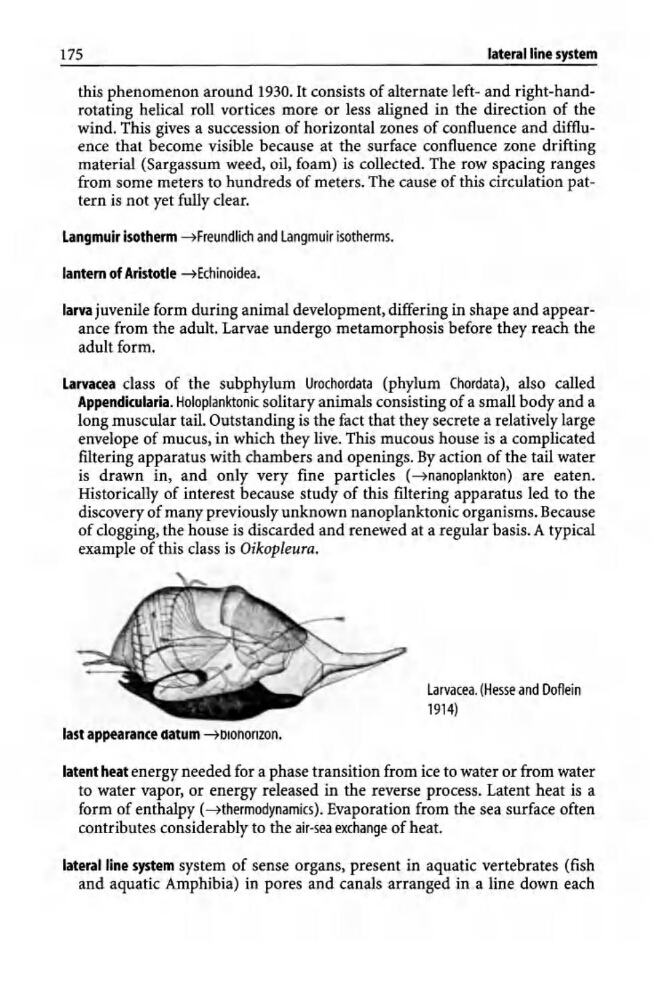
Larvacea class of the subphylum Urochordata (phylum Chordata), also called
Appendicularia. Holoplanktonic solitary animals consisting of a small body and a
long muscular tail. Outstanding is the fact that they secrete a relatively large
envelope of mucus, in which they live. This mucous house is a complicated
filtering apparatus with chambers and openings. By action of the tail water
is drawn in, and only very fine particles (~nanoplankton) are eaten.
Historically of interest because study of this filtering apparatus led to the
discovery of many previously unknown nanoplanktonic organisms. Because
of clogging, the house is discarded and renewed at a regular basis. A typical
example of this class is Oikopleura.
last appearance datum ~Dlononzon.
Larvacea. (Hesse and Doflein
1914)
latent heat energy needed for a phase transition from ice to water or from water
to water vapor, or energy released in the reverse process. Latent heat is a
form of enthalpy (~thermodynamics). Evaporation from the sea surface often
contributes considerably to the air-sea exchange of heat.
lateral line system system of sense organs, present in aquatic vertebrates (fish
and aquatic Amphibia) in pores and canals arranged in a line down each
lateral line system
this phenomenon around 1930. It consists of alternate left- and right-handrotating helical roll vortices more or less aligned in the direction of the
wind. This gives a succession of horizontal zones of confluence and diffluence that become visible because at the surface confluence zone drifting
material (Sargassum weed, oil, foam) is collected. The row spacing ranges
from some meters to hundreds of meters. The cause of this circulation pattern is not yet fully clear.
Langmuir isotherm ~Freundlich and Langmuir isotherms.
lantern of Aristotle ~Echinoidea.
larva juvenile form during animal development, differing in shape and appearance from the adult. Larvae undergo metamorphosis before they reach the
adult form.
Larvacea class of the subphylum Urochordata (phylum Chordata), also called
Appendicularia. Holoplanktonic solitary animals consisting of a small body and a
long muscular tail. Outstanding is the fact that they secrete a relatively large
envelope of mucus, in which they live. This mucous house is a complicated
filtering apparatus with chambers and openings. By action of the tail water
is drawn in, and only very fine particles (~nanoplankton) are eaten.
Historically of interest because study of this filtering apparatus led to the
discovery of many previously unknown nanoplanktonic organisms. Because
of clogging, the house is discarded and renewed at a regular basis. A typical
example of this class is Oikopleura.
last appearance datum ~Dlononzon.
Larvacea. (Hesse and Doflein
1914)
latent heat energy needed for a phase transition from ice to water or from water
to water vapor, or energy released in the reverse process. Latent heat is a
form of enthalpy (~thermodynamics). Evaporation from the sea surface often
contributes considerably to the air-sea exchange of heat.
lateral line system system of sense organs, present in aquatic vertebrates (fish
and aquatic Amphibia) in pores and canals arranged in a line down each