

163
30
to
dbor
~~------------------------~
interspecies hydrogen transfer
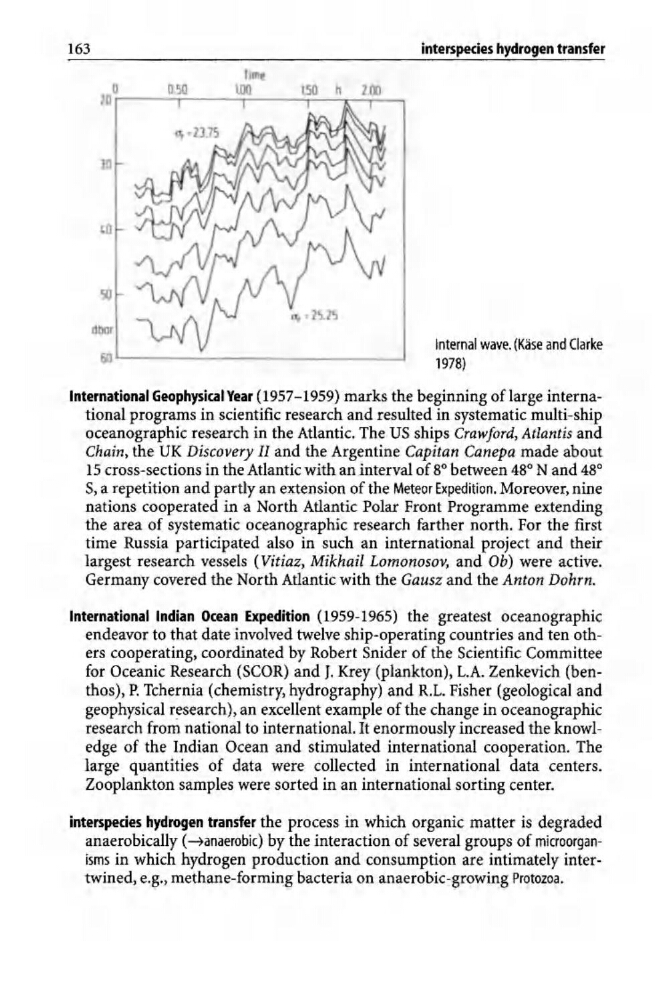
Internal wave. (Kase and Clarke
1978)
International Geophysical Year (1957 -1959) marks the beginning of large international programs in scientific research and resulted in systematic multi-ship
oceanographic research in the Atlantic. The US ships Crawford, Atlantis and
Chain, the UK Discovery II and the Argentine Capitan Canepa made about
15 cross-sections in the Atlantic with an interval of 8° between 48° Nand 48°
S, a repetition and partly an extension of the Meteor Expedition. Moreover, nine
nations cooperated in a North Atlantic Polar Front Programme extending
the area of systematic oceanographic research farther north. For the first
time Russia participated also in such an international project and their
largest research vessels (Vitiaz, Mikhail Lomonosov, and Db) were active.
Germany covered the North Atlantic with the Gausz and the Anton Dohrn.
International Indian Ocean Expedition (1959-1965) the greatest oceanographic
endeavor to that date involved twelve ship-operating countries and ten others cooperating, coordinated by Robert Snider of the Scientific Committee
for Oceanic Research (SCOR) and J. Krey (plankton), L.A. Zenkevich (benthos), P. Tchernia (chemistry, hydrography) and R.L. Fisher (geological and
geophysical research), an excellent example of the change in oceanographic
research from national to international. It enormously increased the knowledge of the Indian Ocean and stimulated international cooperation. The
large quantities of data were collected in international data centers.
Zooplankton samples were sorted in an international sorting center.
interspecies hydrogen transfer the process in which organic matter is degraded
anaerobically (~anaerobic) by the interaction of several groups of microorganisms in which hydrogen production and consumption are intimately intertwined, e.g., methane-forming bacteria on anaerobic-growing Protozoa.
30
to
dbor
~~------------------------~
interspecies hydrogen transfer
Internal wave. (Kase and Clarke
1978)
International Geophysical Year (1957 -1959) marks the beginning of large international programs in scientific research and resulted in systematic multi-ship
oceanographic research in the Atlantic. The US ships Crawford, Atlantis and
Chain, the UK Discovery II and the Argentine Capitan Canepa made about
15 cross-sections in the Atlantic with an interval of 8° between 48° Nand 48°
S, a repetition and partly an extension of the Meteor Expedition. Moreover, nine
nations cooperated in a North Atlantic Polar Front Programme extending
the area of systematic oceanographic research farther north. For the first
time Russia participated also in such an international project and their
largest research vessels (Vitiaz, Mikhail Lomonosov, and Db) were active.
Germany covered the North Atlantic with the Gausz and the Anton Dohrn.
International Indian Ocean Expedition (1959-1965) the greatest oceanographic
endeavor to that date involved twelve ship-operating countries and ten others cooperating, coordinated by Robert Snider of the Scientific Committee
for Oceanic Research (SCOR) and J. Krey (plankton), L.A. Zenkevich (benthos), P. Tchernia (chemistry, hydrography) and R.L. Fisher (geological and
geophysical research), an excellent example of the change in oceanographic
research from national to international. It enormously increased the knowledge of the Indian Ocean and stimulated international cooperation. The
large quantities of data were collected in international data centers.
Zooplankton samples were sorted in an international sorting center.
interspecies hydrogen transfer the process in which organic matter is degraded
anaerobically (~anaerobic) by the interaction of several groups of microorganisms in which hydrogen production and consumption are intimately intertwined, e.g., methane-forming bacteria on anaerobic-growing Protozoa.