

hydrothermal vent (hot spring)
156
hydrothermal vent (or hot spring) site where hot water is ejected. Hydrothermal
vents occur both on land and at the sea floor. The existence of such submarine vents had been postulated in the late 1960s. Percolation of seawater
through the oceanic lithosphere upon its emanation along the axes of mid-ocean
ridges was supposed to account for its observed rapid cooling. In the late
1970s the tracing of ambient seawater anomalies (notably for helium isotopes,
temperature and manganese concentration), combined with deep dives of
R.Y. submarine Alvin (Woods Hole Oceanographic Institution), led to the
discovery of several active vent sites in the Pacific Ocean, later followed by
vents discovered on the Mid-Atlantic Ridge in the mid 1980s. The emanating vent water has temperatures up to about 350°C, and a chemical composition very different from normal seawater. Biological communities living
around the vent sites are unique (--Westimentifera, --7Archaebacteria), not only
because of several new species found, but mostly because they are ultimately driven by geothermal rather than solar energy.
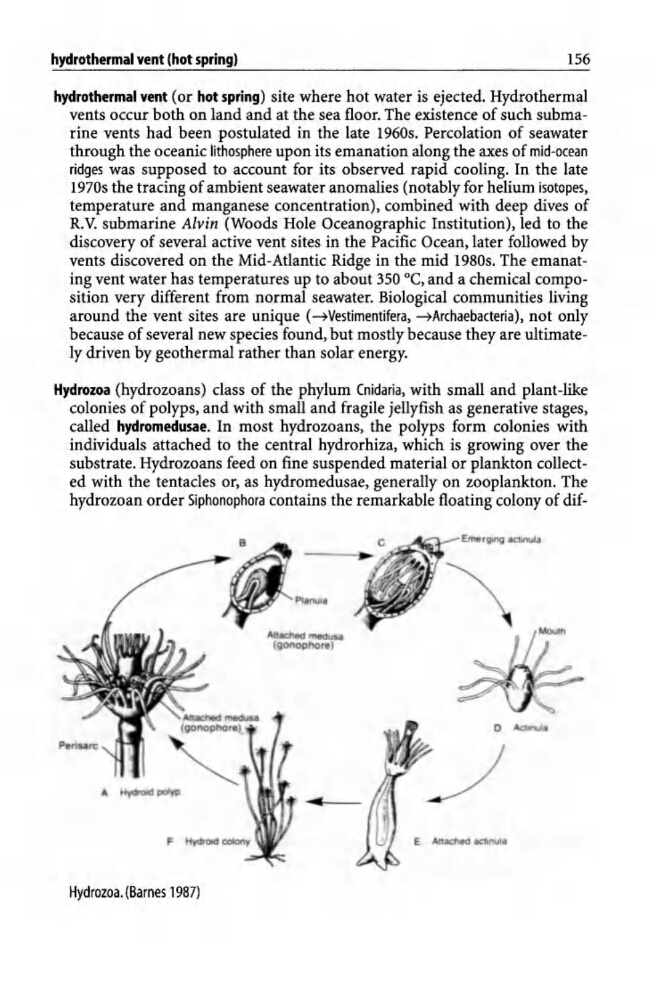
Hydrozoa (hydrozoans) class of the phylum Cnidaria, with small and plant-like
colonies of polyps, and with small and fragile jellyfish as generative stages,
called hydromedusae. In most hydrozoans, the polyps form colonies with
individuals attached to the central hydrorhiza, which is growing over the
substrate. Hydrozoans feed on fine suspended material or plankton collected with the tentacles or, as hydromedusae, generally on zooplankton. The
hydrozoan order Siphonophora contains the remarkable floating colony of difHydrozoa. (Barnes 1987)
156
hydrothermal vent (or hot spring) site where hot water is ejected. Hydrothermal
vents occur both on land and at the sea floor. The existence of such submarine vents had been postulated in the late 1960s. Percolation of seawater
through the oceanic lithosphere upon its emanation along the axes of mid-ocean
ridges was supposed to account for its observed rapid cooling. In the late
1970s the tracing of ambient seawater anomalies (notably for helium isotopes,
temperature and manganese concentration), combined with deep dives of
R.Y. submarine Alvin (Woods Hole Oceanographic Institution), led to the
discovery of several active vent sites in the Pacific Ocean, later followed by
vents discovered on the Mid-Atlantic Ridge in the mid 1980s. The emanating vent water has temperatures up to about 350°C, and a chemical composition very different from normal seawater. Biological communities living
around the vent sites are unique (--Westimentifera, --7Archaebacteria), not only
because of several new species found, but mostly because they are ultimately driven by geothermal rather than solar energy.
Hydrozoa (hydrozoans) class of the phylum Cnidaria, with small and plant-like
colonies of polyps, and with small and fragile jellyfish as generative stages,
called hydromedusae. In most hydrozoans, the polyps form colonies with
individuals attached to the central hydrorhiza, which is growing over the
substrate. Hydrozoans feed on fine suspended material or plankton collected with the tentacles or, as hydromedusae, generally on zooplankton. The
hydrozoan order Siphonophora contains the remarkable floating colony of difHydrozoa. (Barnes 1987)