

Holocene
152
Holocene the name given to the last ten thousand years of the Quaternary.
~geological time scale.
Holocephalii ~Chondrichthyes.
holoplankton plankton with a completely pelagic life cycle. ~plankton .
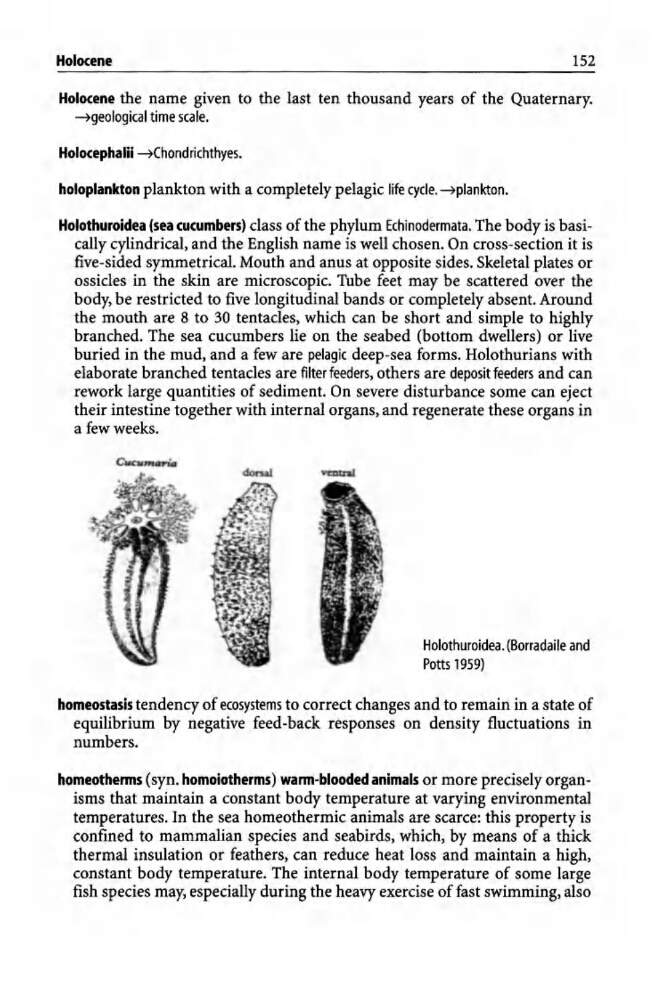
Holothuroidea (sea cucumbers) class of the phylum Echinodermata. The body is basically cylindrical, and the English name is well chosen. On cross-section it is
five-sided symmetrical. Mouth and anus at opposite sides. Skeletal plates or
ossicles in the skin are microscopic. Tube feet may be scattered over the
body, be restricted to five longitudinal bands or completely absent. Around
the mouth are 8 to 30 tentacles, which can be short and simple to highly
branched. The sea cucumbers lie on the seabed (bottom dwellers) or live
buried in the mud, and a few are pelagic deep-sea forms. Holothurians with
elaborate branched tentacles are filter feeders, others are deposit feeders and can
rework large quantities of sediment. On severe disturbance some can eject
their intestine together with internal organs, and regenerate these organs in
a few weeks.
Holothuroidea. (Borradaile and
Potts 1959)
homeostasis tendency of ecosystems to correct changes and to remain in a state of
equilibrium by negative feed-back responses on density fluctuations in
numbers.
homeotherms (syn. homoiotherms) warm-blooded animals or more precisely organisms that maintain a constant body temperature at varying environmental
temperatures. In the sea homeothermic animals are scarce: this property is
confined to mammalian species and seabirds, which, by means of a thick
thermal insulation or feathers, can reduce heat loss and maintain a high,
constant body temperature. The internal body temperature of some large
fish species may, especially during the heavy exercise of fast swimming, also
152
Holocene the name given to the last ten thousand years of the Quaternary.
~geological time scale.
Holocephalii ~Chondrichthyes.
holoplankton plankton with a completely pelagic life cycle. ~plankton .
Holothuroidea (sea cucumbers) class of the phylum Echinodermata. The body is basically cylindrical, and the English name is well chosen. On cross-section it is
five-sided symmetrical. Mouth and anus at opposite sides. Skeletal plates or
ossicles in the skin are microscopic. Tube feet may be scattered over the
body, be restricted to five longitudinal bands or completely absent. Around
the mouth are 8 to 30 tentacles, which can be short and simple to highly
branched. The sea cucumbers lie on the seabed (bottom dwellers) or live
buried in the mud, and a few are pelagic deep-sea forms. Holothurians with
elaborate branched tentacles are filter feeders, others are deposit feeders and can
rework large quantities of sediment. On severe disturbance some can eject
their intestine together with internal organs, and regenerate these organs in
a few weeks.
Holothuroidea. (Borradaile and
Potts 1959)
homeostasis tendency of ecosystems to correct changes and to remain in a state of
equilibrium by negative feed-back responses on density fluctuations in
numbers.
homeotherms (syn. homoiotherms) warm-blooded animals or more precisely organisms that maintain a constant body temperature at varying environmental
temperatures. In the sea homeothermic animals are scarce: this property is
confined to mammalian species and seabirds, which, by means of a thick
thermal insulation or feathers, can reduce heat loss and maintain a high,
constant body temperature. The internal body temperature of some large
fish species may, especially during the heavy exercise of fast swimming, also