

139
GEOSECS
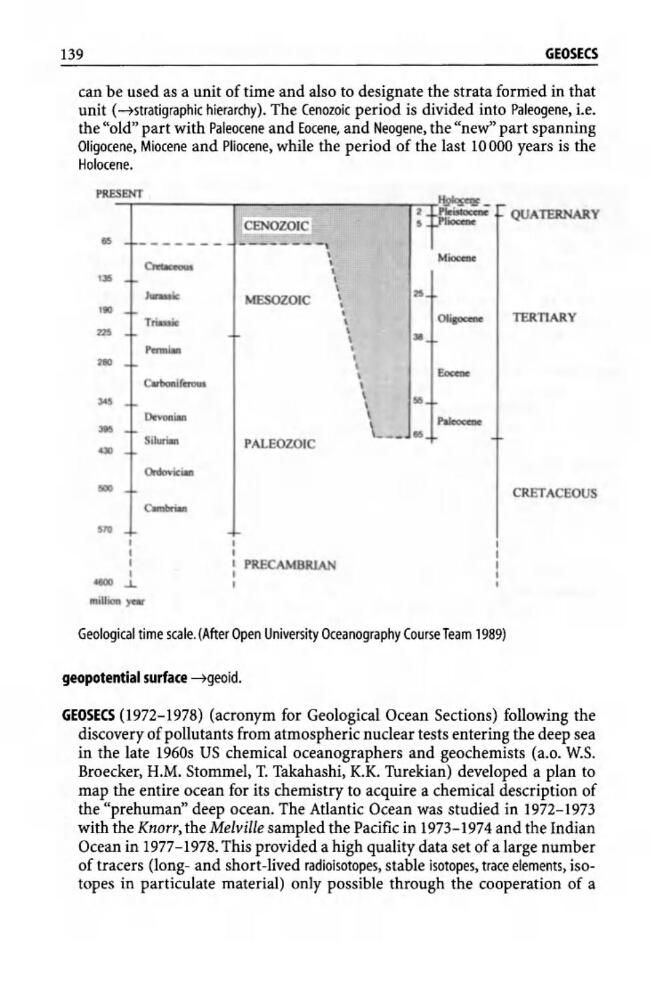
can be used as a unit of time and also to designate the strata formed in that
unit (~stratigraphic hierarchy). The Cenozoic period is divided into Paleogene, i.e.
the "old" part with Paleocene and Eocene, and Neogene, the "new" part spanning
Oligocene, Miocene and Pliocene, while the period of the last 10 000 years is the
Holocene.
PRESENT
65
.35
'80
225
28D
W
3116
0130
I
ere-..
JurMllc
Triassic
Permian
Carbon_
Devonian
SHurion
OnIoyklan
miUion yar
~2
I'IcisIDcmo
OZOIC
5
PIloome
---- \
M:_
,
t
I
I
25
MESOZOIC
\
. ,
\
0Iia<>
\ ,
I
-
I
\
!iii
~
85
PALEOZOI
PRE AMBRlAN
Geological time scale. (After Open University Oceanography Course Team 1989)
geopotential surface ~geoid .
QUATERNARY
TERTIARY
CRETACEOU
GEOSECS (1972-1978) (acronym for Geological Ocean Sections) following the
discovery of pollutants from atmospheric nuclear tests entering the deep sea
in the late 1960s US chemical oceanographers and geochemists (a.o. W.S.
Broecker, H.M. Stommel, T. Takahashi, K.K. Turekian) developed a plan to
map the entire ocean for its chemistry to acquire a chemical description of
the "prehuman" deep ocean. The Atlantic Ocean was studied in 1972-1973
with the Knorr, the Melville sampled the Pacific in 1973-1974 and the Indian
Ocean in 1977-1978. This provided a high quality data set of a large number
of tracers (long- and short-lived radioisotopes, stable isotopes, trace elements, isotopes in particulate material) only possible through the cooperation of a
GEOSECS
can be used as a unit of time and also to designate the strata formed in that
unit (~stratigraphic hierarchy). The Cenozoic period is divided into Paleogene, i.e.
the "old" part with Paleocene and Eocene, and Neogene, the "new" part spanning
Oligocene, Miocene and Pliocene, while the period of the last 10 000 years is the
Holocene.
PRESENT
65
.35
'80
225
28D
W
3116
0130
I
ere-..
JurMllc
Triassic
Permian
Carbon_
Devonian
SHurion
OnIoyklan
miUion yar
~2
I'IcisIDcmo
OZOIC
5
PIloome
---- \
M:_
,
t
I
I
25
MESOZOIC
\
. ,
\
0Iia<>
\ ,
I
-
I
\
!iii
~
85
PALEOZOI
PRE AMBRlAN
Geological time scale. (After Open University Oceanography Course Team 1989)
geopotential surface ~geoid .
QUATERNARY
TERTIARY
CRETACEOU
GEOSECS (1972-1978) (acronym for Geological Ocean Sections) following the
discovery of pollutants from atmospheric nuclear tests entering the deep sea
in the late 1960s US chemical oceanographers and geochemists (a.o. W.S.
Broecker, H.M. Stommel, T. Takahashi, K.K. Turekian) developed a plan to
map the entire ocean for its chemistry to acquire a chemical description of
the "prehuman" deep ocean. The Atlantic Ocean was studied in 1972-1973
with the Knorr, the Melville sampled the Pacific in 1973-1974 and the Indian
Ocean in 1977-1978. This provided a high quality data set of a large number
of tracers (long- and short-lived radioisotopes, stable isotopes, trace elements, isotopes in particulate material) only possible through the cooperation of a