

137
Gazelle Expedition
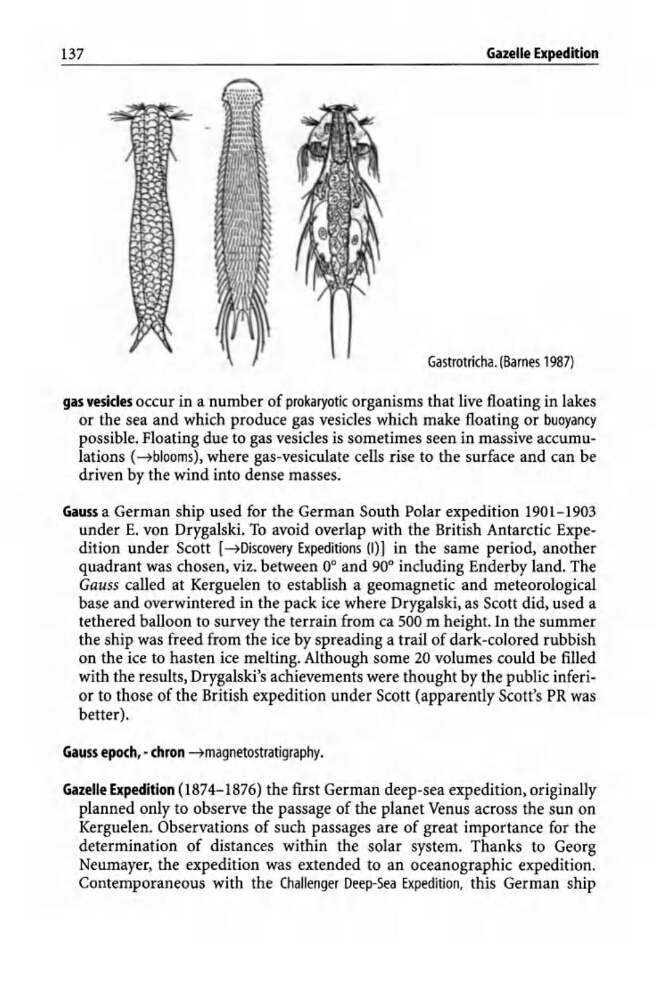
Gastrotricha. (Barnes 1987)
gas vesicles occur in a number of prokaryotic organisms that live floating in lakes
or the sea and which produce gas vesicles which make floating or buoyancy
possible. Floating due to gas vesicles is sometimes seen in massive accumulations (~blooms), where gas-vesiculate cells rise to the surface and can be
driven by the wind into dense masses.
Gauss a German ship used for the German South Polar expedition 1901-1903
under E. von Drygalski. To avoid overlap with the British Antarctic Expedition under Scott [~Discovery Expeditions (I) I in the same period, another
quadrant was chosen, viz. between 0° and 90° including Enderby land. The
Gauss called at Kerguelen to establish a geomagnetic and meteorological
base and overwintered in the pack ice where Drygalski, as Scott did, used a
tethered balloon to survey the terrain from ca 500 m height. In the summer
the ship was freed from the ice by spreading a trail of dark-colored rubbish
on the ice to hasten ice melting. Although some 20 volumes could be filled
with the results, Drygalski's achievements were thought by the public inferior to those of the British expedition under Scott (apparently Scott's PR was
better).
Gauss epoch, - chron ~magnetostratigraphy.
Gazelle Expedition (1874-1876) the first German deep-sea expedition, originally
planned only to observe the passage of the planet Venus across the sun on
Kerguelen. Observations of such passages are of great importance for the
determination of distances within the solar system. Thanks to Georg
Neumayer, the expedition was extended to an oceanographic expedition.
Contemporaneous with the Challenger Deep-Sea Expedition, this German ship
Gazelle Expedition
Gastrotricha. (Barnes 1987)
gas vesicles occur in a number of prokaryotic organisms that live floating in lakes
or the sea and which produce gas vesicles which make floating or buoyancy
possible. Floating due to gas vesicles is sometimes seen in massive accumulations (~blooms), where gas-vesiculate cells rise to the surface and can be
driven by the wind into dense masses.
Gauss a German ship used for the German South Polar expedition 1901-1903
under E. von Drygalski. To avoid overlap with the British Antarctic Expedition under Scott [~Discovery Expeditions (I) I in the same period, another
quadrant was chosen, viz. between 0° and 90° including Enderby land. The
Gauss called at Kerguelen to establish a geomagnetic and meteorological
base and overwintered in the pack ice where Drygalski, as Scott did, used a
tethered balloon to survey the terrain from ca 500 m height. In the summer
the ship was freed from the ice by spreading a trail of dark-colored rubbish
on the ice to hasten ice melting. Although some 20 volumes could be filled
with the results, Drygalski's achievements were thought by the public inferior to those of the British expedition under Scott (apparently Scott's PR was
better).
Gauss epoch, - chron ~magnetostratigraphy.
Gazelle Expedition (1874-1876) the first German deep-sea expedition, originally
planned only to observe the passage of the planet Venus across the sun on
Kerguelen. Observations of such passages are of great importance for the
determination of distances within the solar system. Thanks to Georg
Neumayer, the expedition was extended to an oceanographic expedition.
Contemporaneous with the Challenger Deep-Sea Expedition, this German ship