

euphotic zone
116
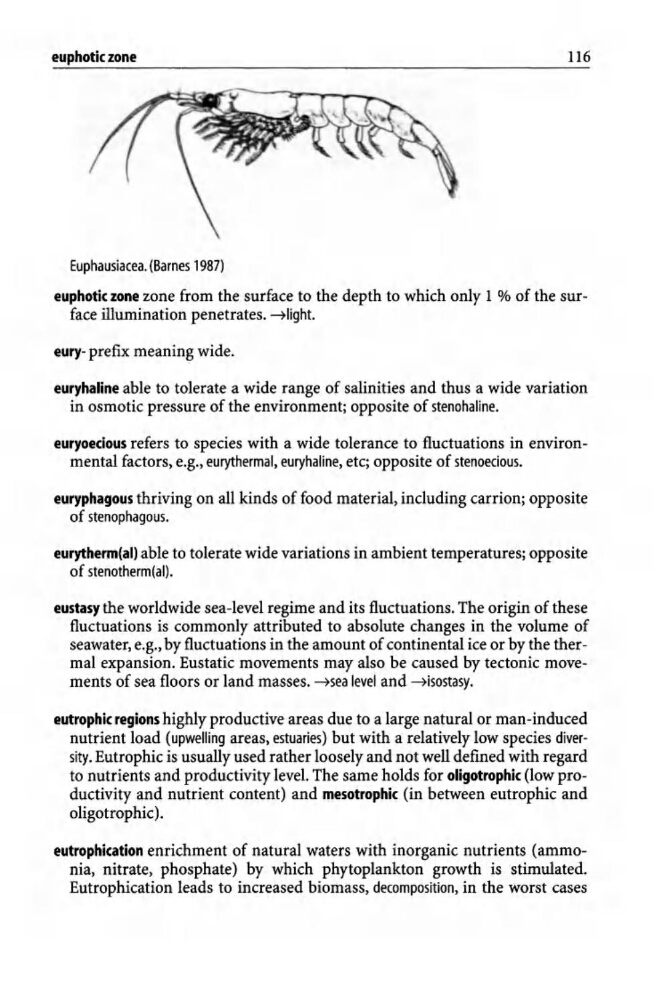
Euphausiacea. (Barnes 1987)
euphotic zone zone from the surface to the depth to which only 1 % of the surface illumination penetrates. ~light.
eury- prefix meaning wide.
euryhaline able to tolerate a wide range of salinities and thus a wide variation
in osmotic pressure of the environment; opposite of stenohaline.
euryoecious refers to species with a wide tolerance to fluctuations in environmental factors, e.g., eurythermal, euryhaline, etc; opposite of stenoecious.
euryphagous thriving on all kinds of food material, including carrion; opposite
of stenophagous.
eurytherm{al) able to tolerate wide variations in ambient temperatures; opposite
of stenotherm{al).
eustasy the worldwide sea-level regime and its fluctuations. The origin of these
fluctuations is commonly attributed to absolute changes in the volume of
seawater, e.g., by fluctuations in the amount of continental ice or by the thermal expansion. Eustatic movements may also be caused by tectonic movements of sea floors or land masses. ~sea level and ~isostasy.
eutrophic regions highly productive areas due to a large natural or man-induced
nutrient load (upwelling areas, estuaries) but with a relatively low species diversity. Eutrophic is usually used rather loosely and not well defined with regard
to nutrients and productivity level. The same holds for oligotrophic (low productivity and nutrient content) and mesotrophic (in between eutrophic and
oligotrophic).
eutrophication enrichment of natural waters with inorganic nutrients (ammonia, nitrate, phosphate) by which phytoplankton growth is stimulated.
Eutrophication leads to increased biomass, decomposition, in the worst cases
116
Euphausiacea. (Barnes 1987)
euphotic zone zone from the surface to the depth to which only 1 % of the surface illumination penetrates. ~light.
eury- prefix meaning wide.
euryhaline able to tolerate a wide range of salinities and thus a wide variation
in osmotic pressure of the environment; opposite of stenohaline.
euryoecious refers to species with a wide tolerance to fluctuations in environmental factors, e.g., eurythermal, euryhaline, etc; opposite of stenoecious.
euryphagous thriving on all kinds of food material, including carrion; opposite
of stenophagous.
eurytherm{al) able to tolerate wide variations in ambient temperatures; opposite
of stenotherm{al).
eustasy the worldwide sea-level regime and its fluctuations. The origin of these
fluctuations is commonly attributed to absolute changes in the volume of
seawater, e.g., by fluctuations in the amount of continental ice or by the thermal expansion. Eustatic movements may also be caused by tectonic movements of sea floors or land masses. ~sea level and ~isostasy.
eutrophic regions highly productive areas due to a large natural or man-induced
nutrient load (upwelling areas, estuaries) but with a relatively low species diversity. Eutrophic is usually used rather loosely and not well defined with regard
to nutrients and productivity level. The same holds for oligotrophic (low productivity and nutrient content) and mesotrophic (in between eutrophic and
oligotrophic).
eutrophication enrichment of natural waters with inorganic nutrients (ammonia, nitrate, phosphate) by which phytoplankton growth is stimulated.
Eutrophication leads to increased biomass, decomposition, in the worst cases