

eu114
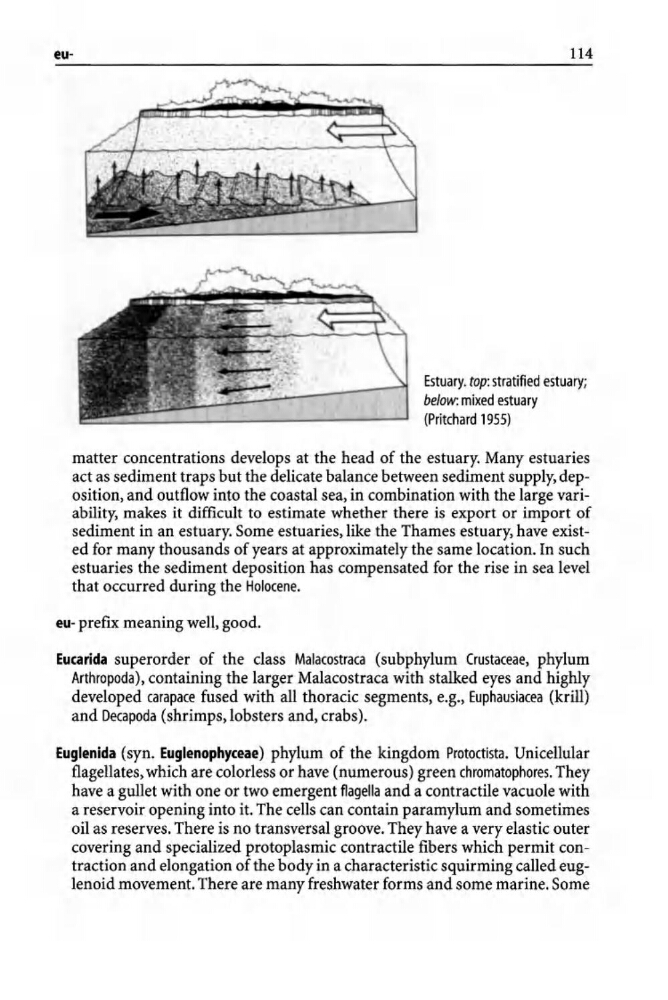
Estuary. top: stratified estuary;
below: mixed estuary
(Pritchard 1955)
matter concentrations develops at the head of the estuary. Many estuaries
act as sediment traps but the delicate balance between sediment supply, deposition, and outflow into the coastal sea, in combination with the large variability, makes it difficult to estimate whether there is export or import of
sediment in an estuary. Some estuaries, like the Thames estuary, have existed for many thousands of years at approximately the same location. In such
estuaries the sediment deposition has compensated for the rise in sea level
that occurred during the Holocene.
eu- prefIx meaning well, good.
Eucarida superorder of the class Malacostraca (subphylum Crustaceae, phylum
Arthropoda), containing the larger Malacostraca with stalked eyes and highly
developed carapace fused with all thoracic segments, e.g., Euphausiacea (krill)
and Decapoda (shrimps, lobsters and, crabs).
Euglenida (syn. Euglenophyceae) phylum of the kingdom Protoctista. Unicellular
flagellates, which are colorless or have (numerous) green chromatophores. They
have a gullet with one or two emergent flagella and a contractile vacuole with
a reservoir opening into it. The cells can contain paramylum and sometimes
oil as reserves. There is no transversal groove. They have a very elastic outer
covering and specialized protoplasmic contractile fIbers which permit contraction and elongation of the body in a characteristic squirming called euglenoid movement. There are many freshwater forms and some marine. Some
Estuary. top: stratified estuary;
below: mixed estuary
(Pritchard 1955)
matter concentrations develops at the head of the estuary. Many estuaries
act as sediment traps but the delicate balance between sediment supply, deposition, and outflow into the coastal sea, in combination with the large variability, makes it difficult to estimate whether there is export or import of
sediment in an estuary. Some estuaries, like the Thames estuary, have existed for many thousands of years at approximately the same location. In such
estuaries the sediment deposition has compensated for the rise in sea level
that occurred during the Holocene.
eu- prefIx meaning well, good.
Eucarida superorder of the class Malacostraca (subphylum Crustaceae, phylum
Arthropoda), containing the larger Malacostraca with stalked eyes and highly
developed carapace fused with all thoracic segments, e.g., Euphausiacea (krill)
and Decapoda (shrimps, lobsters and, crabs).
Euglenida (syn. Euglenophyceae) phylum of the kingdom Protoctista. Unicellular
flagellates, which are colorless or have (numerous) green chromatophores. They
have a gullet with one or two emergent flagella and a contractile vacuole with
a reservoir opening into it. The cells can contain paramylum and sometimes
oil as reserves. There is no transversal groove. They have a very elastic outer
covering and specialized protoplasmic contractile fIbers which permit contraction and elongation of the body in a characteristic squirming called euglenoid movement. There are many freshwater forms and some marine. Some