

ecotypes
106
ring in enhanced concentrations and physical agents introduced into the
environment by human activities. Effects on living organisms are studied,
especially on populations and communities within defined ecosystems;
studies include the transfer pathways of those agents and their interactions
with the environment.
ecotypes morphological and/or physiological variants of a species that occur
and survive as a distinct group in a specific kind of habitat. These variants
may be genetic races or merely physiological acclimation.
ectoderm the outermost tissue layer of an animal embryo, developing mainly
into epidermis, nervous tissue and nephridia (when present). All the tissues at
later stages derived from this embryonic layer are ectodermal.
ectoparasites ~parasites.
Ectoprocta ~Bryozoa.
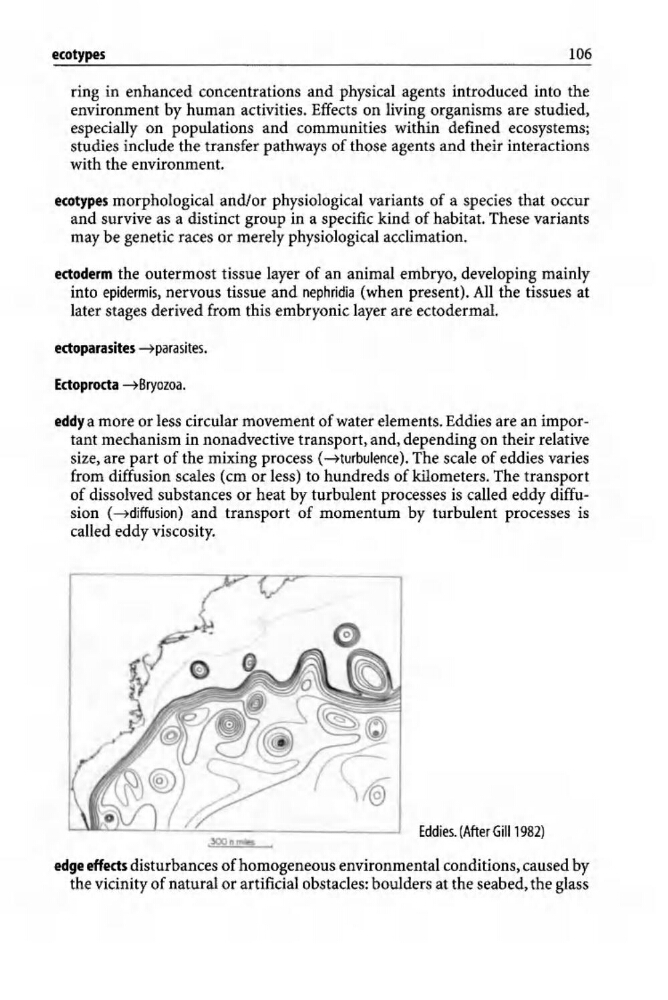
eddy a more or less circular movement of water elements. Eddies are an important mechanism in nonadvective transport, and, depending on their relative
size, are part of the mixing process (~turbulence). The scale of eddies varies
from diffusion scales (cm or less) to hundreds of kilometers. The transport
of dissolved substances or heat by turbulent processes is called eddy diffusion (~diffusion) and transport of momentum by turbulent processes is
called eddy viscosity.
Eddies. (After Gill 1982)
edge effects disturbances of homogeneous environmental conditions, caused by
the vicinity of natural or artificial obstacles: boulders at the seabed, the glass
106
ring in enhanced concentrations and physical agents introduced into the
environment by human activities. Effects on living organisms are studied,
especially on populations and communities within defined ecosystems;
studies include the transfer pathways of those agents and their interactions
with the environment.
ecotypes morphological and/or physiological variants of a species that occur
and survive as a distinct group in a specific kind of habitat. These variants
may be genetic races or merely physiological acclimation.
ectoderm the outermost tissue layer of an animal embryo, developing mainly
into epidermis, nervous tissue and nephridia (when present). All the tissues at
later stages derived from this embryonic layer are ectodermal.
ectoparasites ~parasites.
Ectoprocta ~Bryozoa.
eddy a more or less circular movement of water elements. Eddies are an important mechanism in nonadvective transport, and, depending on their relative
size, are part of the mixing process (~turbulence). The scale of eddies varies
from diffusion scales (cm or less) to hundreds of kilometers. The transport
of dissolved substances or heat by turbulent processes is called eddy diffusion (~diffusion) and transport of momentum by turbulent processes is
called eddy viscosity.
Eddies. (After Gill 1982)
edge effects disturbances of homogeneous environmental conditions, caused by
the vicinity of natural or artificial obstacles: boulders at the seabed, the glass