

95
diurnal inequality of tides
marine environment show a contagious distribution; (2) when a large number of measurements or counts of some variable is collected, the observations can be arranged in numerical order and grouped into classes. The set
of frequencies of each class show the observed distribution along the axis of
measurement. Such a distribution can be summarized by a "measure of central tendency" like the mean, median and mode, and by a "measure of dispersion", like the standard deviation and the variance. The way in which values of a
variable are distributed can be theoretically described by a probability distribution. Commonly applied distributions are the binomial distribution,
Poisson distribution, and normal distribution. The bell-shaped normal distribution is the most widely used distribution in statistics and is completely
determined, if its parameters, the mean, and the variance are known.
distribution coefficient the empirical factor for describing the partition or sorption-desorption equilibria of dissolved and particulate substances; symbol
Ki is defined as the ratio of the concentration in particulate or solid matter,
for instance expressed in Ilg g-l, and the concentration in solution (also in
the same units). This Kd is applicable for transport-, budget- and hydrodynamic modeling, as well as for calculating apparent diffusion coefficients of
transport in bottom sediments. Sometimes Kds are expressed in the dimension ml g-l, which differs a factor equal to the solid matter density from the
dimensionless Kd factor.
diurnal referring to events that occur during daytime and to processes or
rhythms related to the diurnal rotation of the earth, more in particular to the
natural light and dark periods, either physically, like the diel temperature
cycle with heating and cooling of the surface layer at low latitudes, or physiologically, like photosynthesis in algae in the light, or behaviorally, like nocturnal feeding in animals. The latter is often coupled with diurnal vertical
migration, the ascent of zooplankton and nekton to surface water at dusk, and
descent at dawn. This is clearest in echosound recordings which occur at
deep scattering layers (DSLs) at depths of several hundred meters by day, rising
to and diffusing in the upper 100 m at night. ~diurnal tide.
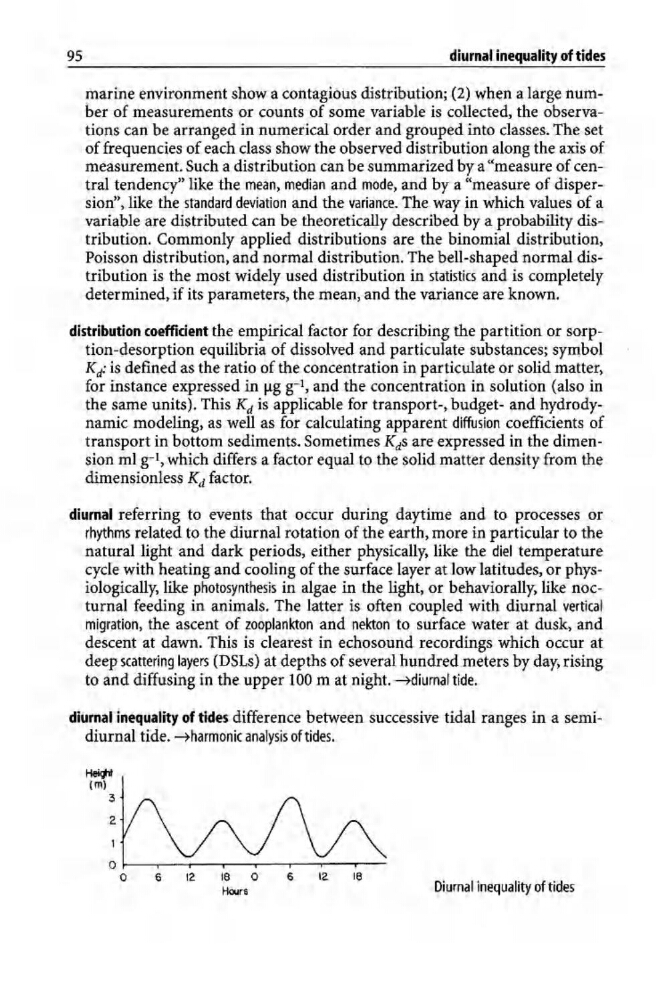
diurnal inequality of tides difference between successive tidal ranges in a semidiurnal tide. ~harmonic analysis of tides.
Height~
(m)
3
2
1
01--.------,----,--.,--...,--,....--,--o
6
12
18
0
6
12
18
Hours
Diurnal inequality oftides
diurnal inequality of tides
marine environment show a contagious distribution; (2) when a large number of measurements or counts of some variable is collected, the observations can be arranged in numerical order and grouped into classes. The set
of frequencies of each class show the observed distribution along the axis of
measurement. Such a distribution can be summarized by a "measure of central tendency" like the mean, median and mode, and by a "measure of dispersion", like the standard deviation and the variance. The way in which values of a
variable are distributed can be theoretically described by a probability distribution. Commonly applied distributions are the binomial distribution,
Poisson distribution, and normal distribution. The bell-shaped normal distribution is the most widely used distribution in statistics and is completely
determined, if its parameters, the mean, and the variance are known.
distribution coefficient the empirical factor for describing the partition or sorption-desorption equilibria of dissolved and particulate substances; symbol
Ki is defined as the ratio of the concentration in particulate or solid matter,
for instance expressed in Ilg g-l, and the concentration in solution (also in
the same units). This Kd is applicable for transport-, budget- and hydrodynamic modeling, as well as for calculating apparent diffusion coefficients of
transport in bottom sediments. Sometimes Kds are expressed in the dimension ml g-l, which differs a factor equal to the solid matter density from the
dimensionless Kd factor.
diurnal referring to events that occur during daytime and to processes or
rhythms related to the diurnal rotation of the earth, more in particular to the
natural light and dark periods, either physically, like the diel temperature
cycle with heating and cooling of the surface layer at low latitudes, or physiologically, like photosynthesis in algae in the light, or behaviorally, like nocturnal feeding in animals. The latter is often coupled with diurnal vertical
migration, the ascent of zooplankton and nekton to surface water at dusk, and
descent at dawn. This is clearest in echosound recordings which occur at
deep scattering layers (DSLs) at depths of several hundred meters by day, rising
to and diffusing in the upper 100 m at night. ~diurnal tide.
diurnal inequality of tides difference between successive tidal ranges in a semidiurnal tide. ~harmonic analysis of tides.
Height~
(m)
3
2
1
01--.------,----,--.,--...,--,....--,--o
6
12
18
0
6
12
18
Hours
Diurnal inequality oftides