

HI. Sediment Transport
73
The reference concentration is determined from the bed load transport, assuming
a bed load layer thickness equal to 2 particle diameters. The Ii and I2 -integrals
can be determined graphically (cf. Einstein, 1950) or numerically.
The method of Einstein is not given in full detail here, because of its complexity.
Furthermore, an extensive verification study" of White et al. (1973) has shown
that the predicting ability of the Einstein method is much less than other (and
simpler) methods.
2.9 Prediction Method of Bagnold (1966)
Bagnold (1966) introduced an energy balance concept and related the suspended
load transport to the work clone by the fluid. The suspended load transport is
expressed as :
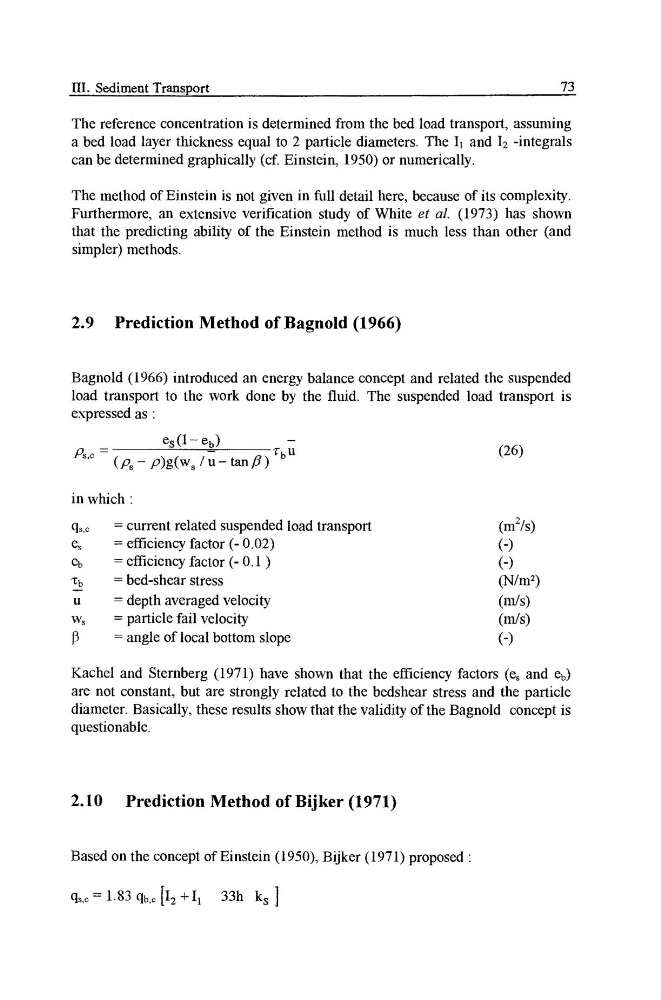
e s (1 - %)
P~'° = (p~ - p)g(w~ I u - tan/3 ) vb u
(26)
in which :
q~,o
= current related suspended load transport
(m2/s)
e~
= efficiency factor (- 0.02)
(-)
eb
= efficiency factor (- 0.1 )
(-)
Zb
= bed-shear stress
(N/m 2)
u
= depth averaged velocity
(m/s)
ws
= particle fail velocity
(m/s)
[3
= angle of local bottom slope
(-)
Kachel and Sternberg (1971) have shown that the efficiency factors (es and eb)
are not constant, but are strongly related to the bedshear stress and the particle
diameter. Basically, these results show that the validity of the Bagnold concept is
questionable.
2.10 Prediction Method of Bijker (1971)
Based on the concept of Einstein (1950), Bijker (1971) proposed :
q~,o = 1.83 qb, o [12 +I 1 33h k s ]
73
The reference concentration is determined from the bed load transport, assuming
a bed load layer thickness equal to 2 particle diameters. The Ii and I2 -integrals
can be determined graphically (cf. Einstein, 1950) or numerically.
The method of Einstein is not given in full detail here, because of its complexity.
Furthermore, an extensive verification study" of White et al. (1973) has shown
that the predicting ability of the Einstein method is much less than other (and
simpler) methods.
2.9 Prediction Method of Bagnold (1966)
Bagnold (1966) introduced an energy balance concept and related the suspended
load transport to the work clone by the fluid. The suspended load transport is
expressed as :
e s (1 - %)
P~'° = (p~ - p)g(w~ I u - tan/3 ) vb u
(26)
in which :
q~,o
= current related suspended load transport
(m2/s)
e~
= efficiency factor (- 0.02)
(-)
eb
= efficiency factor (- 0.1 )
(-)
Zb
= bed-shear stress
(N/m 2)
u
= depth averaged velocity
(m/s)
ws
= particle fail velocity
(m/s)
[3
= angle of local bottom slope
(-)
Kachel and Sternberg (1971) have shown that the efficiency factors (es and eb)
are not constant, but are strongly related to the bedshear stress and the particle
diameter. Basically, these results show that the validity of the Bagnold concept is
questionable.
2.10 Prediction Method of Bijker (1971)
Based on the concept of Einstein (1950), Bijker (1971) proposed :
q~,o = 1.83 qb, o [12 +I 1 33h k s ]