

72
R.H. Charlier and Chr: P. De Meyer
ds - l+0.011(crs-1 ) (T-25)
(22)
dso
Equation (22) has been compared with experimental data of Guy et al. (1966).
The scatter of the data is too large to detect a clear influence of the Ors- parameter,
but, in an average sense the agreement between measured and computed values
(C~s = 2.5) is quite good.
2.8.
Prediction Method of Einstein (1950)
Einstein's method is based on a parabolic distribution of the fluid mixing
coefficient and a logarithmic distribution for the velocity.
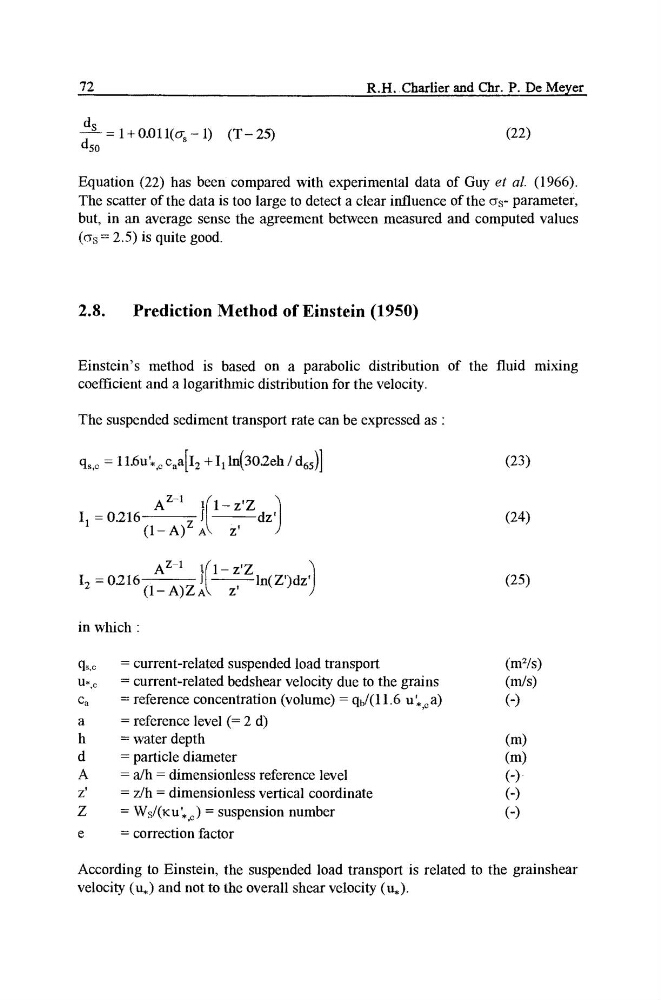
The suspended sediment transport rate can be expressed as •
qs,o =l 1.Su'. o %a[I 2 + I 1 ln(30.2eh / d65)]
(23)
A z-1 ~ll- Z'Zdz,t
11 = 0.216(1_A) ~A\
z'
7
(24)
A Z1
~(1-z'Z
, ,~
12=0216 -lt--ln(Z)dzq
(I- A)ZA\ z'
7
(25)
in which •
q~,o
= current-related suspended load transport
(mVs)
u.o
= current-related bedshear velocity due to the grains
(m/s)
ca
= reference concentration (volume) = qJ(11.6 U',o a)
(-)
a
= reference level (= 2 d)
h
= water depth
(m)
d
= particle diameter
(In)
A
= a/h = dimensionless reference level
(-)
z'
= z/h = dimensionless vertical coordinate
(-)
Z
= Ws/(~zu" o) = suspension number
(-)
e
= correction factor
According to Einstein, the suspended load transport is related to the grainshear
velocity (u.) and not to the overall shear velocity (u.).
R.H. Charlier and Chr: P. De Meyer
ds - l+0.011(crs-1 ) (T-25)
(22)
dso
Equation (22) has been compared with experimental data of Guy et al. (1966).
The scatter of the data is too large to detect a clear influence of the Ors- parameter,
but, in an average sense the agreement between measured and computed values
(C~s = 2.5) is quite good.
2.8.
Prediction Method of Einstein (1950)
Einstein's method is based on a parabolic distribution of the fluid mixing
coefficient and a logarithmic distribution for the velocity.
The suspended sediment transport rate can be expressed as •
qs,o =l 1.Su'. o %a[I 2 + I 1 ln(30.2eh / d65)]
(23)
A z-1 ~ll- Z'Zdz,t
11 = 0.216(1_A) ~A\
z'
7
(24)
A Z1
~(1-z'Z
, ,~
12=0216 -lt--ln(Z)dzq
(I- A)ZA\ z'
7
(25)
in which •
q~,o
= current-related suspended load transport
(mVs)
u.o
= current-related bedshear velocity due to the grains
(m/s)
ca
= reference concentration (volume) = qJ(11.6 U',o a)
(-)
a
= reference level (= 2 d)
h
= water depth
(m)
d
= particle diameter
(In)
A
= a/h = dimensionless reference level
(-)
z'
= z/h = dimensionless vertical coordinate
(-)
Z
= Ws/(~zu" o) = suspension number
(-)
e
= correction factor
According to Einstein, the suspended load transport is related to the grainshear
velocity (u.) and not to the overall shear velocity (u.).