

Appendices
319
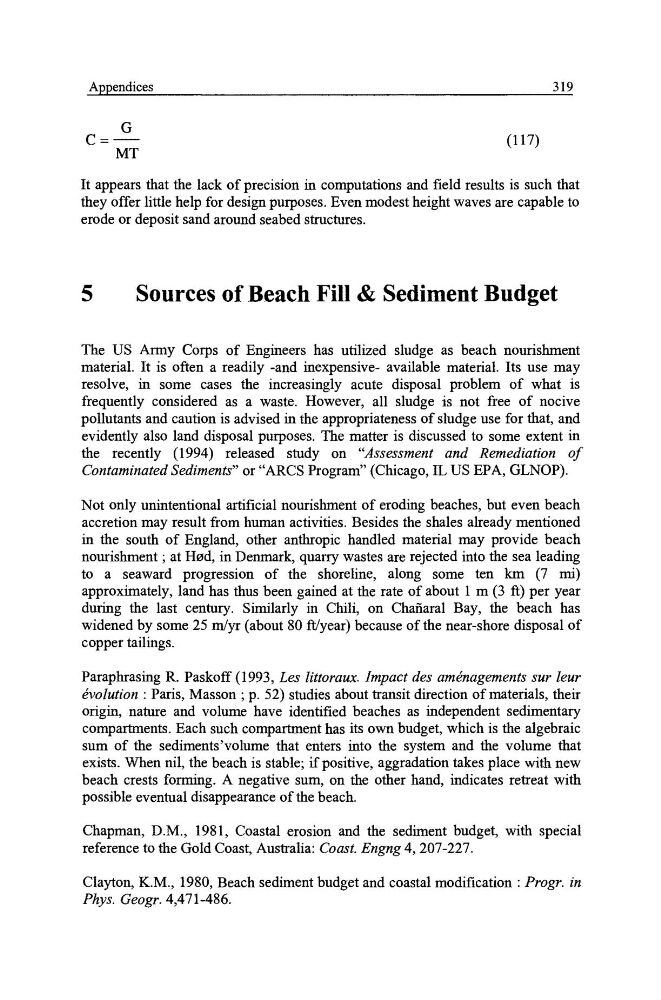
G
C -
(117)
MT
It appears that the lack of precision in computations and field results is such that
they offer little help for design purposes. Even modest height waves are capable to
erode or deposit sand around seabed structures.
5
Sources of Beach Fill & Sediment Budget
The US Army Corps of Engineers has utilized sludge as beach nourishment
material. It is often a readily -and inexpensive- available material. Its use may
resolve, in some cases the increasingly acute disposal problem of what is
frequently considered as a waste. However, all sludge is not free of nocive
pollutants and caution is advised in the appropriateness of sludge use for that, and
evidently also land disposal purposes. The matter is discussed to some extent in
the recently (1994) released study on "Assessment and Remediation of
Contaminated Sediments" or "ARCS Program" (Chicago, IL US EPA, GLNOP).
Not only unintentional artificial nourishment of eroding beaches, but even beach
accretion may result from human activities. Besides the shales already mentioned
in the south of England, other anthropic handled material may provide beach
nourishment ; at Hod, in Denmark, quarry wastes are rejected into the sea leading
to a seaward progression of the shoreline, along some ten km (7 mi)
approximately, land has thus been gained at the rate of about 1 m (3 ft) per year
during the last century. Similarly in Chili, on Chafiaral Bay, the beach has
widened by some 25 m/yr (about 80 if/year) because of the near-shore disposal of
copper tailings.
Paraphrasing R. Paskoff (1993, Les littoraux. Impact des amdnagements sur leur
dvolution : Paris, Masson ; p. 52) studies about transit direction of materials, their
origin, nature and volume have identified beaches as independent sedimentary
compartments. Each such compartment has its own budget, which is the algebraic
sum of the sediments'volume that enters into the system and the volume that
exists. When nil, the beach is stable; if positive, aggradation takes place with new
beach crests forming. A negative sum, on the other hand, indicates retreat with
possible eventual disappearance of the beach.
Chapman, D.M., 1981, Coastal erosion and the sediment budget, with special
reference to the Gold Coast, Australia: Coast. Engng 4, 207-227.
Clayton, K.M., 1980, Beach sediment budget and coastal modification : Progr. in
Phys. Geogr. 4,471-486.
319
G
C -
(117)
MT
It appears that the lack of precision in computations and field results is such that
they offer little help for design purposes. Even modest height waves are capable to
erode or deposit sand around seabed structures.
5
Sources of Beach Fill & Sediment Budget
The US Army Corps of Engineers has utilized sludge as beach nourishment
material. It is often a readily -and inexpensive- available material. Its use may
resolve, in some cases the increasingly acute disposal problem of what is
frequently considered as a waste. However, all sludge is not free of nocive
pollutants and caution is advised in the appropriateness of sludge use for that, and
evidently also land disposal purposes. The matter is discussed to some extent in
the recently (1994) released study on "Assessment and Remediation of
Contaminated Sediments" or "ARCS Program" (Chicago, IL US EPA, GLNOP).
Not only unintentional artificial nourishment of eroding beaches, but even beach
accretion may result from human activities. Besides the shales already mentioned
in the south of England, other anthropic handled material may provide beach
nourishment ; at Hod, in Denmark, quarry wastes are rejected into the sea leading
to a seaward progression of the shoreline, along some ten km (7 mi)
approximately, land has thus been gained at the rate of about 1 m (3 ft) per year
during the last century. Similarly in Chili, on Chafiaral Bay, the beach has
widened by some 25 m/yr (about 80 if/year) because of the near-shore disposal of
copper tailings.
Paraphrasing R. Paskoff (1993, Les littoraux. Impact des amdnagements sur leur
dvolution : Paris, Masson ; p. 52) studies about transit direction of materials, their
origin, nature and volume have identified beaches as independent sedimentary
compartments. Each such compartment has its own budget, which is the algebraic
sum of the sediments'volume that enters into the system and the volume that
exists. When nil, the beach is stable; if positive, aggradation takes place with new
beach crests forming. A negative sum, on the other hand, indicates retreat with
possible eventual disappearance of the beach.
Chapman, D.M., 1981, Coastal erosion and the sediment budget, with special
reference to the Gold Coast, Australia: Coast. Engng 4, 207-227.
Clayton, K.M., 1980, Beach sediment budget and coastal modification : Progr. in
Phys. Geogr. 4,471-486.