

318
R.H. Charlier and Chr. P. De Meyer
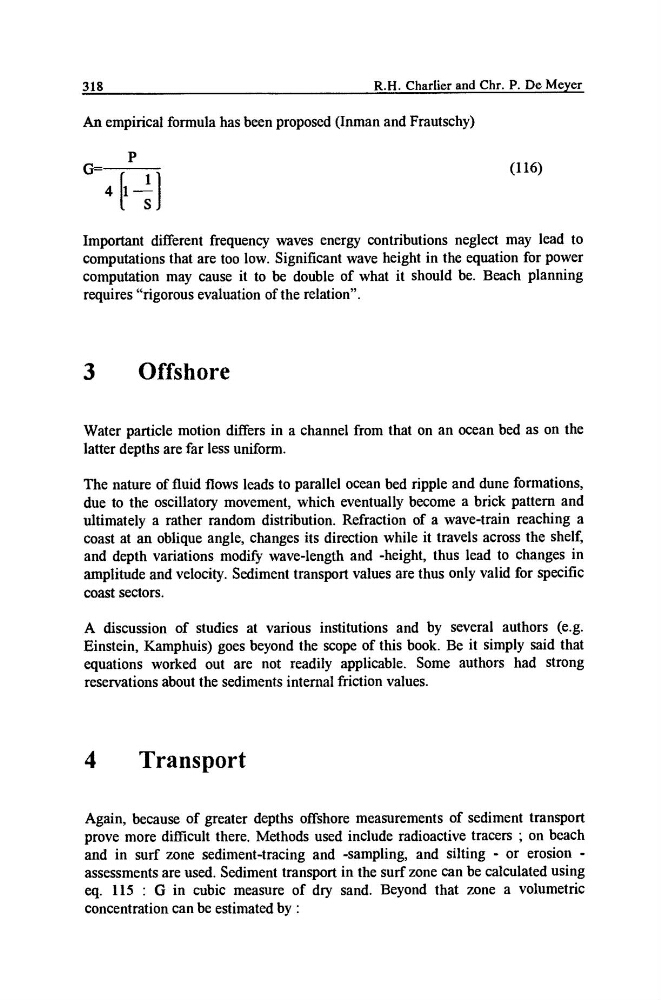
An empirical formula has been proposed (Inman and Frautschy)
P
G
~,m
(116)
Important different frequency waves energy contributions neglect may lead to
computations that are too low. Significant wave height in the equation for power
computation may cause it to be double of what it should be. Beach planning
requires "rigorous evaluation of the relation".
3
Offshore
Water particle motion differs in a channel from that on an ocean bed as on the
latter depths are far less uniform.
The nature of fluid flows leads to parallel ocean bed ripple and dune formations,
due to the oscillatory movement, which eventually become a brick pattern and
ultimately a rather random distribution. Refraction of a wave-train reaching a
coast at an oblique angle, changes its direction while it travels across the shelf,
and depth variations modify wave-length and -height, thus lead to changes in
amplitude and velocity. Sediment transport values are thus only valid for specific
coast sectors.
A discussion of studies at various institutions and by several authors (e.g.
Einstein, Kamphuis) goes beyond the scope of this book. Be it simply said that
equations worked out are not readily applicable. Some authors had strong
reservations about the sediments internal friction values.
4
Transport
Again, because of greater depths offshore measurements of sediment transport
prove more difficult there. Methods used include radioactive tracers ; on beach
and in surf zone sediment-tracing and -sampling, and silting - or erosion -
assessments are used. Sediment transport in the surf zone can be calculated using
eq. 115 : G in cubic measure of dry sand. Beyond that zone a volumetric
concentration can be estimated by :
R.H. Charlier and Chr. P. De Meyer
An empirical formula has been proposed (Inman and Frautschy)
P
G
~,m
(116)
Important different frequency waves energy contributions neglect may lead to
computations that are too low. Significant wave height in the equation for power
computation may cause it to be double of what it should be. Beach planning
requires "rigorous evaluation of the relation".
3
Offshore
Water particle motion differs in a channel from that on an ocean bed as on the
latter depths are far less uniform.
The nature of fluid flows leads to parallel ocean bed ripple and dune formations,
due to the oscillatory movement, which eventually become a brick pattern and
ultimately a rather random distribution. Refraction of a wave-train reaching a
coast at an oblique angle, changes its direction while it travels across the shelf,
and depth variations modify wave-length and -height, thus lead to changes in
amplitude and velocity. Sediment transport values are thus only valid for specific
coast sectors.
A discussion of studies at various institutions and by several authors (e.g.
Einstein, Kamphuis) goes beyond the scope of this book. Be it simply said that
equations worked out are not readily applicable. Some authors had strong
reservations about the sediments internal friction values.
4
Transport
Again, because of greater depths offshore measurements of sediment transport
prove more difficult there. Methods used include radioactive tracers ; on beach
and in surf zone sediment-tracing and -sampling, and silting - or erosion -
assessments are used. Sediment transport in the surf zone can be calculated using
eq. 115 : G in cubic measure of dry sand. Beyond that zone a volumetric
concentration can be estimated by :