

254
R.H. Charlier and Chr. P. De Meyer
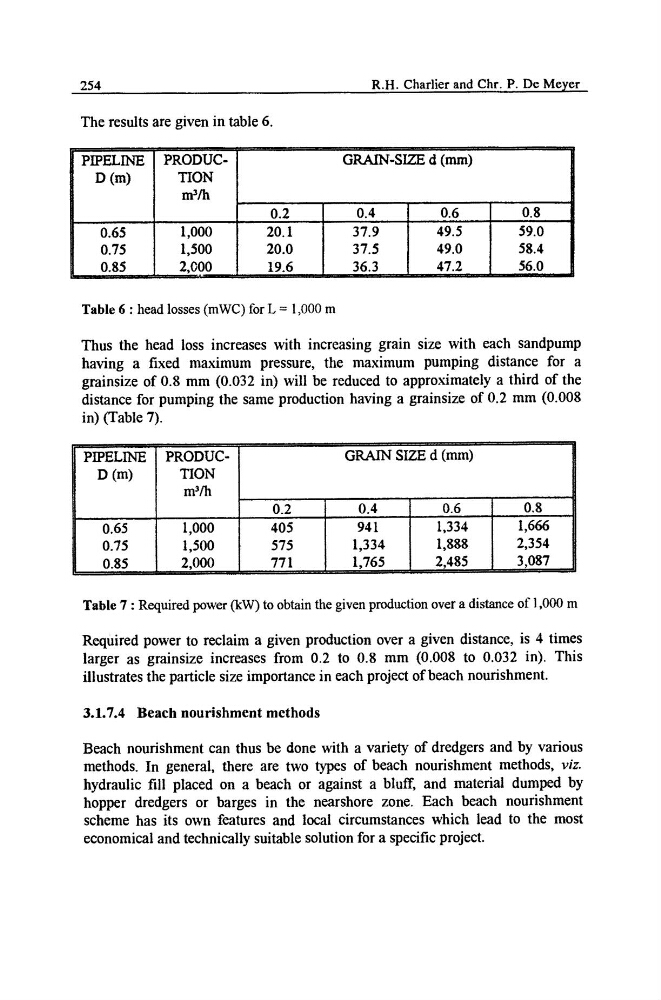
The results are given in table 6.
PIPELINE
D (In)
0.65
0.75
0.85
I
PRODUC"lION
mVh
0.2
1,000
20.1
1,500
20.0
2,000
19.6
GRAIN-SIZE d (mm)
0.4
0.6
0.8
37.9
49.5 ......
59.0
37.5
49.0
58.4
36.3
47.2
56.0
Table 6 : head losses (mWC) for L = 1,000 rn
Thus the head loss increases with increasing grain size with each sandpump
having a fixed maximum pressure, the maximum pumping distance for a
grainsize of 0.8 mm (0.032 in) will be reduced to approximately a third of the
distance for pumping the same production having a grainsize of 0.2 mm (0.008
in) (Table 7).
PIPELINE
D (m)
0.75
0.85
0.65
PRODUCTION
m3/h
1,000
1,500
2,090
GRAIN SIZE d (mm)
0.2
0.4
0.6
0.8
405
941
1,334
1,666
575
1,334
1,888
2,354
771
1,765
2,485
3,087
Table 7 : Required power (kW) to obtain the given production over a distance of 1,000 m
Required power to reclaim a given production over a given distance, is 4 times
larger as grainsize increases from 0.2 to 0.8 mm (0.008 to 0.032 in). This
illustrates the particle size importance in each project of beach nourishment.
3.1.7.4 Beach nourishment methods
Beach nourishment can thus be done with a variety of dredgers and by various
methods. In general, there are two types of beach nourishment methods, viz.
hydraulic fill placed on a beach or against a bluff, and material dumped by
hopper dredgers or barges in the nearshore zone. Each beach nourishment
scheme has its own features and local circumstances which lead to the most
economical and technically suitable solution for a specific project.
R.H. Charlier and Chr. P. De Meyer
The results are given in table 6.
PIPELINE
D (In)
0.65
0.75
0.85
I
PRODUC"lION
mVh
0.2
1,000
20.1
1,500
20.0
2,000
19.6
GRAIN-SIZE d (mm)
0.4
0.6
0.8
37.9
49.5 ......
59.0
37.5
49.0
58.4
36.3
47.2
56.0
Table 6 : head losses (mWC) for L = 1,000 rn
Thus the head loss increases with increasing grain size with each sandpump
having a fixed maximum pressure, the maximum pumping distance for a
grainsize of 0.8 mm (0.032 in) will be reduced to approximately a third of the
distance for pumping the same production having a grainsize of 0.2 mm (0.008
in) (Table 7).
PIPELINE
D (m)
0.75
0.85
0.65
PRODUCTION
m3/h
1,000
1,500
2,090
GRAIN SIZE d (mm)
0.2
0.4
0.6
0.8
405
941
1,334
1,666
575
1,334
1,888
2,354
771
1,765
2,485
3,087
Table 7 : Required power (kW) to obtain the given production over a distance of 1,000 m
Required power to reclaim a given production over a given distance, is 4 times
larger as grainsize increases from 0.2 to 0.8 mm (0.008 to 0.032 in). This
illustrates the particle size importance in each project of beach nourishment.
3.1.7.4 Beach nourishment methods
Beach nourishment can thus be done with a variety of dredgers and by various
methods. In general, there are two types of beach nourishment methods, viz.
hydraulic fill placed on a beach or against a bluff, and material dumped by
hopper dredgers or barges in the nearshore zone. Each beach nourishment
scheme has its own features and local circumstances which lead to the most
economical and technically suitable solution for a specific project.