

3.1.7.3 Reclaiming distance
A very important factor when reclaiming, is the critical velocity of the mixture
in the pipeline. It is the minimum velocity which is required to avoid deposits in
the pipeline and it is also the velocity at which a given production can be
reclaimed with a minimum of pump power. This velocity depends upon the mean
grain size diameter of the sand and upon the diameter of the pipeline.
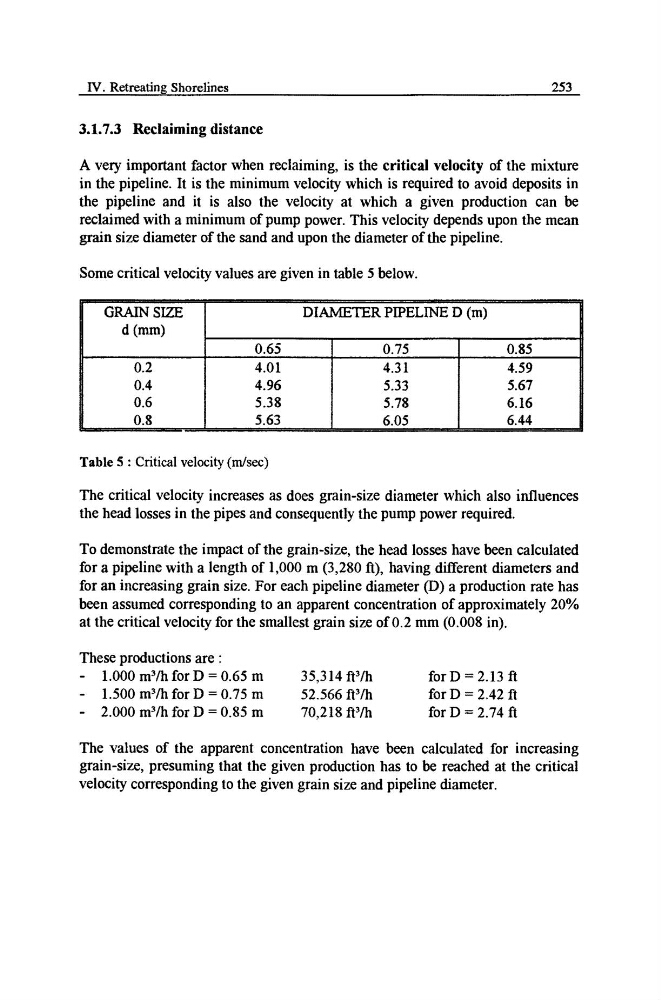
Some critical velocity values are given in table 5 below.
GRAIN SIZE
d (mm)
0.65
0.2
0.4
0.6
0.8
0.75
4.01
4.96
5.38
5.63
iSi, ¢rz'rER PIPELINE D' ¢m)
0.85
4.31
5.33
5.78
6.05
4.59
5.67
6.16
6.44
IV. Retreating Shorelines
253
Table 5 : Critical velocity (m/see)
The critical velocity increases as does grain-size diameter which also influences
the head losses in the pipes and consequently the pump power required.
To demonstrate the impact of the grain-size, the head losses have been calculated
for a pipeline with a length of 1,000 m (3,280 fi), having different diameters and
for an increasing grain size. For each pipeline diameter (D) a production rate has
been assumed corresponding to an apparent concentration of approximately 20%
at the critical velocity for the smallest grain size of 0.2 mm (0.008 in).
These productions are
1.000 mVh for D = 0.65 m
1.500 mVh for D = 0.75 m
2.000 mVh for D = 0.85 m
35,314 ft3/h
forD = 2.13 ft
52.566 ft3/h
for D = 2.42 ft
70,218 ftVh
forD = 2.74 ft
The values of the apparent concentration have been calculated for increasing
grain-size, presuming that the given production has to be reached at the critical
velocity corresponding to the given grain size and pipeline diameter.
A very important factor when reclaiming, is the critical velocity of the mixture
in the pipeline. It is the minimum velocity which is required to avoid deposits in
the pipeline and it is also the velocity at which a given production can be
reclaimed with a minimum of pump power. This velocity depends upon the mean
grain size diameter of the sand and upon the diameter of the pipeline.
Some critical velocity values are given in table 5 below.
GRAIN SIZE
d (mm)
0.65
0.2
0.4
0.6
0.8
0.75
4.01
4.96
5.38
5.63
iSi, ¢rz'rER PIPELINE D' ¢m)
0.85
4.31
5.33
5.78
6.05
4.59
5.67
6.16
6.44
IV. Retreating Shorelines
253
Table 5 : Critical velocity (m/see)
The critical velocity increases as does grain-size diameter which also influences
the head losses in the pipes and consequently the pump power required.
To demonstrate the impact of the grain-size, the head losses have been calculated
for a pipeline with a length of 1,000 m (3,280 fi), having different diameters and
for an increasing grain size. For each pipeline diameter (D) a production rate has
been assumed corresponding to an apparent concentration of approximately 20%
at the critical velocity for the smallest grain size of 0.2 mm (0.008 in).
These productions are
1.000 mVh for D = 0.65 m
1.500 mVh for D = 0.75 m
2.000 mVh for D = 0.85 m
35,314 ft3/h
forD = 2.13 ft
52.566 ft3/h
for D = 2.42 ft
70,218 ftVh
forD = 2.74 ft
The values of the apparent concentration have been calculated for increasing
grain-size, presuming that the given production has to be reached at the critical
velocity corresponding to the given grain size and pipeline diameter.