

204
R.H. Charlier and Chr. P. De Meyer
2.1.3
Breakwaters
Detached breakwaters (parallel to the coast) are offshore barriers intended to
reduce wave action on the existing coastline. They absorb wave energy before
waves reach the shore. This effect will not only reduce onshore - offshore
transport (especially during storm conditions) but will, in certain circumstances
reduce littoral drift and create tombolos due to wave diffraction effects (cf.
Mediterranean coast in Italy). However, in regions with significant tidal ranges,
such as the North Sea, these structures would normally have their crest at mean
or low water level. Under severe storm conditions (extreme high water levels) the
water layer above the crest will no longer abate incoming waves, which will keep
on attacking and eroding the beach area. Furthermore, the wave attack on the
structure is heaviest under these conditions.
Such breakwaters have been constructed in great numbers to protect the beaches
and resorts from Venice's Lido to Rimini. There were, by 1982, 2305 detached
breakwaters in Japan.
The height of a breakwater poses serious problems because if too low inadequate
protection will ensue and if too high interference with the shore processes will
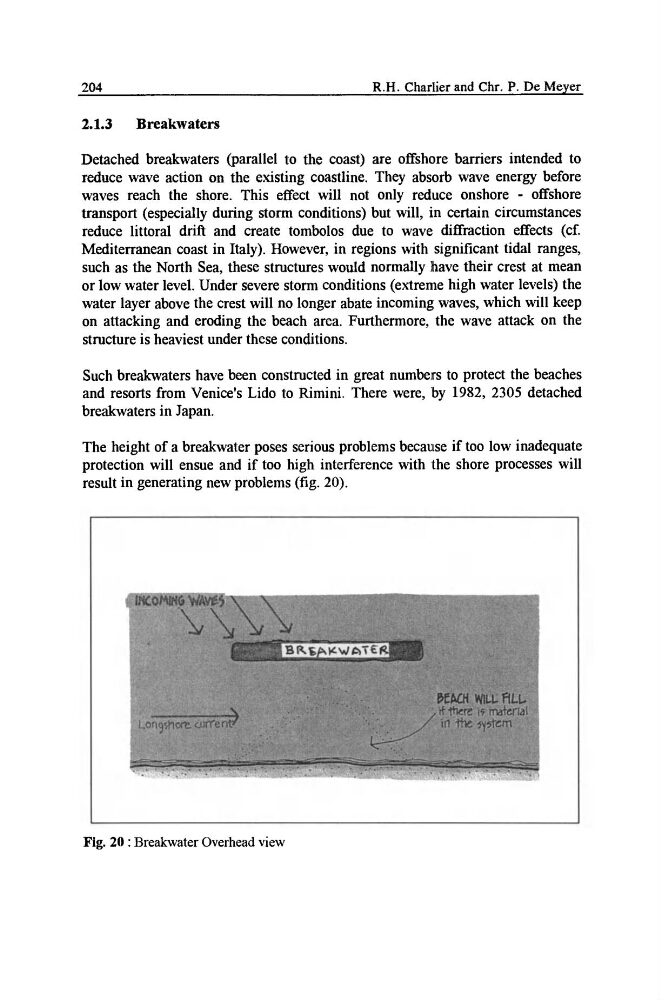
result in generating new problems (fig. 20).
Fig. 20 : Breakwater Overhead view
R.H. Charlier and Chr. P. De Meyer
2.1.3
Breakwaters
Detached breakwaters (parallel to the coast) are offshore barriers intended to
reduce wave action on the existing coastline. They absorb wave energy before
waves reach the shore. This effect will not only reduce onshore - offshore
transport (especially during storm conditions) but will, in certain circumstances
reduce littoral drift and create tombolos due to wave diffraction effects (cf.
Mediterranean coast in Italy). However, in regions with significant tidal ranges,
such as the North Sea, these structures would normally have their crest at mean
or low water level. Under severe storm conditions (extreme high water levels) the
water layer above the crest will no longer abate incoming waves, which will keep
on attacking and eroding the beach area. Furthermore, the wave attack on the
structure is heaviest under these conditions.
Such breakwaters have been constructed in great numbers to protect the beaches
and resorts from Venice's Lido to Rimini. There were, by 1982, 2305 detached
breakwaters in Japan.
The height of a breakwater poses serious problems because if too low inadequate
protection will ensue and if too high interference with the shore processes will
result in generating new problems (fig. 20).
Fig. 20 : Breakwater Overhead view