

194
R.H. Charlier and Chr. P. De Meyer
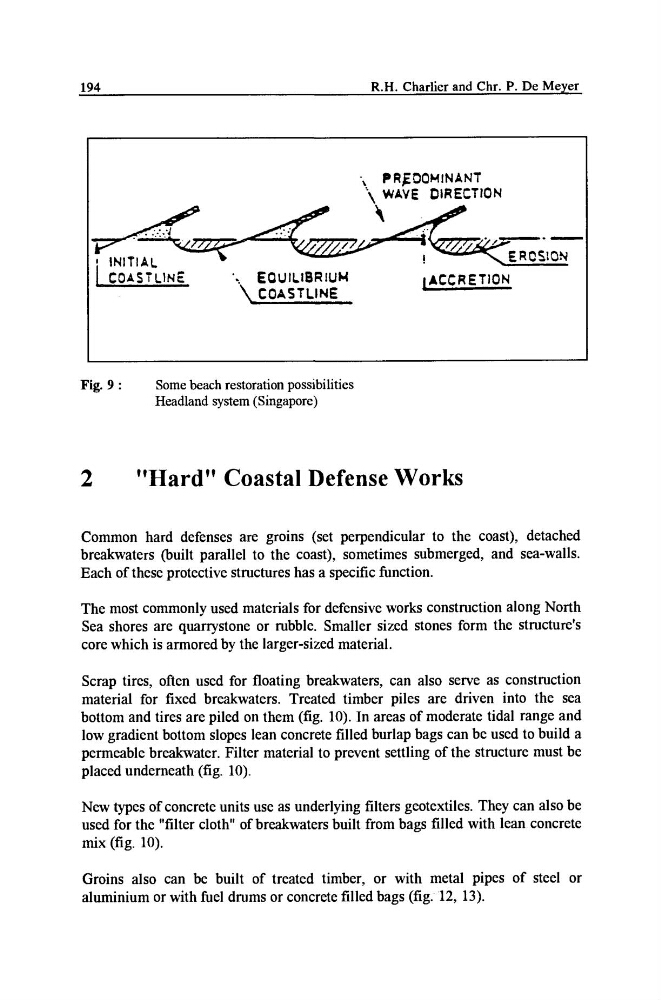
"4 P RjEDONINANT
\ WAVE DIRECTION
7-INITIAL
. COASTI.1NE
": EOUILIBRtUN
[ACCRETION
~.,COASTLINE
Fig. 9 :
Some beach restoration possibilities
Headland system (Singapore)
2
"Hard" Coastal Defense Works
Common hard defenses are groins (set perpendicular to the coast), detached
breakwaters (built parallel to the coast), sometimes submerged, and sea-walls.
Each of these protective structures has a specific function.
The most commonly used materials for defensive works construction along North
Sea shores are quarrystone or rubble. Smaller sized stones form the structure's
core which is armored by the larger-sized material.
Scrap tires, often used for floating breakwaters, can also serve as construction
material for fixed breakwaters. Treated timber piles are driven into the sea
bottom and tires are piled on them (fig. 10). In areas of moderate tidal range and
low gradient bottom slopes lean concrete filled burlap bags can be used to build a
permeable breakwater. Filter material to prevent settling of the structure must be
placed underneath (fig. 10).
New types of concrete units use as underlying filters geotextiles. They can also be
used for the "filter cloth" of breakwaters built from bags filled with lean concrete
mix (fig. 10).
Groins also can be built of treated timber, or with metal pipes of steel or
aluminium or with fuel drums or concrete filled bags (fig. 12, 13).
R.H. Charlier and Chr. P. De Meyer
"4 P RjEDONINANT
\ WAVE DIRECTION
7-INITIAL
. COASTI.1NE
": EOUILIBRtUN
[ACCRETION
~.,COASTLINE
Fig. 9 :
Some beach restoration possibilities
Headland system (Singapore)
2
"Hard" Coastal Defense Works
Common hard defenses are groins (set perpendicular to the coast), detached
breakwaters (built parallel to the coast), sometimes submerged, and sea-walls.
Each of these protective structures has a specific function.
The most commonly used materials for defensive works construction along North
Sea shores are quarrystone or rubble. Smaller sized stones form the structure's
core which is armored by the larger-sized material.
Scrap tires, often used for floating breakwaters, can also serve as construction
material for fixed breakwaters. Treated timber piles are driven into the sea
bottom and tires are piled on them (fig. 10). In areas of moderate tidal range and
low gradient bottom slopes lean concrete filled burlap bags can be used to build a
permeable breakwater. Filter material to prevent settling of the structure must be
placed underneath (fig. 10).
New types of concrete units use as underlying filters geotextiles. They can also be
used for the "filter cloth" of breakwaters built from bags filled with lean concrete
mix (fig. 10).
Groins also can be built of treated timber, or with metal pipes of steel or
aluminium or with fuel drums or concrete filled bags (fig. 12, 13).