

138
R.H. Charlier and Chr. P. De Meyer
where °
ui
are the velocity components in xl -- x, (longitudinal), xz = y (lateral), x3 = z
(vertical) directions, respectively ;
wf = the fall velocity of the sediment ;
v~i = the mixing coefficients, which include wave and current effects
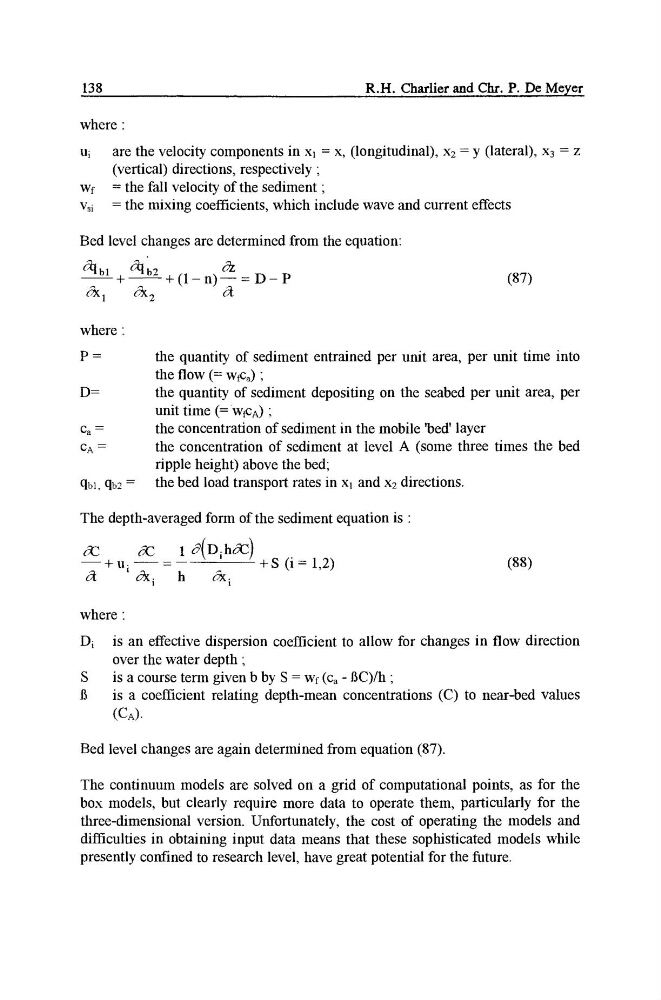
Bed level changes are determined from the equation:
C21b~1 + cTq'b2 +(l-n) c)z= D-P
(~X 1
(7~X 2
(87)
where :
p=
D =
C a
CA =
qbl, qb2 =
the quantity of sediment entrained per unit area, per unit time into
the flow (= wfca) ;
the quantity of sediment depositing on the seabed per unit area, per
unit time (= WiCA)
the concentration of sediment in the mobile ~oed' layer
the concentration of sediment at level A (some three times the bed
ripple height) above the bed;
the bed load transport rates in xl and x2 directions.
The depth-averaged form of the sediment equation is "
~2
e~
1 8(Di hdC )
-+ u i
-
+ S (i = 1,2)
(88)
~i
h
c?x i
where "
Di is an effective dispersion coefficient to allow for changes in flow direction
over the water depth ;
S
is a course term given b by S = wf (ca - BC)/h ;
fi
is a coefficient relating depth-mean concentrations (C) to near-bed values
(CA).
Bed level changes are again determined from equation (87).
The continuum models are solved on a grid of computational points, as for the
box models, but clearly require more data to operate them, particularly for the
three-dimensional version. Unfortunately, the cost of operating the models and
difficulties in obtaining input data means that these sophisticated models while
presently confined to research level, have great potential for the future.
R.H. Charlier and Chr. P. De Meyer
where °
ui
are the velocity components in xl -- x, (longitudinal), xz = y (lateral), x3 = z
(vertical) directions, respectively ;
wf = the fall velocity of the sediment ;
v~i = the mixing coefficients, which include wave and current effects
Bed level changes are determined from the equation:
C21b~1 + cTq'b2 +(l-n) c)z= D-P
(~X 1
(7~X 2
(87)
where :
p=
D =
C a
CA =
qbl, qb2 =
the quantity of sediment entrained per unit area, per unit time into
the flow (= wfca) ;
the quantity of sediment depositing on the seabed per unit area, per
unit time (= WiCA)
the concentration of sediment in the mobile ~oed' layer
the concentration of sediment at level A (some three times the bed
ripple height) above the bed;
the bed load transport rates in xl and x2 directions.
The depth-averaged form of the sediment equation is "
~2
e~
1 8(Di hdC )
-+ u i
-
+ S (i = 1,2)
(88)
~i
h
c?x i
where "
Di is an effective dispersion coefficient to allow for changes in flow direction
over the water depth ;
S
is a course term given b by S = wf (ca - BC)/h ;
fi
is a coefficient relating depth-mean concentrations (C) to near-bed values
(CA).
Bed level changes are again determined from equation (87).
The continuum models are solved on a grid of computational points, as for the
box models, but clearly require more data to operate them, particularly for the
three-dimensional version. Unfortunately, the cost of operating the models and
difficulties in obtaining input data means that these sophisticated models while
presently confined to research level, have great potential for the future.