

IH. Sedimen t Transport
3.4
Box Models
137
Such models have also been called "three-dimensional evolution" models, since
they attempt to model the coastal zone in three or quasi-three dimensions. The
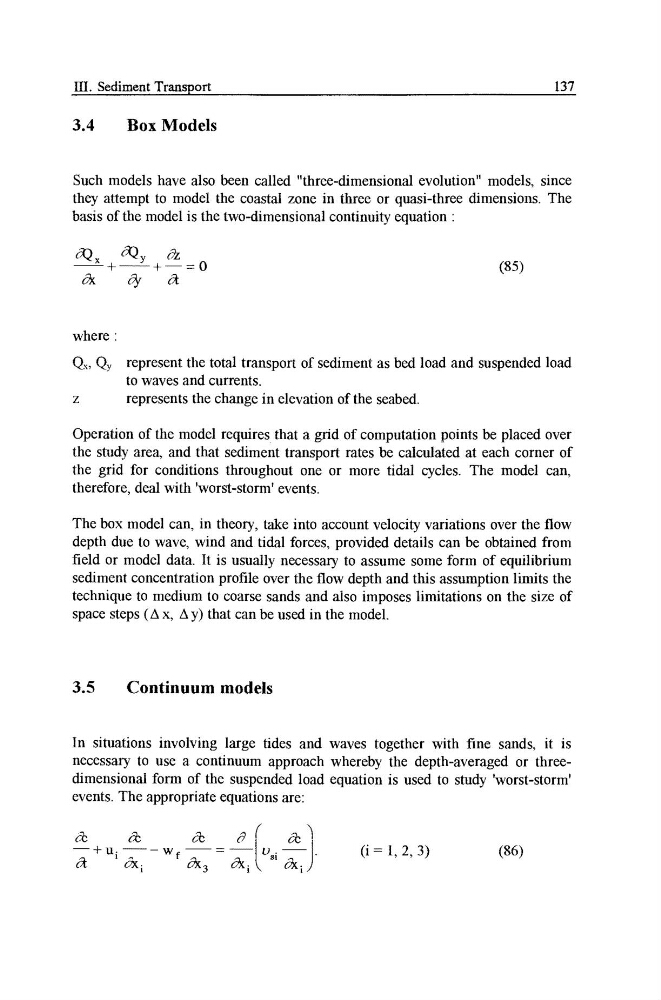
basis of the model is the two-~mensional continuity, equation :
cTQx + C~Qy &
--+--=0
&
c~
gt
(85)
where :
Qx, Qy represent the total transport of sediment as bed load and suspended load
to waves and currents.
represents the change in elevation of the seabed.
Operation of the model requires that a grid of computation points be placed over
the study area, and that sediment transport rates be calculated at each corner of
the grid for conditions throughout one or more tidal cycles. The model can,
therefore, deal with 'worst-storm' events.
The box model can, in theory, take into account velocity variations over the flow
depth due to wave, wind and tidal forces, provided details can be obtained from
field or model data. It is usually necessary to assume some form of equilibrium
sediment concentration profile over the flow depth and this assumption limits the
technique to medium to coarse sands and also imposes limitations on the size of
space steps (A x, Ay) that can be used in the model.
3.5
Continuum models
In situations involving large tides and waves together with fine sands, it is
necessary to use a continuum approach whereby the depth-averaged or threedimensional form of the suspended load equation is used to study 'worst-storm'
events. The appropriate equations are:
+u,
We
l
=
3.4
Box Models
137
Such models have also been called "three-dimensional evolution" models, since
they attempt to model the coastal zone in three or quasi-three dimensions. The
basis of the model is the two-~mensional continuity, equation :
cTQx + C~Qy &
--+--=0
&
c~
gt
(85)
where :
Qx, Qy represent the total transport of sediment as bed load and suspended load
to waves and currents.
represents the change in elevation of the seabed.
Operation of the model requires that a grid of computation points be placed over
the study area, and that sediment transport rates be calculated at each corner of
the grid for conditions throughout one or more tidal cycles. The model can,
therefore, deal with 'worst-storm' events.
The box model can, in theory, take into account velocity variations over the flow
depth due to wave, wind and tidal forces, provided details can be obtained from
field or model data. It is usually necessary to assume some form of equilibrium
sediment concentration profile over the flow depth and this assumption limits the
technique to medium to coarse sands and also imposes limitations on the size of
space steps (A x, Ay) that can be used in the model.
3.5
Continuum models
In situations involving large tides and waves together with fine sands, it is
necessary to use a continuum approach whereby the depth-averaged or threedimensional form of the suspended load equation is used to study 'worst-storm'
events. The appropriate equations are:
+u,
We
l
=