

110
R.H. Charlier and Chr. P. De Meyer
Two parameters in equation (50 or 17) are not obvious to determine : ca and Z.
The quantified airborne multispectral scanner recordings however provide an
immediate answer to the first parameter, c,. It was shown in the field
measurements that at any given stage of the tide, the amount of sediment
suspended in the near-surface part (0-4 m or 12.8 ft.) of the water column does
not vary significantly with height. Therefore, the sediment concentration values
detected by the airborne multispectral scanner can be assumed to represent the
sediment concentration at a fixed level, say 1 m below the water surface, and thus
constitute an areal cover of c, values.
The value of Z mostly determines the vertical gradient of the sediment
concentration profile. The most significant parameters influencing the value of Z
are w~, the settling velocity of the suspended sediments, and u., the bed shear
velocity (see section 3.4, chapt, 1, this part), w~ is mainly dependent on the size of
the suspended matter. Of this parameter again, the field measurements show no
significant changes over a tidal cycle; it is mostly the content of suspended matter
that varies. The size of the suspended material is determined on the calibration
samples.
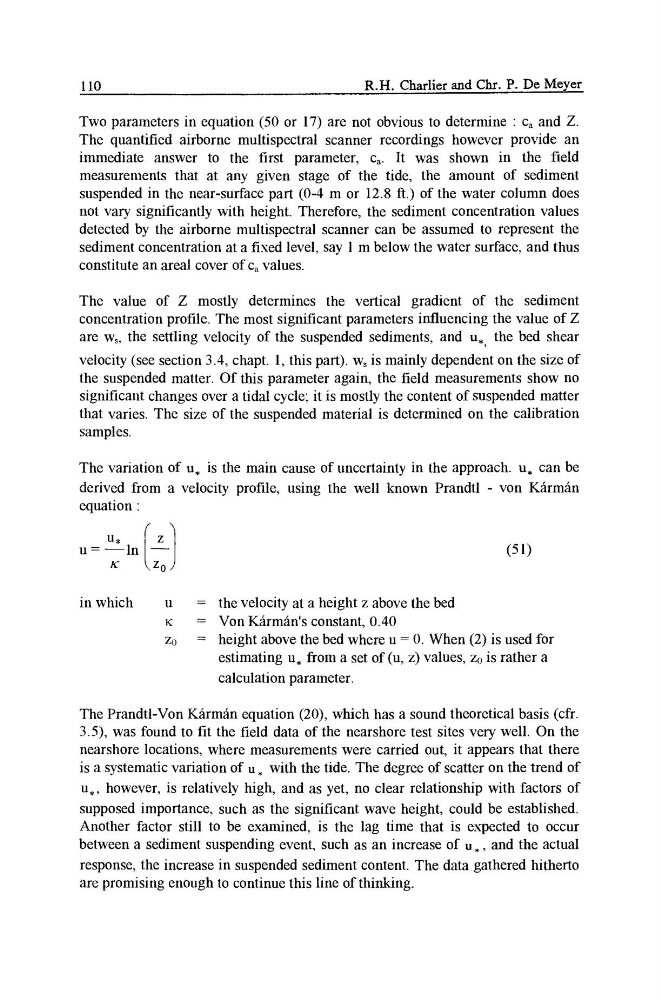
The variation of u. is the main cause of uncertainty in the approach, u. can be
derived from a velocity profile, using the well known Prandtl - yon Kfirmfin
equation :
u,
u=--lnI~oIK
(51)
in which
U
K
Z 0
the velocity at a height z above the bed
Von K~irmfin's constant, 0.40
height above the bed where u = 0. When (2) is used for
estimating u. from a set of (u, z) values, zo is rather a
calculation parameter.
The Prandtl-Von K~irmfin equation (20), which has a sound theoretical basis (cfr.
3.5), was found to fit the field data of the nearshore test sites very well. On the
nearshore locations, where measurements were carried out, it appears that there
is a systematic variation of u, with the fide. The degree of scatter on the trend of
u., however, is relatively high, and as yet, no clear relationship with factors of
supposed importance, such as the significant wave height, could be established.
Another factor still to be examined, is the lag time that is expected to occur
between a sediment suspending event, such as an increase of u., and the actual
response, the increase in suspended sediment content. The data gathered hitherto
are promising enough to continue this line of thinking.
R.H. Charlier and Chr. P. De Meyer
Two parameters in equation (50 or 17) are not obvious to determine : ca and Z.
The quantified airborne multispectral scanner recordings however provide an
immediate answer to the first parameter, c,. It was shown in the field
measurements that at any given stage of the tide, the amount of sediment
suspended in the near-surface part (0-4 m or 12.8 ft.) of the water column does
not vary significantly with height. Therefore, the sediment concentration values
detected by the airborne multispectral scanner can be assumed to represent the
sediment concentration at a fixed level, say 1 m below the water surface, and thus
constitute an areal cover of c, values.
The value of Z mostly determines the vertical gradient of the sediment
concentration profile. The most significant parameters influencing the value of Z
are w~, the settling velocity of the suspended sediments, and u., the bed shear
velocity (see section 3.4, chapt, 1, this part), w~ is mainly dependent on the size of
the suspended matter. Of this parameter again, the field measurements show no
significant changes over a tidal cycle; it is mostly the content of suspended matter
that varies. The size of the suspended material is determined on the calibration
samples.
The variation of u. is the main cause of uncertainty in the approach, u. can be
derived from a velocity profile, using the well known Prandtl - yon Kfirmfin
equation :
u,
u=--lnI~oIK
(51)
in which
U
K
Z 0
the velocity at a height z above the bed
Von K~irmfin's constant, 0.40
height above the bed where u = 0. When (2) is used for
estimating u. from a set of (u, z) values, zo is rather a
calculation parameter.
The Prandtl-Von K~irmfin equation (20), which has a sound theoretical basis (cfr.
3.5), was found to fit the field data of the nearshore test sites very well. On the
nearshore locations, where measurements were carried out, it appears that there
is a systematic variation of u, with the fide. The degree of scatter on the trend of
u., however, is relatively high, and as yet, no clear relationship with factors of
supposed importance, such as the significant wave height, could be established.
Another factor still to be examined, is the lag time that is expected to occur
between a sediment suspending event, such as an increase of u., and the actual
response, the increase in suspended sediment content. The data gathered hitherto
are promising enough to continue this line of thinking.