

98
,,,
R.H. Charlier and Chr. P. De Meyer
Since reliable models to predict time-averaged concentrations in waves alone are
still lacking, Van Rijn (1984) proposes a new model for time-averaged
concentrations, which is based on the time-averaged convection-diffusion
equation and which describes the vertical distribution of the sediment
concentrations above the top of the bedform (ripples) or above the edge of the
wave boundary layer in case of a plane bed with sheet flow.
The following subjects are described :
•
convection-diffusion equation
• particle size and fall velocity
• sediment mixing coefficient
• reference concentration
• computation of concentration profile
• comparison of measured and computed concentration profiles
3.2
Time-Averaged Convection-Diffusion Equation
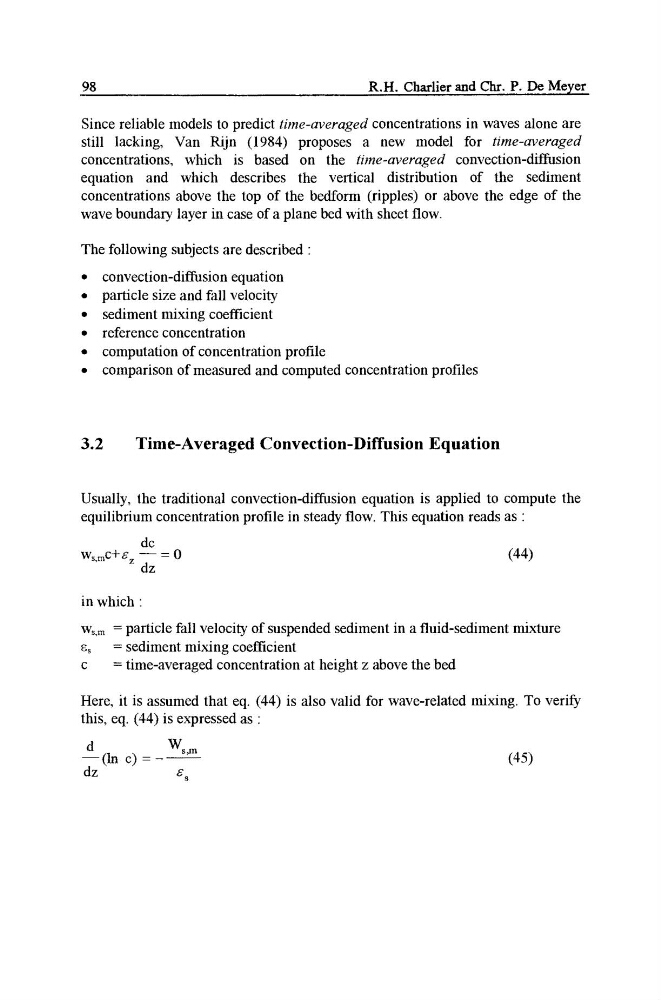
Usually, the traditional convection-diffusion equation is applied to compute the
equilibrium concentration profile in steady flow. This equation reads as •
dc
Ws,mC+~ -- = 0
(44)
dz
in which "
w .... = particle fall velocity of suspended sediment in a fluid-sediment mixture
as
= sediment mixing coefficient
c
= time-averaged concentration at height z above the bed
Here, it is assumed that eq. (44) is also valid for wave-related mixing. To verify
this, eq. (44) is expressed as :
d
w~
--(~ e)-(45)
dz
£s
,,,
R.H. Charlier and Chr. P. De Meyer
Since reliable models to predict time-averaged concentrations in waves alone are
still lacking, Van Rijn (1984) proposes a new model for time-averaged
concentrations, which is based on the time-averaged convection-diffusion
equation and which describes the vertical distribution of the sediment
concentrations above the top of the bedform (ripples) or above the edge of the
wave boundary layer in case of a plane bed with sheet flow.
The following subjects are described :
•
convection-diffusion equation
• particle size and fall velocity
• sediment mixing coefficient
• reference concentration
• computation of concentration profile
• comparison of measured and computed concentration profiles
3.2
Time-Averaged Convection-Diffusion Equation
Usually, the traditional convection-diffusion equation is applied to compute the
equilibrium concentration profile in steady flow. This equation reads as •
dc
Ws,mC+~ -- = 0
(44)
dz
in which "
w .... = particle fall velocity of suspended sediment in a fluid-sediment mixture
as
= sediment mixing coefficient
c
= time-averaged concentration at height z above the bed
Here, it is assumed that eq. (44) is also valid for wave-related mixing. To verify
this, eq. (44) is expressed as :
d
w~
--(~ e)-(45)
dz
£s