

HI. Sediment Transport
3 Computation of Time-Averaged
Concentration Profiles
3.1
Introduction
97
In the literature various models are proposed to compute the sediment
concentration profiles. Most models are based on the time-averaged convectiondiffusion equation (Nielsen, 1979~ Bosman-Steetzel, 1986, Dally, 1980, SkafelKrishnappan, 1984 ), as follows :
dc
W~,m c + ~,w -- = 0
(42)
dz
in which :
c
= sediment concentration
W~.m
= particle fall velocity in fluid-sediment mixture
~,w
= sediment diffusion or mixing coefficient related to the wave motion
z
= vertical coordinate
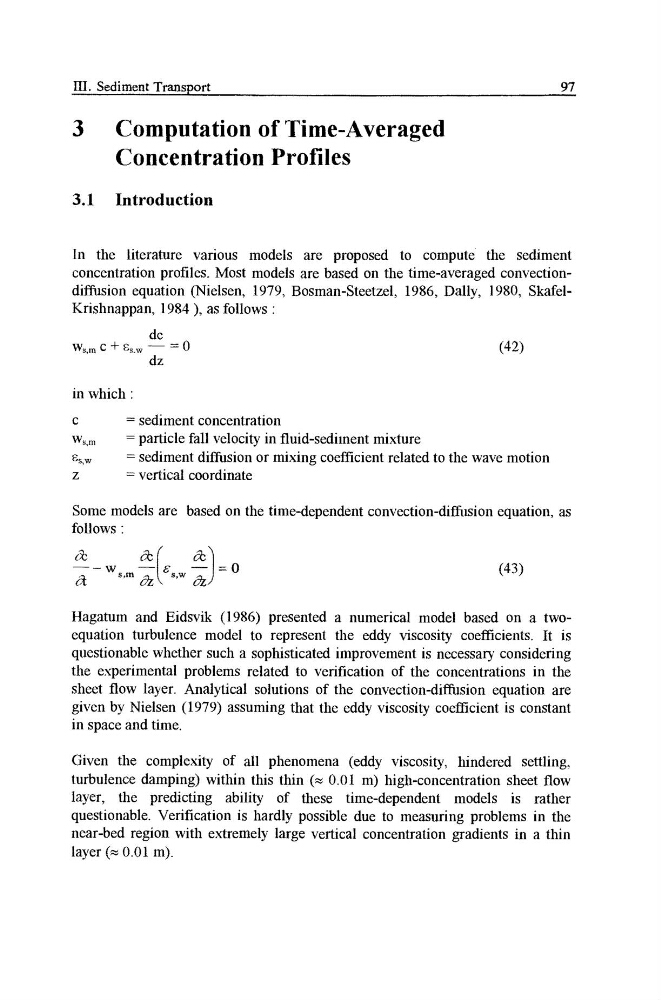
Some models are based on the time-dependent convection-diffusion equation, as
follows :
-- - w
= 0
(43)
Hagatum and Eidsvik (1986) presented a numerical model based on a twoequation turbulence model to represent the eddy viscosity coefficients. It is
questionable whether such a sophisticated improvement is necessary considering
the experimental problems related to verification of the concentrations in the
sheet flow layer. Analytical solutions of the convection-diffusion equation are
given by Nielsen (1979) assuming that the eddy viscosity coefficient is constant
in space mad time.
Given the complexity of all phenomena (eddy viscosity, hindered settling,
turbulence damping) within this thin (~ 0.01 m) high-concentration sheet flow
layer, the predicting ability of these time-dependent models is rather
questionable. Verification is hardly possible due to measuring problems in the
near-bed region with extremely large vertical concentration gradients in a thin
layer (~ 0.01 m).
3 Computation of Time-Averaged
Concentration Profiles
3.1
Introduction
97
In the literature various models are proposed to compute the sediment
concentration profiles. Most models are based on the time-averaged convectiondiffusion equation (Nielsen, 1979~ Bosman-Steetzel, 1986, Dally, 1980, SkafelKrishnappan, 1984 ), as follows :
dc
W~,m c + ~,w -- = 0
(42)
dz
in which :
c
= sediment concentration
W~.m
= particle fall velocity in fluid-sediment mixture
~,w
= sediment diffusion or mixing coefficient related to the wave motion
z
= vertical coordinate
Some models are based on the time-dependent convection-diffusion equation, as
follows :
-- - w
= 0
(43)
Hagatum and Eidsvik (1986) presented a numerical model based on a twoequation turbulence model to represent the eddy viscosity coefficients. It is
questionable whether such a sophisticated improvement is necessary considering
the experimental problems related to verification of the concentrations in the
sheet flow layer. Analytical solutions of the convection-diffusion equation are
given by Nielsen (1979) assuming that the eddy viscosity coefficient is constant
in space mad time.
Given the complexity of all phenomena (eddy viscosity, hindered settling,
turbulence damping) within this thin (~ 0.01 m) high-concentration sheet flow
layer, the predicting ability of these time-dependent models is rather
questionable. Verification is hardly possible due to measuring problems in the
near-bed region with extremely large vertical concentration gradients in a thin
layer (~ 0.01 m).