

3 Introduction to Computational Fluid Dynamics and Ocean Modelling
85
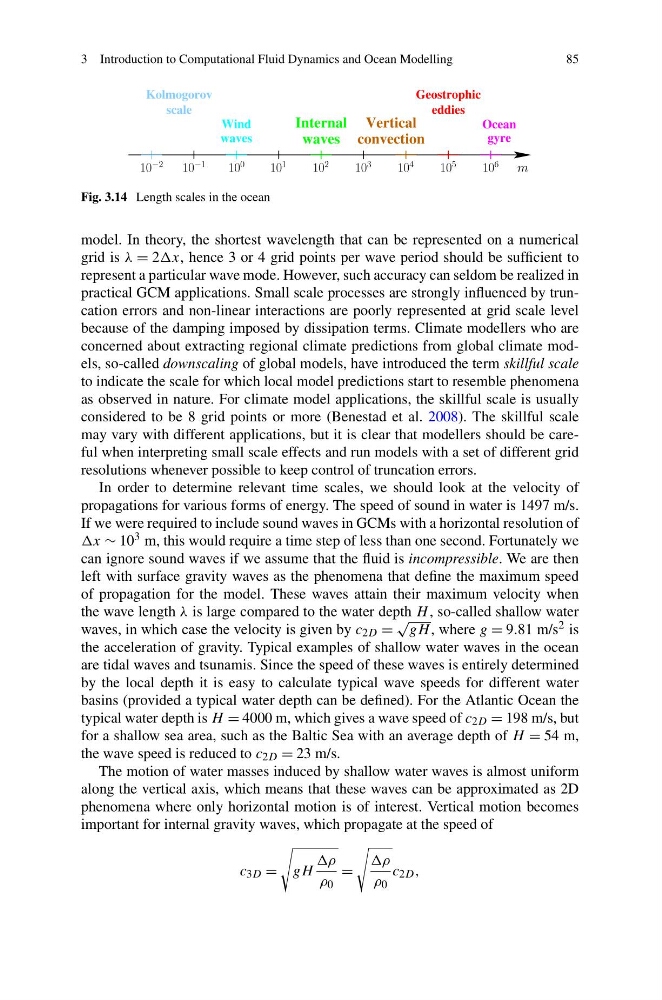
Fig. 3.14 Length scales in the ocean
model. In theory, the shortest wavelength that can be represented on a numerical
grid is λ = 2x, hence 3 or 4 grid points per wave period should be sufficient to
represent a particular wave mode. However, such accuracy can seldom be realized in
practical GCM applications. Small scale processes are strongly influenced by truncation errors and non-linear interactions are poorly represented at grid scale level
because of the damping imposed by dissipation terms. Climate modellers who are
concerned about extracting regional climate predictions from global climate models, so-called downscaling of global models, have introduced the term skillful scale
to indicate the scale for which local model predictions start to resemble phenomena
as observed in nature. For climate model applications, the skillful scale is usually
considered to be 8 grid points or more (Benestad et al. 2008). The skillful scale
may vary with different applications, but it is clear that modellers should be careful when interpreting small scale effects and run models with a set of different grid
resolutions whenever possible to keep control of truncation errors.
In order to determine relevant time scales, we should look at the velocity of
propagations for various forms of energy. The speed of sound in water is 1497 m/s.
If we were required to include sound waves in GCMs with a horizontal resolution of
x ∼ 10 3 m, this would require a time step of less than one second. Fortunately we
can ignore sound waves if we assume that the fluid is incompressible. We are then
left with surface gravity waves as the phenomena that define the maximum speed
of propagation for the model. These waves attain their maximum velocity when
the wave length λ is large compared to the water depth H , so-called shallow water
waves, in which case the velocity is given by c 2D =
√
gH , where g = 9.81 m/s 2 is
the acceleration of gravity. Typical examples of shallow water waves in the ocean
are tidal waves and tsunamis. Since the speed of these waves is entirely determined
by the local depth it is easy to calculate typical wave speeds for different water
basins (provided a typical water depth can be defined). For the Atlantic Ocean the
typical water depth is H = 4000 m, which gives a wave speed of c 2D = 198 m/s, but
for a shallow sea area, such as the Baltic Sea with an average depth of H = 54 m,
the wave speed is reduced to c 2D = 23 m/s.
The motion of water masses induced by shallow water waves is almost uniform
along the vertical axis, which means that these waves can be approximated as 2D
phenomena where only horizontal motion is of interest. Vertical motion becomes
important for internal gravity waves, which propagate at the speed of
c 3D =
gH
ρ
ρ 0
=
ρ
ρ 0
c 2D ,
85
Fig. 3.14 Length scales in the ocean
model. In theory, the shortest wavelength that can be represented on a numerical
grid is λ = 2x, hence 3 or 4 grid points per wave period should be sufficient to
represent a particular wave mode. However, such accuracy can seldom be realized in
practical GCM applications. Small scale processes are strongly influenced by truncation errors and non-linear interactions are poorly represented at grid scale level
because of the damping imposed by dissipation terms. Climate modellers who are
concerned about extracting regional climate predictions from global climate models, so-called downscaling of global models, have introduced the term skillful scale
to indicate the scale for which local model predictions start to resemble phenomena
as observed in nature. For climate model applications, the skillful scale is usually
considered to be 8 grid points or more (Benestad et al. 2008). The skillful scale
may vary with different applications, but it is clear that modellers should be careful when interpreting small scale effects and run models with a set of different grid
resolutions whenever possible to keep control of truncation errors.
In order to determine relevant time scales, we should look at the velocity of
propagations for various forms of energy. The speed of sound in water is 1497 m/s.
If we were required to include sound waves in GCMs with a horizontal resolution of
x ∼ 10 3 m, this would require a time step of less than one second. Fortunately we
can ignore sound waves if we assume that the fluid is incompressible. We are then
left with surface gravity waves as the phenomena that define the maximum speed
of propagation for the model. These waves attain their maximum velocity when
the wave length λ is large compared to the water depth H , so-called shallow water
waves, in which case the velocity is given by c 2D =
√
gH , where g = 9.81 m/s 2 is
the acceleration of gravity. Typical examples of shallow water waves in the ocean
are tidal waves and tsunamis. Since the speed of these waves is entirely determined
by the local depth it is easy to calculate typical wave speeds for different water
basins (provided a typical water depth can be defined). For the Atlantic Ocean the
typical water depth is H = 4000 m, which gives a wave speed of c 2D = 198 m/s, but
for a shallow sea area, such as the Baltic Sea with an average depth of H = 54 m,
the wave speed is reduced to c 2D = 23 m/s.
The motion of water masses induced by shallow water waves is almost uniform
along the vertical axis, which means that these waves can be approximated as 2D
phenomena where only horizontal motion is of interest. Vertical motion becomes
important for internal gravity waves, which propagate at the speed of
c 3D =
gH
ρ
ρ 0
=
ρ
ρ 0
c 2D ,