

2 Topography, Hydrography, Circulation and Modelling of the Baltic Sea
33
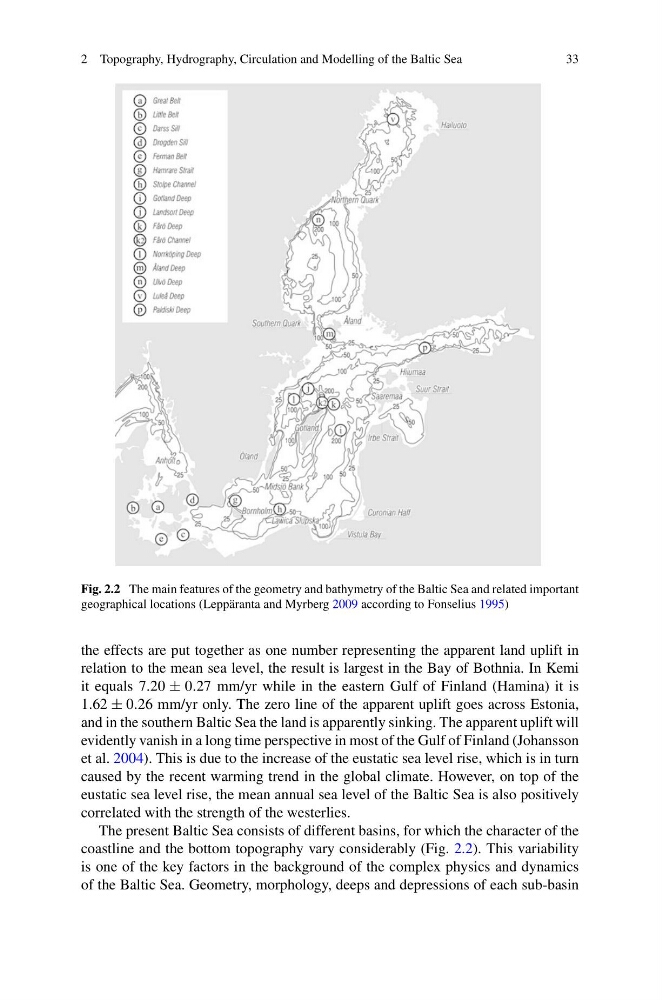
Fig. 2.2 The main features of the geometry and bathymetry of the Baltic Sea and related important
geographical locations (Leppäranta and Myrberg 2009 according to Fonselius 1995)
the effects are put together as one number representing the apparent land uplift in
relation to the mean sea level, the result is largest in the Bay of Bothnia. In Kemi
it equals 7.20 ± 0.27 mm/yr while in the eastern Gulf of Finland (Hamina) it is
1.62 ± 0.26 mm/yr only. The zero line of the apparent uplift goes across Estonia,
and in the southern Baltic Sea the land is apparently sinking. The apparent uplift will
evidently vanish in a long time perspective in most of the Gulf of Finland (Johansson
et al. 2004). This is due to the increase of the eustatic sea level rise, which is in turn
caused by the recent warming trend in the global climate. However, on top of the
eustatic sea level rise, the mean annual sea level of the Baltic Sea is also positively
correlated with the strength of the westerlies.
The present Baltic Sea consists of different basins, for which the character of the
coastline and the bottom topography vary considerably (Fig. 2.2). This variability
is one of the key factors in the background of the complex physics and dynamics
of the Baltic Sea. Geometry, morphology, deeps and depressions of each sub-basin
33
Fig. 2.2 The main features of the geometry and bathymetry of the Baltic Sea and related important
geographical locations (Leppäranta and Myrberg 2009 according to Fonselius 1995)
the effects are put together as one number representing the apparent land uplift in
relation to the mean sea level, the result is largest in the Bay of Bothnia. In Kemi
it equals 7.20 ± 0.27 mm/yr while in the eastern Gulf of Finland (Hamina) it is
1.62 ± 0.26 mm/yr only. The zero line of the apparent uplift goes across Estonia,
and in the southern Baltic Sea the land is apparently sinking. The apparent uplift will
evidently vanish in a long time perspective in most of the Gulf of Finland (Johansson
et al. 2004). This is due to the increase of the eustatic sea level rise, which is in turn
caused by the recent warming trend in the global climate. However, on top of the
eustatic sea level rise, the mean annual sea level of the Baltic Sea is also positively
correlated with the strength of the westerlies.
The present Baltic Sea consists of different basins, for which the character of the
coastline and the bottom topography vary considerably (Fig. 2.2). This variability
is one of the key factors in the background of the complex physics and dynamics
of the Baltic Sea. Geometry, morphology, deeps and depressions of each sub-basin