

11 Applications of an Oil Drift and Fate Model for Fairway Design
407
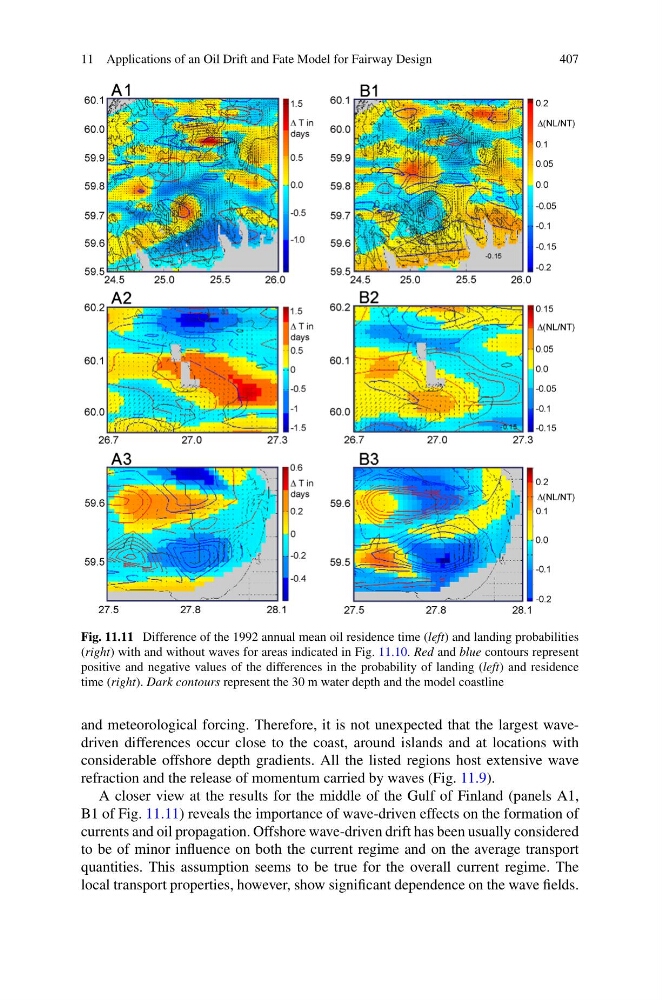
Fig. 11.11 Difference of the 1992 annual mean oil residence time (left) and landing probabilities
(right) with and without waves for areas indicated in Fig. 11.10. Red and blue contours represent
positive and negative values of the differences in the probability of landing (left) and residence
time (right). Dark contours represent the 30 m water depth and the model coastline
and meteorological forcing. Therefore, it is not unexpected that the largest wavedriven differences occur close to the coast, around islands and at locations with
considerable offshore depth gradients. All the listed regions host extensive wave
refraction and the release of momentum carried by waves (Fig. 11.9).
A closer view at the results for the middle of the Gulf of Finland (panels A1,
B1 of Fig. 11.11) reveals the importance of wave-driven effects on the formation of
currents and oil propagation. Offshore wave-driven drift has been usually considered
to be of minor influence on both the current regime and on the average transport
quantities. This assumption seems to be true for the overall current regime. The
local transport properties, however, show significant dependence on the wave fields.
407
Fig. 11.11 Difference of the 1992 annual mean oil residence time (left) and landing probabilities
(right) with and without waves for areas indicated in Fig. 11.10. Red and blue contours represent
positive and negative values of the differences in the probability of landing (left) and residence
time (right). Dark contours represent the 30 m water depth and the model coastline
and meteorological forcing. Therefore, it is not unexpected that the largest wavedriven differences occur close to the coast, around islands and at locations with
considerable offshore depth gradients. All the listed regions host extensive wave
refraction and the release of momentum carried by waves (Fig. 11.9).
A closer view at the results for the middle of the Gulf of Finland (panels A1,
B1 of Fig. 11.11) reveals the importance of wave-driven effects on the formation of
currents and oil propagation. Offshore wave-driven drift has been usually considered
to be of minor influence on both the current regime and on the average transport
quantities. This assumption seems to be true for the overall current regime. The
local transport properties, however, show significant dependence on the wave fields.