

402
J. Murawski and J. Woge Nielsen
Most of the published studies of wave-driven effects on the oil drift focus on various scenarios, particular shipping accidents or specific storms. Systematic inclusion
of wave-induced drift effects in oil spill models has been problematic mostly because of the associated large computational efforts. For example, in basically calm
local conditions but in sea areas affected by swell it is necessary to run a global
wave model.
We focus on the analysis of the magnitude of wave-induced drift effects under
different weather conditions. For this purpose, 50,688 drift simulations at 528 release sites were conducted in the Gulf of Finland to estimate average effects of
waves on the propagation pattern of oil at sea. The simulations cover the year 1992,
which represents an average year. Unlike the above-described fairway design studies that covered three years of data, we skip the analysis of seasonality of the waveinduced oil drift as the simulation period is too short to analyse drift patterns on a
sub-annual scale. Instead average wave effects are studied.
11.6.1 Calculation of Wave-Induced Oil Drift
One of the major issues in the coupling of wave and 3D circulation models is that
these models usually do not account for the vertical structure of the counterpart
(Mellor 2003). The equations that govern the surface wave motion are often first
integrated from the bottom to the water surface, and then are phase averaged. Also,
the horizontal velocities in the upper layer of the sea are often assumed to be homogeneous in the vertical direction. While this assumption can be partially justified
by the problems of replicating accurately the vertical structure of the upper-layer
flow in large-scale circulation models, the result is a mismatch of the treatment of
z-dependent horizontal velocities and other properties between the wave models and
3D circulation models. This mismatch is apparently largest just at the sea surface,
that is, in the flow region that directly affects the oil propagation.
A derivation of the depth-dependent equations that account for the vertical structure of the wave motion follows the analysis of Mellor (2003). As the procedure
is technically quite complicated, we omit the details and only present the final result. The goal is to derive a prognostic equation for the depth-dependent mean current u(x, z, t) in the presence of waves, expressed as a sum of the ambient (e.g.,
modelled) current and wave-induced depth-dependent drift in a sea area of finite
depth D. The starting point is the momentum equation du/dt = F − ∇δp for an
incompressible fluid, where d/dt denotes the total derivative, F is the sum of all
wave-independent external forces and body forces and ∇δp is the pressure gradient that specifically involves the impact of the oscillating wave motion on the mean
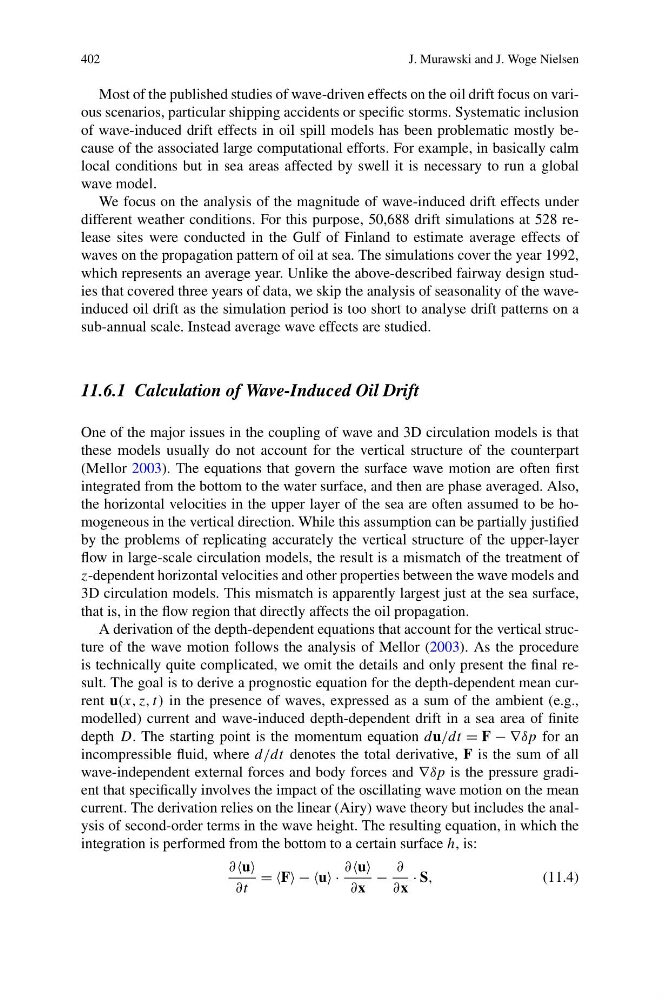
current. The derivation relies on the linear (Airy) wave theory but includes the analysis of second-order terms in the wave height. The resulting equation, in which the
integration is performed from the bottom to a certain surface h, is:
∂u
∂t
= =F − −u ·
∂u
∂x
−
∂
∂x
· S,
(11.4)
J. Murawski and J. Woge Nielsen
Most of the published studies of wave-driven effects on the oil drift focus on various scenarios, particular shipping accidents or specific storms. Systematic inclusion
of wave-induced drift effects in oil spill models has been problematic mostly because of the associated large computational efforts. For example, in basically calm
local conditions but in sea areas affected by swell it is necessary to run a global
wave model.
We focus on the analysis of the magnitude of wave-induced drift effects under
different weather conditions. For this purpose, 50,688 drift simulations at 528 release sites were conducted in the Gulf of Finland to estimate average effects of
waves on the propagation pattern of oil at sea. The simulations cover the year 1992,
which represents an average year. Unlike the above-described fairway design studies that covered three years of data, we skip the analysis of seasonality of the waveinduced oil drift as the simulation period is too short to analyse drift patterns on a
sub-annual scale. Instead average wave effects are studied.
11.6.1 Calculation of Wave-Induced Oil Drift
One of the major issues in the coupling of wave and 3D circulation models is that
these models usually do not account for the vertical structure of the counterpart
(Mellor 2003). The equations that govern the surface wave motion are often first
integrated from the bottom to the water surface, and then are phase averaged. Also,
the horizontal velocities in the upper layer of the sea are often assumed to be homogeneous in the vertical direction. While this assumption can be partially justified
by the problems of replicating accurately the vertical structure of the upper-layer
flow in large-scale circulation models, the result is a mismatch of the treatment of
z-dependent horizontal velocities and other properties between the wave models and
3D circulation models. This mismatch is apparently largest just at the sea surface,
that is, in the flow region that directly affects the oil propagation.
A derivation of the depth-dependent equations that account for the vertical structure of the wave motion follows the analysis of Mellor (2003). As the procedure
is technically quite complicated, we omit the details and only present the final result. The goal is to derive a prognostic equation for the depth-dependent mean current u(x, z, t) in the presence of waves, expressed as a sum of the ambient (e.g.,
modelled) current and wave-induced depth-dependent drift in a sea area of finite
depth D. The starting point is the momentum equation du/dt = F − ∇δp for an
incompressible fluid, where d/dt denotes the total derivative, F is the sum of all
wave-independent external forces and body forces and ∇δp is the pressure gradient that specifically involves the impact of the oscillating wave motion on the mean
current. The derivation relies on the linear (Airy) wave theory but includes the analysis of second-order terms in the wave height. The resulting equation, in which the
integration is performed from the bottom to a certain surface h, is:
∂u
∂t
= =F − −u ·
∂u
∂x
−
∂
∂x
· S,
(11.4)