

388
J. Murawski and J. Woge Nielsen
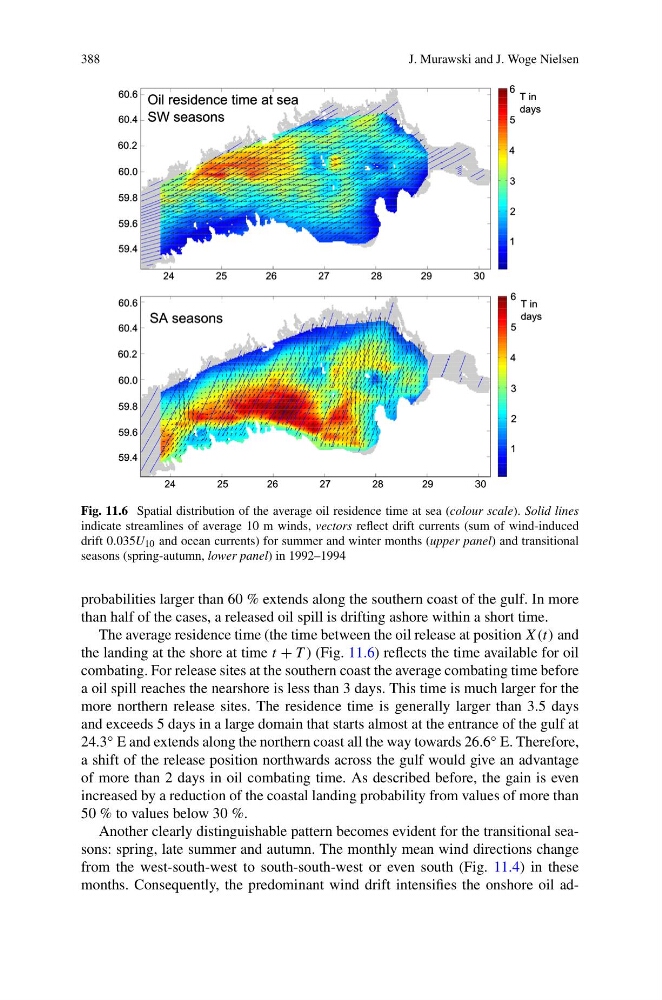
Fig. 11.6 Spatial distribution of the average oil residence time at sea (colour scale). Solid lines
indicate streamlines of average 10 m winds, vectors reflect drift currents (sum of wind-induced
drift 0.035U 10 and ocean currents) for summer and winter months (upper panel) and transitional
seasons (spring-autumn, lower panel) in 1992–1994
probabilities larger than 60 % extends along the southern coast of the gulf. In more
than half of the cases, a released oil spill is drifting ashore within a short time.
The average residence time (the time between the oil release at position X(t) and
the landing at the shore at time t + T ) (Fig. 11.6) reflects the time available for oil
combating. For release sites at the southern coast the average combating time before
a oil spill reaches the nearshore is less than 3 days. This time is much larger for the
more northern release sites. The residence time is generally larger than 3.5 days
and exceeds 5 days in a large domain that starts almost at the entrance of the gulf at
24.3 ◦ E and extends along the northern coast all the way towards 26.6 ◦ E. Therefore,
a shift of the release position northwards across the gulf would give an advantage
of more than 2 days in oil combating time. As described before, the gain is even
increased by a reduction of the coastal landing probability from values of more than
50 % to values below 30 %.
Another clearly distinguishable pattern becomes evident for the transitional seasons: spring, late summer and autumn. The monthly mean wind directions change
from the west-south-west to south-south-west or even south (Fig. 11.4) in these
months. Consequently, the predominant wind drift intensifies the onshore oil ad-
J. Murawski and J. Woge Nielsen
Fig. 11.6 Spatial distribution of the average oil residence time at sea (colour scale). Solid lines
indicate streamlines of average 10 m winds, vectors reflect drift currents (sum of wind-induced
drift 0.035U 10 and ocean currents) for summer and winter months (upper panel) and transitional
seasons (spring-autumn, lower panel) in 1992–1994
probabilities larger than 60 % extends along the southern coast of the gulf. In more
than half of the cases, a released oil spill is drifting ashore within a short time.
The average residence time (the time between the oil release at position X(t) and
the landing at the shore at time t + T ) (Fig. 11.6) reflects the time available for oil
combating. For release sites at the southern coast the average combating time before
a oil spill reaches the nearshore is less than 3 days. This time is much larger for the
more northern release sites. The residence time is generally larger than 3.5 days
and exceeds 5 days in a large domain that starts almost at the entrance of the gulf at
24.3 ◦ E and extends along the northern coast all the way towards 26.6 ◦ E. Therefore,
a shift of the release position northwards across the gulf would give an advantage
of more than 2 days in oil combating time. As described before, the gain is even
increased by a reduction of the coastal landing probability from values of more than
50 % to values below 30 %.
Another clearly distinguishable pattern becomes evident for the transitional seasons: spring, late summer and autumn. The monthly mean wind directions change
from the west-south-west to south-south-west or even south (Fig. 11.4) in these
months. Consequently, the predominant wind drift intensifies the onshore oil ad-