

386
J. Murawski and J. Woge Nielsen
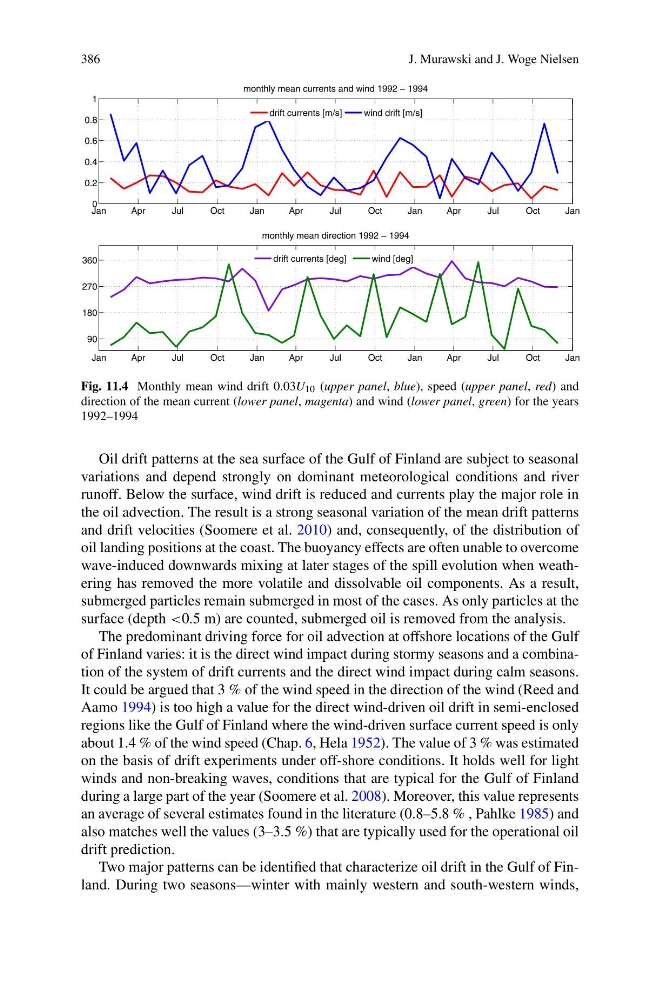
Fig. 11.4 Monthly mean wind drift 0.03U 10 (upper panel, blue), speed (upper panel, red) and
direction of the mean current (lower panel, magenta) and wind (lower panel, green) for the years
1992–1994
Oil drift patterns at the sea surface of the Gulf of Finland are subject to seasonal
variations and depend strongly on dominant meteorological conditions and river
runoff. Below the surface, wind drift is reduced and currents play the major role in
the oil advection. The result is a strong seasonal variation of the mean drift patterns
and drift velocities (Soomere et al. 2010) and, consequently, of the distribution of
oil landing positions at the coast. The buoyancy effects are often unable to overcome
wave-induced downwards mixing at later stages of the spill evolution when weathering has removed the more volatile and dissolvable oil components. As a result,
submerged particles remain submerged in most of the cases. As only particles at the
surface (depth <0.5 m) are counted, submerged oil is removed from the analysis.
The predominant driving force for oil advection at offshore locations of the Gulf
of Finland varies: it is the direct wind impact during stormy seasons and a combination of the system of drift currents and the direct wind impact during calm seasons.
It could be argued that 3 % of the wind speed in the direction of the wind (Reed and
Aamo 1994) is too high a value for the direct wind-driven oil drift in semi-enclosed
regions like the Gulf of Finland where the wind-driven surface current speed is only
about 1.4 % of the wind speed (Chap. 6, Hela 1952). The value of 3 % was estimated
on the basis of drift experiments under off-shore conditions. It holds well for light
winds and non-breaking waves, conditions that are typical for the Gulf of Finland
during a large part of the year (Soomere et al. 2008). Moreover, this value represents
an average of several estimates found in the literature (0.8–5.8 % , Pahlke 1985) and
also matches well the values (3–3.5 %) that are typically used for the operational oil
drift prediction.
Two major patterns can be identified that characterize oil drift in the Gulf of Finland. During two seasons—winter with mainly western and south-western winds,
J. Murawski and J. Woge Nielsen
Fig. 11.4 Monthly mean wind drift 0.03U 10 (upper panel, blue), speed (upper panel, red) and
direction of the mean current (lower panel, magenta) and wind (lower panel, green) for the years
1992–1994
Oil drift patterns at the sea surface of the Gulf of Finland are subject to seasonal
variations and depend strongly on dominant meteorological conditions and river
runoff. Below the surface, wind drift is reduced and currents play the major role in
the oil advection. The result is a strong seasonal variation of the mean drift patterns
and drift velocities (Soomere et al. 2010) and, consequently, of the distribution of
oil landing positions at the coast. The buoyancy effects are often unable to overcome
wave-induced downwards mixing at later stages of the spill evolution when weathering has removed the more volatile and dissolvable oil components. As a result,
submerged particles remain submerged in most of the cases. As only particles at the
surface (depth <0.5 m) are counted, submerged oil is removed from the analysis.
The predominant driving force for oil advection at offshore locations of the Gulf
of Finland varies: it is the direct wind impact during stormy seasons and a combination of the system of drift currents and the direct wind impact during calm seasons.
It could be argued that 3 % of the wind speed in the direction of the wind (Reed and
Aamo 1994) is too high a value for the direct wind-driven oil drift in semi-enclosed
regions like the Gulf of Finland where the wind-driven surface current speed is only
about 1.4 % of the wind speed (Chap. 6, Hela 1952). The value of 3 % was estimated
on the basis of drift experiments under off-shore conditions. It holds well for light
winds and non-breaking waves, conditions that are typical for the Gulf of Finland
during a large part of the year (Soomere et al. 2008). Moreover, this value represents
an average of several estimates found in the literature (0.8–5.8 % , Pahlke 1985) and
also matches well the values (3–3.5 %) that are typically used for the operational oil
drift prediction.
Two major patterns can be identified that characterize oil drift in the Gulf of Finland. During two seasons—winter with mainly western and south-western winds,