

354
T. Soomere
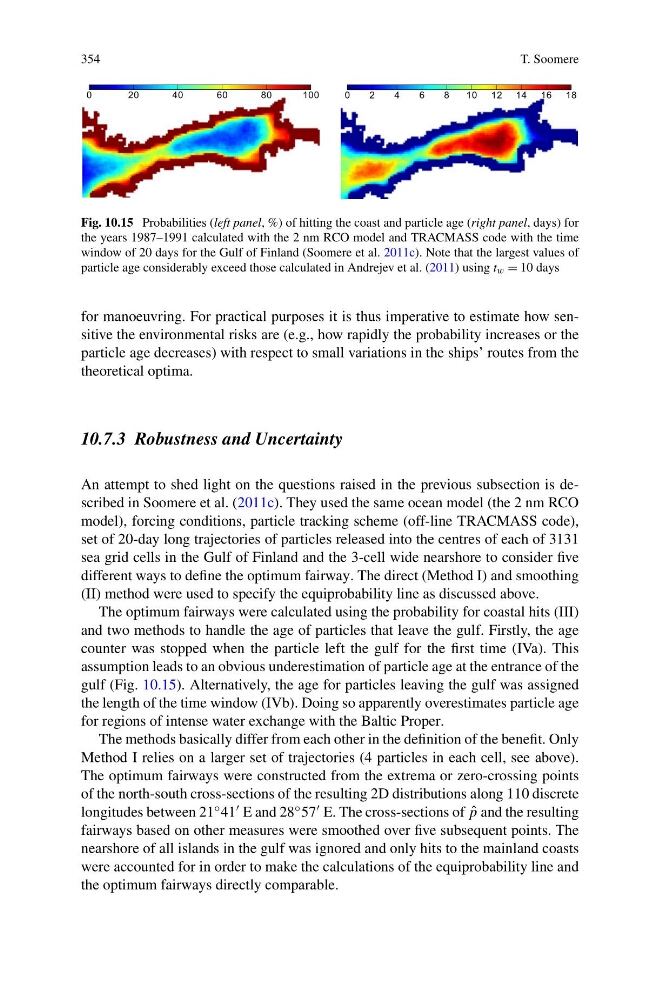
Fig. 10.15 Probabilities (left panel, %) of hitting the coast and particle age (right panel, days) for
the years 1987–1991 calculated with the 2 nm RCO model and TRACMASS code with the time
window of 20 days for the Gulf of Finland (Soomere et al. 2011c). Note that the largest values of
particle age considerably exceed those calculated in Andrejev et al. (2011) using t w = 10 days
for manoeuvring. For practical purposes it is thus imperative to estimate how sensitive the environmental risks are (e.g., how rapidly the probability increases or the
particle age decreases) with respect to small variations in the ships’ routes from the
theoretical optima.
10.7.3 Robustness and Uncertainty
An attempt to shed light on the questions raised in the previous subsection is described in Soomere et al. (2011c). They used the same ocean model (the 2 nm RCO
model), forcing conditions, particle tracking scheme (off-line TRACMASS code),
set of 20-day long trajectories of particles released into the centres of each of 3131
sea grid cells in the Gulf of Finland and the 3-cell wide nearshore to consider five
different ways to define the optimum fairway. The direct (Method I) and smoothing
(II) method were used to specify the equiprobability line as discussed above.
The optimum fairways were calculated using the probability for coastal hits (III)
and two methods to handle the age of particles that leave the gulf. Firstly, the age
counter was stopped when the particle left the gulf for the first time (IVa). This
assumption leads to an obvious underestimation of particle age at the entrance of the
gulf (Fig. 10.15). Alternatively, the age for particles leaving the gulf was assigned
the length of the time window (IVb). Doing so apparently overestimates particle age
for regions of intense water exchange with the Baltic Proper.
The methods basically differ from each other in the definition of the benefit. Only
Method I relies on a larger set of trajectories (4 particles in each cell, see above).
The optimum fairways were constructed from the extrema or zero-crossing points
of the north-south cross-sections of the resulting 2D distributions along 110 discrete
longitudes between 21 ◦ 41 E and 28 ◦ 57 E. The cross-sections of ˆ
p and the resulting
fairways based on other measures were smoothed over five subsequent points. The
nearshore of all islands in the gulf was ignored and only hits to the mainland coasts
were accounted for in order to make the calculations of the equiprobability line and
the optimum fairways directly comparable.
T. Soomere
Fig. 10.15 Probabilities (left panel, %) of hitting the coast and particle age (right panel, days) for
the years 1987–1991 calculated with the 2 nm RCO model and TRACMASS code with the time
window of 20 days for the Gulf of Finland (Soomere et al. 2011c). Note that the largest values of
particle age considerably exceed those calculated in Andrejev et al. (2011) using t w = 10 days
for manoeuvring. For practical purposes it is thus imperative to estimate how sensitive the environmental risks are (e.g., how rapidly the probability increases or the
particle age decreases) with respect to small variations in the ships’ routes from the
theoretical optima.
10.7.3 Robustness and Uncertainty
An attempt to shed light on the questions raised in the previous subsection is described in Soomere et al. (2011c). They used the same ocean model (the 2 nm RCO
model), forcing conditions, particle tracking scheme (off-line TRACMASS code),
set of 20-day long trajectories of particles released into the centres of each of 3131
sea grid cells in the Gulf of Finland and the 3-cell wide nearshore to consider five
different ways to define the optimum fairway. The direct (Method I) and smoothing
(II) method were used to specify the equiprobability line as discussed above.
The optimum fairways were calculated using the probability for coastal hits (III)
and two methods to handle the age of particles that leave the gulf. Firstly, the age
counter was stopped when the particle left the gulf for the first time (IVa). This
assumption leads to an obvious underestimation of particle age at the entrance of the
gulf (Fig. 10.15). Alternatively, the age for particles leaving the gulf was assigned
the length of the time window (IVb). Doing so apparently overestimates particle age
for regions of intense water exchange with the Baltic Proper.
The methods basically differ from each other in the definition of the benefit. Only
Method I relies on a larger set of trajectories (4 particles in each cell, see above).
The optimum fairways were constructed from the extrema or zero-crossing points
of the north-south cross-sections of the resulting 2D distributions along 110 discrete
longitudes between 21 ◦ 41 E and 28 ◦ 57 E. The cross-sections of ˆ
p and the resulting
fairways based on other measures were smoothed over five subsequent points. The
nearshore of all islands in the gulf was ignored and only hits to the mainland coasts
were accounted for in order to make the calculations of the equiprobability line and
the optimum fairways directly comparable.