

10 Applications of the Inverse Problem of Pollution Propagation
351
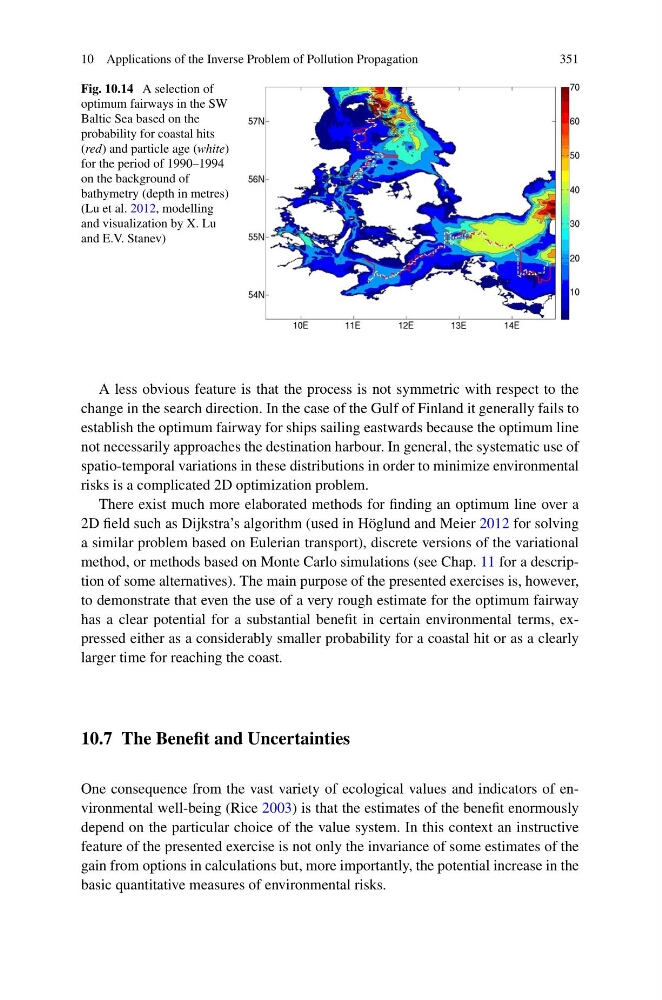
Fig. 10.14 A selection of
optimum fairways in the SW
Baltic Sea based on the
probability for coastal hits
(red) and particle age (white)
for the period of 1990–1994
on the background of
bathymetry (depth in metres)
(Lu et al. 2012, modelling
and visualization by X. Lu
and E.V. Stanev)
A less obvious feature is that the process is not symmetric with respect to the
change in the search direction. In the case of the Gulf of Finland it generally fails to
establish the optimum fairway for ships sailing eastwards because the optimum line
not necessarily approaches the destination harbour. In general, the systematic use of
spatio-temporal variations in these distributions in order to minimize environmental
risks is a complicated 2D optimization problem.
There exist much more elaborated methods for finding an optimum line over a
2D field such as Dijkstra’s algorithm (used in Höglund and Meier 2012 for solving
a similar problem based on Eulerian transport), discrete versions of the variational
method, or methods based on Monte Carlo simulations (see Chap. 11 for a description of some alternatives). The main purpose of the presented exercises is, however,
to demonstrate that even the use of a very rough estimate for the optimum fairway
has a clear potential for a substantial benefit in certain environmental terms, expressed either as a considerably smaller probability for a coastal hit or as a clearly
larger time for reaching the coast.
10.7 The Benefit and Uncertainties
One consequence from the vast variety of ecological values and indicators of environmental well-being (Rice 2003) is that the estimates of the benefit enormously
depend on the particular choice of the value system. In this context an instructive
feature of the presented exercise is not only the invariance of some estimates of the
gain from options in calculations but, more importantly, the potential increase in the
basic quantitative measures of environmental risks.
351
Fig. 10.14 A selection of
optimum fairways in the SW
Baltic Sea based on the
probability for coastal hits
(red) and particle age (white)
for the period of 1990–1994
on the background of
bathymetry (depth in metres)
(Lu et al. 2012, modelling
and visualization by X. Lu
and E.V. Stanev)
A less obvious feature is that the process is not symmetric with respect to the
change in the search direction. In the case of the Gulf of Finland it generally fails to
establish the optimum fairway for ships sailing eastwards because the optimum line
not necessarily approaches the destination harbour. In general, the systematic use of
spatio-temporal variations in these distributions in order to minimize environmental
risks is a complicated 2D optimization problem.
There exist much more elaborated methods for finding an optimum line over a
2D field such as Dijkstra’s algorithm (used in Höglund and Meier 2012 for solving
a similar problem based on Eulerian transport), discrete versions of the variational
method, or methods based on Monte Carlo simulations (see Chap. 11 for a description of some alternatives). The main purpose of the presented exercises is, however,
to demonstrate that even the use of a very rough estimate for the optimum fairway
has a clear potential for a substantial benefit in certain environmental terms, expressed either as a considerably smaller probability for a coastal hit or as a clearly
larger time for reaching the coast.
10.7 The Benefit and Uncertainties
One consequence from the vast variety of ecological values and indicators of environmental well-being (Rice 2003) is that the estimates of the benefit enormously
depend on the particular choice of the value system. In this context an instructive
feature of the presented exercise is not only the invariance of some estimates of the
gain from options in calculations but, more importantly, the potential increase in the
basic quantitative measures of environmental risks.